Vol.180 · Can LLM Agents Do Recommender Systems Research?, Agentic Memory Management as an Information Retrieval Problem
Vol.180 for Oct 26 - Nov 01, 2026: Structured digest of 10 papers including Agentic Memory Management as an Information Retrieval Problem; Naive Bayes Similarity Measures for Item-Based Collaborative Filtering; Revisiting Agent Memory Against a Raw-History Retrieval Baseline. Includes a quick-reference paper list, one-sentence practical use cases, figure screenshots, and related literature.
Paper List & One-Sentence Practical Guide
This issue (Vol.180 for Oct 26 - Nov 01, 2026) covers 10 papers across information retrieval, generative recommendation, Semantic IDs, LLM reranking, and agentic search. Start with the quick-reference list below to see what each paper is useful for and which related papers to read alongside it, or jump directly to any paper's detailed section and architecture screenshot.
Agentic Memory Management as an Information Retrieval Problem (from Qingyao Ai) — Paper
- What it's useful for: Use this study (from Qingyao Ai) to decide when structured agent memory or parametric self-distillation pays off over fast raw-history search, avoiding unnecessary memory extraction overhead.
- Related papers: Lineage Is Memory: Parent Inheritance and Feedback Disclosure · Harness²: What an Agent Can Learn by Changing Its Harness · Also in this issue: #3 Revisiting Agent Memory Against a Raw-History Retrieval Baseline
Naive Bayes Similarity Measures for Item-Based Collaborative Filtering (from the University of Antwerp) — Paper
- What it's useful for: Use this architecture (from the University of Antwerp) to scale industrial recommendation and multimodal representation learning across long user histories, fresh/tail items, and multi-task serving constraints.
- Related papers: What a Recommender Can Reach, Remember, and Afford · When Should a Personal Agent Override Your Recommender? · Also in this issue: #5 Training Contextual Embeddings Without Gold-Chunk Labels
Revisiting Agent Memory Against a Raw-History Retrieval Baseline (from He et al.) — Paper
- What it's useful for: Use this study (from He et al.) to decide when structured agent memory or parametric self-distillation pays off over fast raw-history search, avoiding unnecessary memory extraction overhead.
- Related papers: Lineage Is Memory: Parent Inheritance and Feedback Disclosure · Harness²: What an Agent Can Learn by Changing Its Harness · Also in this issue: #1 Agentic Memory Management as an Information Retrieval Problem
LLM Agents Tune Recommenders Well but Rarely Invent New Algorithms (from Tian et al.) — Paper
- What it's useful for: Use this agentic search recipe (from Tian et al.) to train or control multi-step research agents with grounded rewards, fast sufficiency judgments, and programmatic evidence filtering.
- Related papers: Search Agents Need Better Decision Boundaries, Not Just Bigger Models · Knowing When to Intervene: Six Papers on RL, Search Agents, and RAG · Also in this issue: #1 Agentic Memory Management as an Information Retrieval Problem
Training Contextual Embeddings Without Gold-Chunk Labels (from Perplexity AI) — Paper
- What it's useful for: Use this architecture (from Perplexity AI) to scale industrial recommendation and multimodal representation learning across long user histories, fresh/tail items, and multi-task serving constraints.
- Related papers: What a Recommender Can Reach, Remember, and Afford · When Should a Personal Agent Override Your Recommender? · Also in this issue: #2 Naive Bayes Similarity Measures for Item-Based Collaborative Filtering
Token-Efficient Generative Retrieval with Semantic IDs (from Pinterest) — Paper
- What it's useful for: Use this method (from Pinterest) to construct and decode discrete Semantic IDs that preserve collaborative and semantic item topology without codebook collapse or item-churn drift.
- Related papers: TIGER: Recommender Systems with Generative Retrieval · A Semantic Tokenizer Cannot Be Judged Without Its Decoder (FLASH) · Also in this issue: #2 Naive Bayes Similarity Measures for Item-Based Collaborative Filtering
Can System-1-Style Decision Models Replace Dedicated Rerankers in RAG? (from Li et al.) — Paper
- What it's useful for: Use this technique (from Li et al.) to replace slow autoregressive LLM reranking with calibrated single-pass scoring, reusable document prefixes, or query-adaptive reranking depth.
- Related papers: Search Agents Need Better Decision Boundaries (SearchJev) · RankZephyr / Listwise LLM Reranking · Also in this issue: #8 Phantom Correlation from User Activity in Item-Item Similarity
Phantom Correlation from User Activity in Item-Item Similarity (from the University of Antwerp) — Paper
- What it's useful for: Use this architecture (from the University of Antwerp) to scale industrial recommendation and multimodal representation learning across long user histories, fresh/tail items, and multi-task serving constraints.
- Related papers: What a Recommender Can Reach, Remember, and Afford · When Should a Personal Agent Override Your Recommender? · Also in this issue: #2 Naive Bayes Similarity Measures for Item-Based Collaborative Filtering
Reusing Positives as Hard Negatives for Instruction-Following Retrieval (from Li et al.) — Paper
- What it's useful for: Use this architecture (from Li et al.) to scale industrial recommendation and multimodal representation learning across long user histories, fresh/tail items, and multi-task serving constraints.
- Related papers: What a Recommender Can Reach, Remember, and Afford · When Should a Personal Agent Override Your Recommender? · Also in this issue: #2 Naive Bayes Similarity Measures for Item-Based Collaborative Filtering
EmbeddingGemma 2: Unified and Efficient Multimodal Representations (from Google) — Paper
- What it's useful for: Use this architecture (from Google) to scale industrial recommendation and multimodal representation learning across long user histories, fresh/tail items, and multi-task serving constraints.
- Related papers: What a Recommender Can Reach, Remember, and Afford · When Should a Personal Agent Override Your Recommender? · Also in this issue: #2 Naive Bayes Similarity Measures for Item-Based Collaborative Filtering
Detailed Paper Sections
[1] Agentic Memory Management Is the Next Frontier of Information Retrieval
- Newsletter Headline: Agentic Memory Management as an Information Retrieval Problem (from Qingyao Ai)
- Links: arXiv:2610.32464 · Digest Section
- Research Area: LLM Agents · Agentic & Parametric Memory Systems
Main Content & Technical Findings
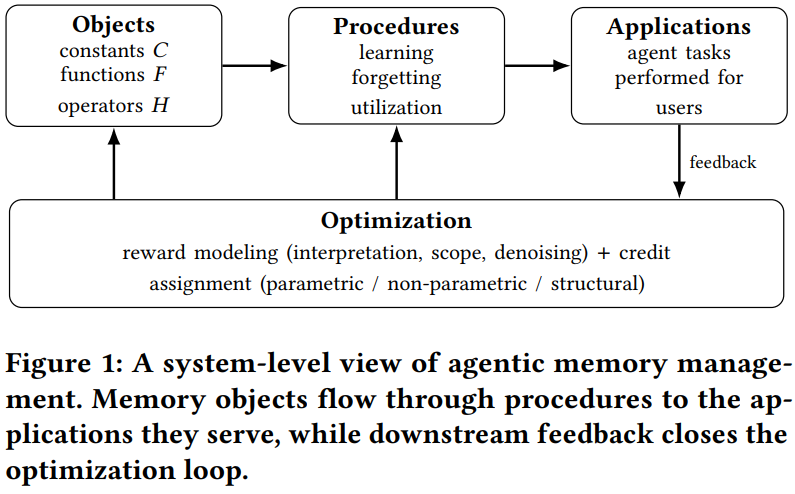
This perspective paper from Qingyao Ai argues that agentic memory management (AMM) is a natural extension of information retrieval and an area where IR researchers can make distinct contributions. AMM covers how an agent stores, organizes, retrieves, and uses information in its own memory. The author describes two shifts. First, the consumer of retrieved information is increasingly a model rather than a person, and models behave differently. They show that position effects in long contexts can be misled by high-scoring passages that lack the answer, and they may follow instructions injected into retrieved content. Second, IR moves from an external tool to an internal module that decides what an agent keeps and how that changes its next action. The paper proposes a system-level framework built on memory objects, procedures (learning, forgetting, and utilization), applications, and feedback-driven optimization. It sorts memory objects into constants (facts matched by content), functions (skills matched by whether they apply to the current task), and operators (preferences that modify how skills run, matched by scope). Mapping systems such as MemGPT, Reflexion, Voyager, and Mem0 onto this framework shows that most focus on facts and retrieval, with weak support for reusable skills, scoped preferences, principled forgetting, or learned optimization. Agents can also be instrumented and replayed, unlike human users, so evaluation can link component metrics to task outcomes directly. The author calls this the observability inversion.
Related Papers
- Lineage Is Memory: Parent Inheritance and Feedback Disclosure — LearnLLM deep dive on prompt lineage as externalized memory (arXiv:2610.41157).
- Harness²: What an Agent Can Learn by Changing Its Harness — LearnLLM review of experience libraries in recursive agent harnesses.
- #3 in this issue: Revisiting Agent Memory Against a Raw-History Retrieval Baseline (from He et al.) — Companion study in this newsletter.
[2] Theoretically Sound Item Similarity Measures for Recommender Systems
- Newsletter Headline: Naive Bayes Similarity Measures for Item-Based Collaborative Filtering (from the University of Antwerp)
- Links: arXiv:2610.34402 · Digest Section · Code / Resource
- Research Area: Recommender Systems · Large-Scale Recommendation & Representation Learning
Main Content & Technical Findings
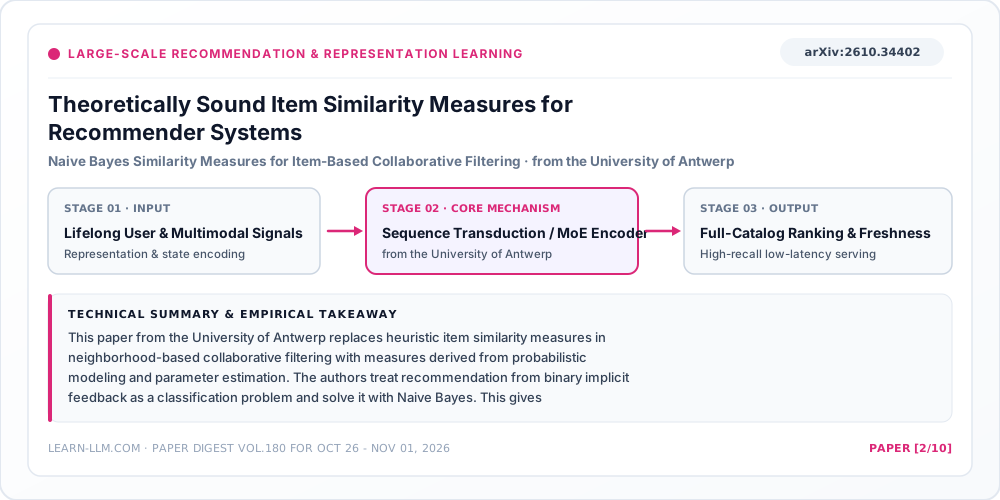
This paper from the University of Antwerp replaces heuristic item similarity measures in neighborhood-based collaborative filtering with measures derived from probabilistic modeling and parameter estimation. The authors treat recommendation from binary implicit feedback as a classification problem and solve it with Naive Bayes. This gives closed-form similarities computed from co-occurrence counts, plus a bias term for item popularity. They study two event models. The Bernoulli model treats every zero in the interaction matrix as a negative, which is wrong for implicit feedback. The authors show that dropping those negative features without re-deriving the parameters is also incorrect, so they add a weight on negatives and derive the matching estimates. The multinomial model treats a user’s history as a bag of items and learns only from positive interactions, so it handles unknowns correctly by design. An empirical Bayes prior that assumes independence by default is used to stop rarely seen items from creating spurious correlations. The paper also shows that cosine similarity and conditional probability are minima of a simple loss under specific regularization weights, which explains why cosine carries popularity bias. The authors test on Amazon Books, MIND, and MovieLens 25M. EASE scores best on all three, but the Naive Bayes measures fit in under a tenth of its time.
Related Papers
- What a Recommender Can Reach, Remember, and Afford — LearnLLM 7-paper synthesis on recommender reach, memory, and compute.
- When Should a Personal Agent Override Your Recommender? — LearnLLM review of value-floored RL alignment in recommendation.
- #5 in this issue: Training Contextual Embeddings Without Gold-Chunk Labels (from Perplexity AI) — Companion study in this newsletter.
[3] Memory Tax: Dissecting the Net Value of Agent Memory
- Newsletter Headline: Revisiting Agent Memory Against a Raw-History Retrieval Baseline (from He et al.)
- Links: arXiv:2610.34073 · Digest Section · Code / Resource · Code / Resource
- Research Area: LLM Agents · Agentic & Parametric Memory Systems
Main Content & Technical Findings
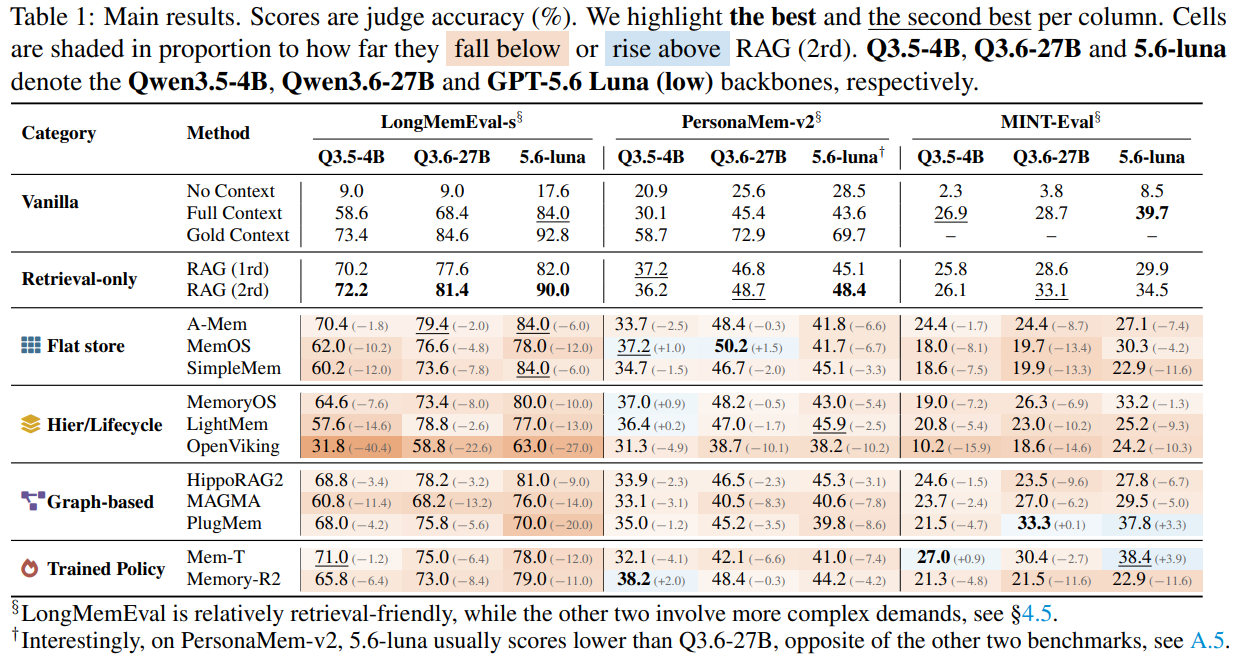
This paper from He et al. asks whether dedicated memory systems for long-horizon LLM agents add value over naive RAG on the raw interaction history. The authors test eleven open-source memory systems on LongMemEval-s, PersonaMem-v2 and MINT-Eval, using three backbones. The systems cover flat stores, hierarchical designs, graph-based memories, and trained memory policies. They align retrieval budgets so each system shows the model a comparable share of its store. Most systems score below two-round RAG, often at higher token cost. A per-query comparison shows that memory solves some questions RAG misses, which the authors call memory benefit, but also loses some that RAG already answers, which they call memory tax. They trace the tax to three causes. Memory construction drops or distorts some facts. Evidence that survives becomes harder to retrieve once it is split up, mixed with unrelated content, or rephrased. Memory pipelines are also more sensitive than RAG to changes in the backbone model. Simple keyword and hybrid retrieval baselines already score well on many popular memory benchmarks, which leaves little room for memory to help and makes the tax easier to see. The same split shows up in experiential memory, where distilled workflows help on web tasks but several methods trail RAG on tool use. Their proposed fix works on top of existing systems. Retrieving from the raw history alongside memory and reranking the two together cuts the tax, raising SimpleMem from 73.6% to 82.8% on LongMemEval-s.
🤗 https://huggingface.co/datasets/hexuan21/MemoryTax-Res
Related Papers
- Lineage Is Memory: Parent Inheritance and Feedback Disclosure — LearnLLM deep dive on prompt lineage as externalized memory (arXiv:2610.41157).
- Harness²: What an Agent Can Learn by Changing Its Harness — LearnLLM review of experience libraries in recursive agent harnesses.
- #1 in this issue: Agentic Memory Management as an Information Retrieval Problem (from Qingyao Ai) — Companion study in this newsletter.
[4] AutoRSE: Evaluating LLM Agents as Recommendation Engineers for Self-Evolving Recommender Systems
- Newsletter Headline: LLM Agents Tune Recommenders Well but Rarely Invent New Algorithms (from Tian et al.)
- Links: arXiv:2610.37228 · Digest Section · Code / Resource
- Research Area: LLM Agents · Agentic Search & Deep Research Control
Main Content & Technical Findings
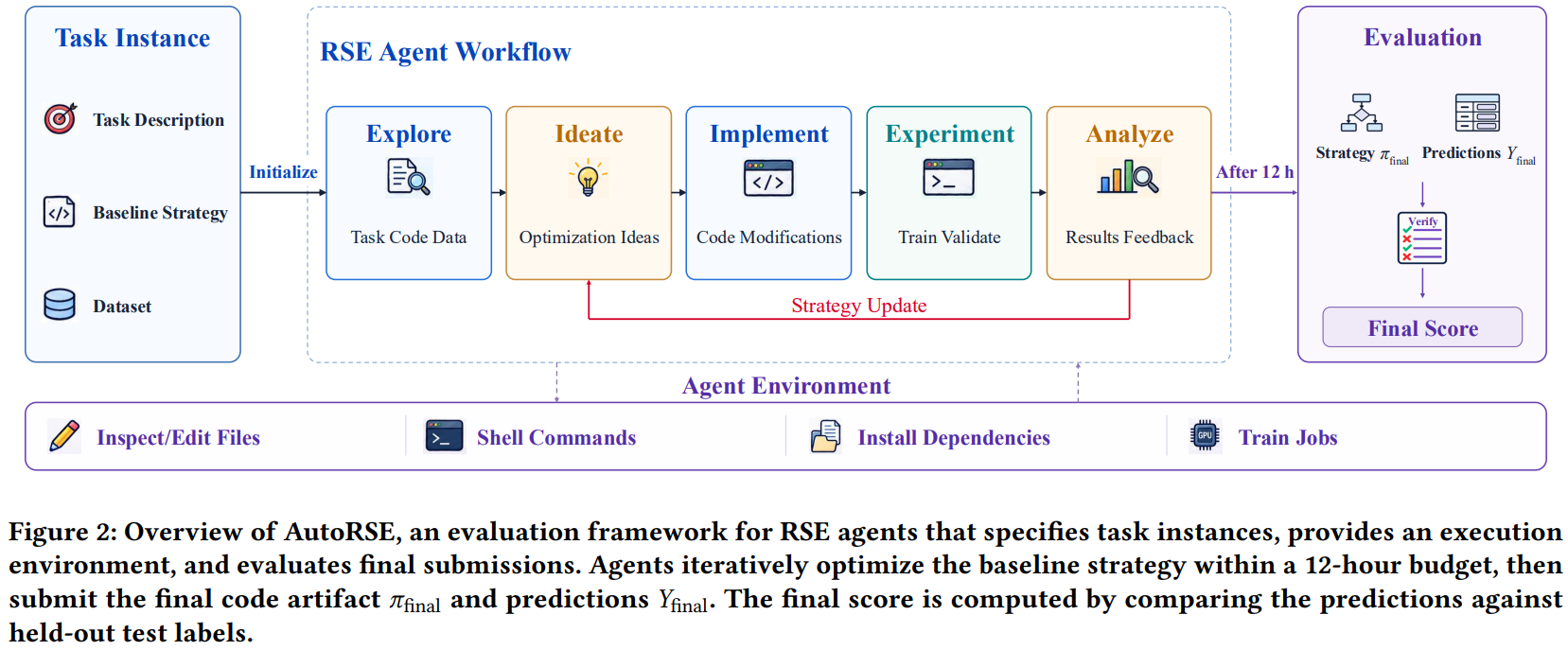
This paper from Tian et al. introduces AutoRSE, a benchmark that tests whether LLM coding agents can improve recommendation algorithms on their own. Each of its six tasks gives the agent a faithfully reproduced state-of-the-art baseline, one H200 GPU, no internet access, hidden test labels, and a 12-hour budget. Three of the six tasks cover generative recommendation (HSTU, TIGER, IntSR) and the other three cover CTR prediction (WuKong, RankMixer, OneTrans). The authors run Claude Opus 4.8, GPT-5.5, and DeepSeek V4 Flash inside Claude Code, Codex, and Terminus-2, giving seven model-harness pairs with three runs each. Agents beat the baseline in 35 of 42 settings, with an average relative gain of 16.1%. Gains are much larger on generative recommendation (29.2%) than on CTR prediction (3.1%), where AUC is already close to saturated. Most agents fall below the baseline on IntSR, the joint search-recommendation task. Models do best in their own vendor’s harness. The authors use an LLM judge to sort 4,425 experiments from the agent trajectories by strategy. It found that 91.7% were engineering changes such as ensembling, hyperparameter tuning, and training schedules, and only 8.3% changed features, architecture, or the objective. Final solutions average 2.42 on a 0–4 novelty scale, and novelty correlates strongly with improvement (r = 0.79). In the idea-injection experiments, having the agent brainstorm and pick its own ideas barely helps. Giving the agent a library of ideas distilled from top-venue papers and competition solutions raises scores by about 13% over self-generated ideas. The authors conclude that the main bottleneck for these agents is generating ideas, not implementing them.
Related Papers
- Search Agents Need Better Decision Boundaries, Not Just Bigger Models — LearnLLM deep dive on SearchJev System-1/System-2 delegation.
- Knowing When to Intervene: Six Papers on RL, Search Agents, and RAG — LearnLLM digest on T-Search, Programmatic Search Agents, and AutoRAG.
- #5 in this issue: Training Contextual Embeddings Without Gold-Chunk Labels (from Perplexity AI) — Companion study in this newsletter.
[5] Contextual Embeddings Beyond the Gold Chunk
- Newsletter Headline: Training Contextual Embeddings Without Gold-Chunk Labels (from Perplexity AI)
- Links: arXiv:2610.38854 · Digest Section · Code / Resource · Code / Resource
- Research Area: Recommender Systems · Large-Scale Recommendation & Representation Learning
Main Content & Technical Findings
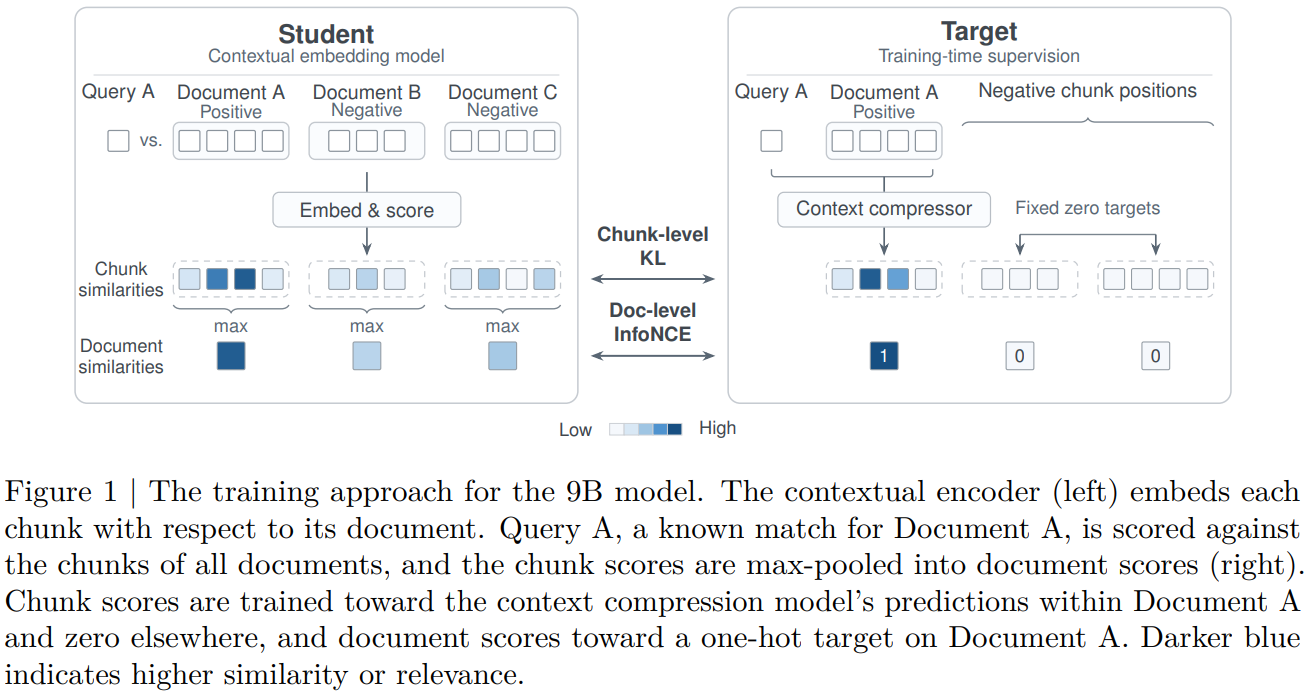
This paper from Perplexity AI argues that contextual chunk embeddings are trained and evaluated on a flawed assumption that each relevant document contains a single gold chunk. Gold-chunk training treats every other chunk as a negative, including chunks that identify the entity or state a condition the answer depends on. The labels also have to be regenerated whenever the chunking changes. The authors replace these labels with graded relevance distilled from Perplexity’s query-aware context compression model, a cross-encoder that scores each document token as answer-bearing, supporting, or irrelevant. They pool the top-k token scores into a relevance score for each chunk under a randomly sampled chunking. The student then learns to match that distribution through a KL loss over all chunks in the batch, and a document-level contrastive loss that scores each document by its best chunk. The 9B model starts from a vision-language ColBERT backbone, and a 0.6B model is distilled from it at the representation level, so the two share an embedding space. For evaluation, the authors build two benchmarks that label both the answer chunks and the evidence needed to verify them. Context-bench is a private diagnostic built around near-identical look-alike documents. Q2D-Chunk is a public leaderboard built from about 6,000 real search queries in 10 languages. The 9B model sets a new state of the art on both and on ConTEB, even though it was never trained on ConTEB data.
🤗 https://huggingface.co/perplexity-ai/pplx-embed-v2-context-0.6b
🤗 https://huggingface.co/perplexity-ai/pplx-embed-v2-context-9b
Related Papers
- What a Recommender Can Reach, Remember, and Afford — LearnLLM 7-paper synthesis on recommender reach, memory, and compute.
- When Should a Personal Agent Override Your Recommender? — LearnLLM review of value-floored RL alignment in recommendation.
- #2 in this issue: Naive Bayes Similarity Measures for Item-Based Collaborative Filtering (from the University of Antwerp) — Companion study in this newsletter.
[6] PinGER: Token-Efficient Generative Retrieval with Semantic IDs
- Newsletter Headline: Token-Efficient Generative Retrieval with Semantic IDs (from Pinterest)
- Links: arXiv:2610.33435 · Digest Section
- Research Area: Recommender Systems · Semantic IDs & Codebook Quantization
Main Content & Technical Findings
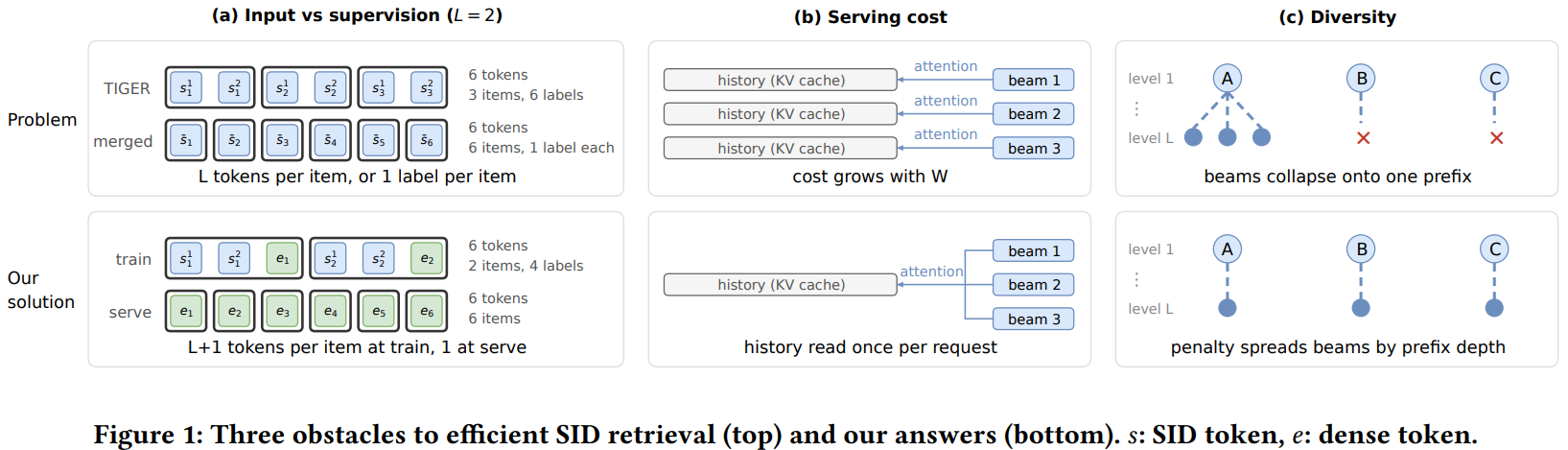
This paper from Pinterest presents PinGER, a generative retriever that decodes an item’s semantic ID (SID) token-by-token instead of running nearest-neighbor search, while keeping the user history compact. SID methods such as TIGER spend L tokens on each history item, so a fixed context holds L times fewer items. The authors show that this matters because recall continues to improve as the context grows from 1,024 to 6,144 tokens. PinGER puts each item’s SID tokens and one dense embedding token side by side in a single causal decoder. An asymmetric attention mask lets dense tokens attend only to earlier dense tokens, while SID tokens see the dense history and the shallower codes of their own item. No later position ever reads a past SID token, so serving can drop those tokens and read the history at one token per item while computing the same function. Training still supervises every SID level, and custom attention kernels that skip masked entries help raise training throughput by 94% over TIGER. The model also conditions generation on a target action, surface, and time. Beams tend to collapse onto a few prefixes, so the authors penalize each candidate by how deep a prefix it shares with beams already chosen. In contrast, temperature sampling lowers both diversity and the share of valid SIDs. The serving stack reads the shared history once per request across all beams, limits decoding to SIDs that exist in the corpus, and resolves SIDs to items from a host-local index. Offline, PinGER matches TIGER’s Recall@100 with 6× fewer serving tokens and beats it by 9.5% at equal cost. The authors also run what they describe as the first online head-to-head between embedding-based and SID-based generative retrieval. On Related Pins, replacing the embedding retriever PinRec with PinGER raised saves by 0.62% and saves of fresh Pins by 3.60%, since new Pins become retrievable as soon as they have an SID. The switch also cut latency slightly and retired the nearest-neighbor serving fleet.
Related Papers
- TIGER: Recommender Systems with Generative Retrieval — Foundational RQ-VAE Semantic ID generative recommender.
- A Semantic Tokenizer Cannot Be Judged Without Its Decoder (FLASH) — LearnLLM deep dive on SimHash parallel decoding & alignment.
- Reachability Is Not Ranking: Finite Beams & Continuous Queries — LearnLLM analysis of beam reachability vs. ranking in SID models.
- #7 in this issue: Can System-1-Style Decision Models Replace Dedicated Rerankers in RAG? (from Li et al.) — Companion study in this newsletter.
[7] Can System-1-Style Decision Models Replace Dedicated Rerankers in RAG? A Systems Evaluation
- Newsletter Headline: Can System-1-Style Decision Models Replace Dedicated Rerankers in RAG? (from Li et al.)
- Links: arXiv:2610.34816 · Digest Section
- Research Area: Retrieval-Augmented Generation · LLM & Cross-Encoder Reranking
Main Content & Technical Findings
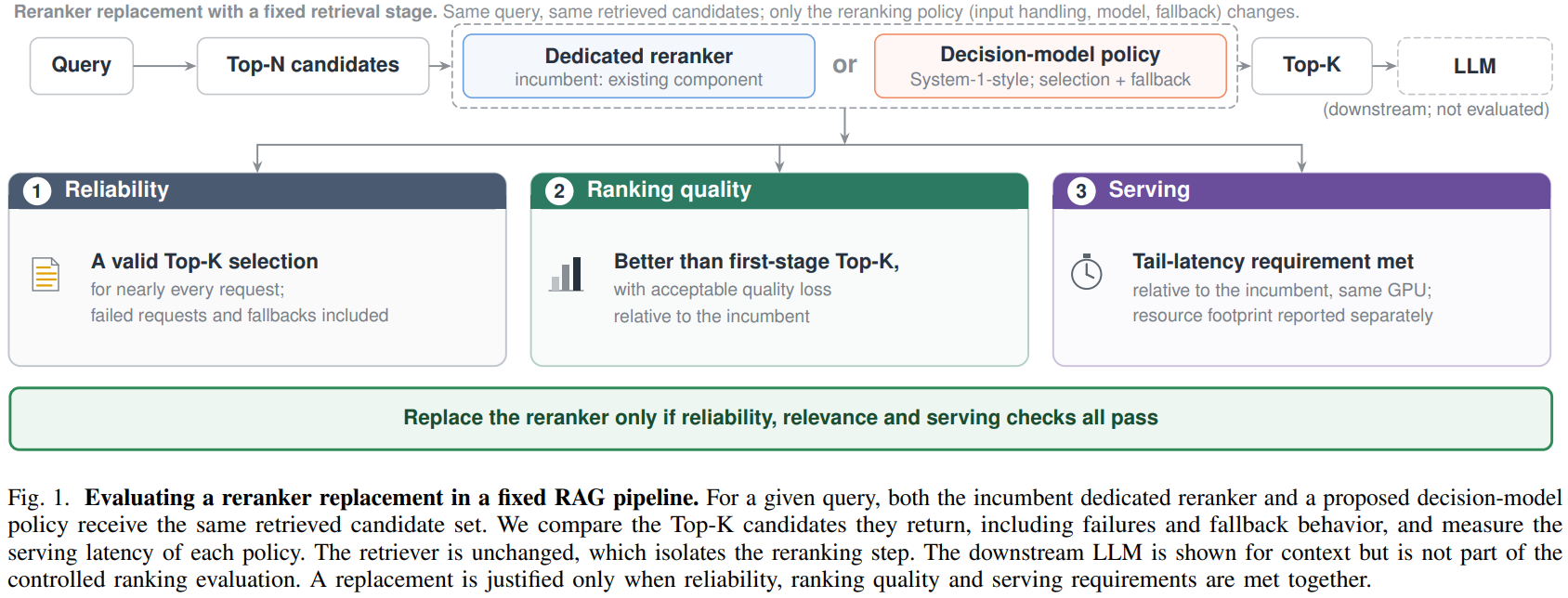
This paper from Li et al. asks whether System-1-style decision models, which return scores or selections over fixed options instead of free-form text, can replace a dedicated reranker in a RAG pipeline. The authors screen 21 open-weight models (nine rerankers and 12 decision models) across 11 benchmarks. They then run a controlled comparison between the 27B PPLX Decider and the 0.6B Jina Reranker v3.5 on BRIGHT, with the BM25 Top-20 candidates held fixed. To count as a replacement, a policy must return a valid Top-5 for at least 99% of requests, beat the BM25 order while staying within 0.02 nDCG@5 of Jina, and keep p95 latency under twice Jina’s on the same A100. In its default setup, PPLX fails on 56% of BRIGHT queries because long candidate sets overflow its context. Scored only on the requests it completes, it looks better than Jina, but it trails by about 0.10 nDCG@5 once failures count. Giving each candidate an equal share of the token budget fixes reliability and brings PPLX roughly level with Jina, though part of its score depends on getting candidates in BM25 order. A sweep over input budgets shows that single-call PPLX passes all three checks at 4,096 and 6,144 tokens and needs far less input text than Jina to reach similar quality. A Jina simply truncated to 8,192 tokens also passes, at a fifth of its full-text latency and 1.9 GiB of GPU memory, against roughly 50 GiB for PPLX. On other workloads, PPLX ranks better on EnterpriseRAG-Bench and worse on MuSiQue, and it misses the latency target on both. The authors conclude that decision models can rerank competitively but aren’t inherently better replacements, and that teams should tune the reranker they already run before switching.
Related Papers
- Search Agents Need Better Decision Boundaries (SearchJev) — LearnLLM review of calibrated single-token System-1 decision models.
- RankZephyr / Listwise LLM Reranking — Baseline autoregressive listwise LLM reranking.
- #8 in this issue: Phantom Correlation from User Activity in Item-Item Similarity (from the University of Antwerp) — Companion study in this newsletter.
[8] Do Similarity Measures Measure Similarity? How User Activity Creates Phantom Correlation in Recommender Systems
- Newsletter Headline: Phantom Correlation from User Activity in Item-Item Similarity (from the University of Antwerp)
- Links: arXiv:2610.35765 · Digest Section · Code / Resource
- Research Area: Recommender Systems · Large-Scale Recommendation & Representation Learning
Main Content & Technical Findings
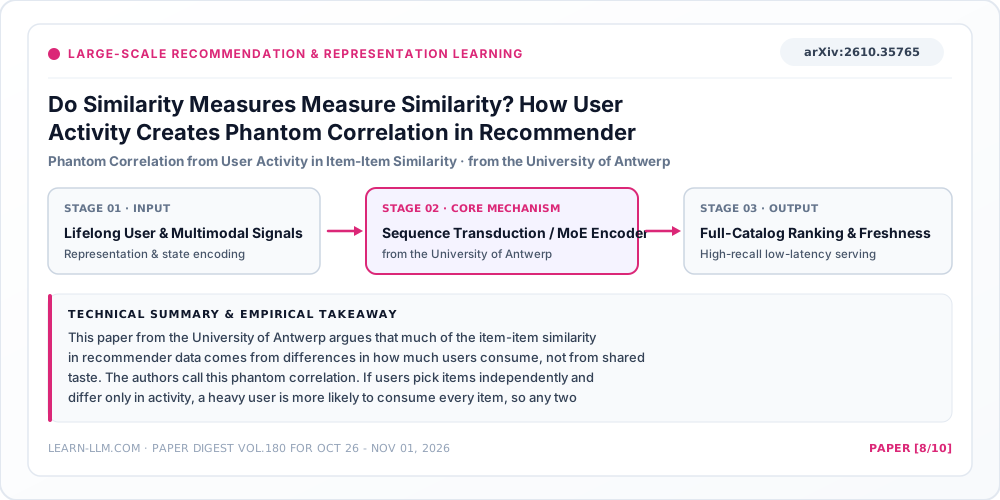
This paper from the University of Antwerp argues that much of the item-item similarity in recommender data comes from differences in how much users consume, not from shared taste. The authors call this phantom correlation. If users pick items independently and differ only in activity, a heavy user is more likely to consume every item, so any two items co-occur more often than chance and standard measures report them as similar. They state three assumptions. Users consume items independently given an activity trait; higher activity raises the probability of every item without changing the popularity order, and history length captures everything about a user’s activity. They prove these lead uniquely to a Rasch model, in which a more active user has the odds of every item multiplied by the same factor. For any data, the total covariance across item pairs is fixed by item popularities and the variance in history lengths. Under the first two assumptions, every pair is non-negatively correlated. Under the full model, lift is largest for rare pairs and falls toward 1 as popularity grows, while cosine and Pearson correlation scale lift by a popularity term. The authors fit the model by EM using only item popularities and the distribution of history lengths, never the pairwise co-occurrences. On MovieLens-1M and MovieLens-20M, activity accounts for 73% to 81% of the gap between independence and the data over all pairs. Over popularity blocks, it accounts for nearly all of the gap for lift, cosine, and Pearson, and somewhat less for EASE weights. Activity also reproduces how each measure depends on popularity, with lift highest among rare films and cosine among popular ones. It does not predict which specific pairs stand out, though. On MovieLens-1M, observed and model lift have a Spearman correlation of only 0.31, so the authors treat genuine preference as deviation from an activity baseline. They note that cosine gives popular items a built-in head start and lift favors rare ones.
Related Papers
- What a Recommender Can Reach, Remember, and Afford — LearnLLM 7-paper synthesis on recommender reach, memory, and compute.
- When Should a Personal Agent Override Your Recommender? — LearnLLM review of value-floored RL alignment in recommendation.
- #2 in this issue: Naive Bayes Similarity Measures for Item-Based Collaborative Filtering (from the University of Antwerp) — Companion study in this newsletter.
[9] Natural Hard-Negative Mining from Positives for Instruction-Following Retrieval
- Newsletter Headline: Reusing Positives as Hard Negatives for Instruction-Following Retrieval (from Li et al.)
- Links: arXiv:2610.36900 · Digest Section
- Research Area: Recommender Systems · Large-Scale Recommendation & Representation Learning
Main Content & Technical Findings
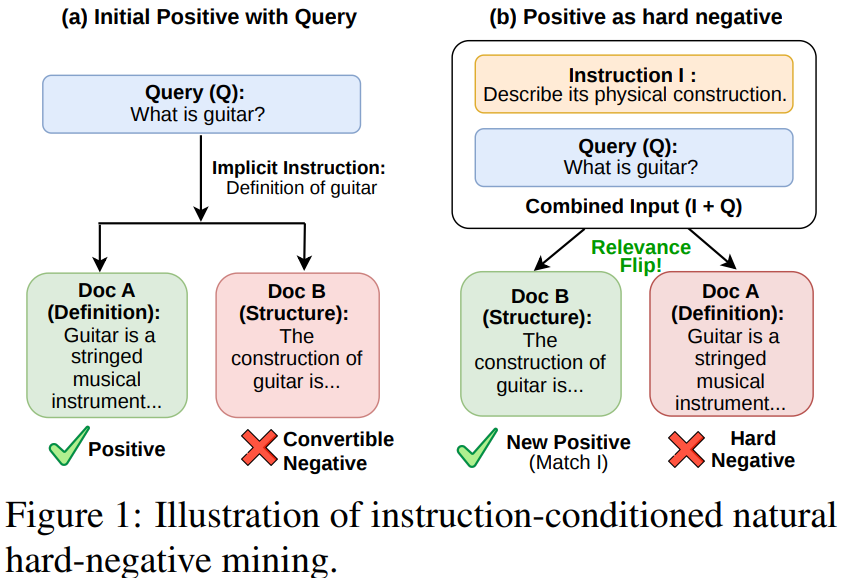
This paper from Li et al. proposes Natural Hard-Negative Mining (NHNM), a way to build training data for instruction-following retrieval without asking an LLM to write long negative passages. Prior methods such as Promptriever and InF-IR keep a fixed positive and synthesize instruction-violating negatives around it. NHNM goes the other way. It searches BM25-retrieved negatives for a “convertible” one that would become relevant under a narrower instruction, has an LLM write a short instruction that promotes it to positive, and reuses the original positive as a hard negative, since that passage still matches the query but violates the new instruction. GPT-5.1 first cleans the candidates and sorts negatives into false, convertible, and other. A second pass then picks the clearest convertible negative and trims the instruction down to the minimum condition that separates the two passages. A final filter keeps only instances where adding the instruction raises the frozen encoder’s similarity to the new positive. Run on about 36K MS MARCO tuples, the pipeline yields 6,716 training examples, and 88% of a 100-sample subset passed manual review. One epoch of fine-tuning on a single RTX 3090 lifts Qwen3-Embedding-0.6B from 49.3 to 67.1 Robustness@10 on InstructIR, ahead of the 7B Promptriever trained on roughly 500K examples.
Related Papers
- What a Recommender Can Reach, Remember, and Afford — LearnLLM 7-paper synthesis on recommender reach, memory, and compute.
- When Should a Personal Agent Override Your Recommender? — LearnLLM review of value-floored RL alignment in recommendation.
- #2 in this issue: Naive Bayes Similarity Measures for Item-Based Collaborative Filtering (from the University of Antwerp) — Companion study in this newsletter.
[10] EmbeddingGemma 2: Unified and Efficient Multimodal Representations
- Newsletter Headline: EmbeddingGemma 2: Unified and Efficient Multimodal Representations (from Google)
- Links: arXiv:2610.37364 · Digest Section · Code / Resource
- Research Area: Recommender Systems · Large-Scale Recommendation & Representation Learning
Main Content & Technical Findings
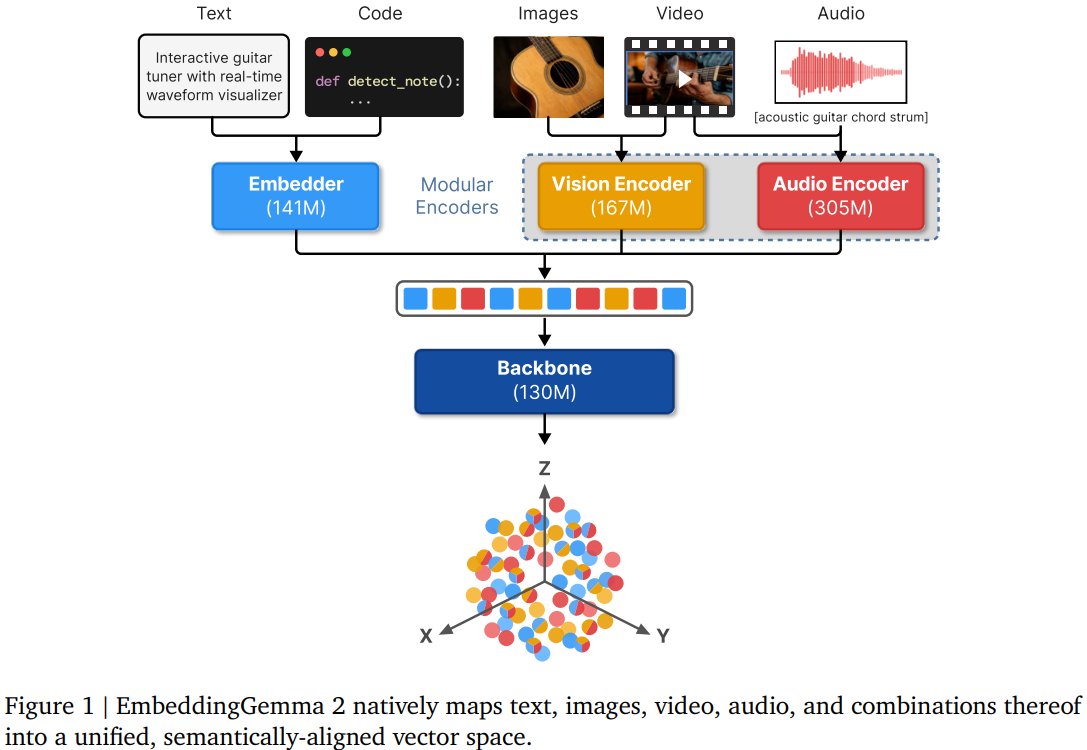
This paper from Google presents EmbeddingGemma 2, an open 744M-parameter model that embeds text, images, video, audio, and interleaved mixes of them into one shared space. It pairs a 271M bidirectional backbone adapted from Gemma 4 with a 167M vision encoder and a frozen 305M audio encoder. The encoders are modular, so the model can also run as a 271M text-only or 439M vision-language model. The authors drop the dedicated per-layer embedding lookup table that Gemma 3n and Gemma 4 use and build the per-layer inputs from the main input embeddings instead, which saves memory and slightly improves quality. Training covers about 2.9T tokens in three stages. Text pre-finetuning and then multimodal pre-finetuning rely mostly on embedding-matching distillation from Gemini Embedding 2. A final multimodal finetuning stage drops distillation for contrastive loss with a spread-out regularizer and Matryoshka losses, followed by checkpoint averaging and a separate quantization-aware training stage. The model scores 78.7 on MTEB(Code), ahead of every model under 4B parameters. It edges past its text-only predecessor on multilingual text, drops slightly on English, and leads sub-1B models on MIEB(lite) by a wide margin. The release supports embeddings from 128 to 768 dimensions and includes int4 checkpoints that need 191 MB of memory for text-only use and 567 MB for the full model on a Pixel 11 Pro.
Related Papers
- What a Recommender Can Reach, Remember, and Afford — LearnLLM 7-paper synthesis on recommender reach, memory, and compute.
- When Should a Personal Agent Override Your Recommender? — LearnLLM review of value-floored RL alignment in recommendation.
- #2 in this issue: Naive Bayes Similarity Measures for Item-Based Collaborative Filtering (from the University of Antwerp) — Companion study in this newsletter.