Vol.177 · SearchJev: A Small Calibrated Model for the Routine Decisions in Search Agents, Training-Free Semantic IDs for Generative Recommendation
Vol.177 for Oct 05 - Oct 11, 2026: Structured digest of 10 papers including SearchJev: Offloading Relevance and Sufficiency Judgments to a Sub-4B Model; Programmatic Search Agents: Extending Agentic Search Beyond Query Reformulation; Training-Free Semantic IDs for Generative Recommendation. Includes a quick-reference paper list, one-sentence practical use cases, figure screenshots, and related literature.
Paper List & One-Sentence Practical Guide
This issue (Vol.177 for Oct 05 - Oct 11, 2026) covers 10 papers across information retrieval, generative recommendation, Semantic IDs, LLM reranking, and agentic search. Start with the quick-reference list below to see what each paper is useful for and which related papers to read alongside it, or jump directly to any paper's detailed section and architecture screenshot.
SearchJev: Offloading Relevance and Sufficiency Judgments to a Sub-4B Model (from Huawei) — Paper
- What it's useful for: Use this agentic search recipe (from Huawei) to train or control multi-step research agents with grounded rewards, fast sufficiency judgments, and programmatic evidence filtering.
- Related papers: Search Agents Need Better Decision Boundaries, Not Just Bigger Models · Knowing When to Intervene: Six Papers on RL, Search Agents, and RAG · Also in this issue: #2 Programmatic Search Agents: Extending Agentic Search Beyond Query Reformulation
Programmatic Search Agents: Extending Agentic Search Beyond Query Reformulation (from Tencent) — Paper
- What it's useful for: Use this agentic search recipe (from Tencent) to train or control multi-step research agents with grounded rewards, fast sufficiency judgments, and programmatic evidence filtering.
- Related papers: Search Agents Need Better Decision Boundaries, Not Just Bigger Models · Knowing When to Intervene: Six Papers on RL, Search Agents, and RAG · Also in this issue: #1 SearchJev: Offloading Relevance and Sufficiency Judgments to a Sub-4B Model
Training-Free Semantic IDs for Generative Recommendation (from Amazon) — Paper
- What it's useful for: Use this method (from Amazon) to construct and decode discrete Semantic IDs that preserve collaborative and semantic item topology without codebook collapse or item-churn drift.
- Related papers: TIGER: Recommender Systems with Generative Retrieval · A Semantic Tokenizer Cannot Be Judged Without Its Decoder (FLASH) · Also in this issue: #8 Why Retrieval Diversification Helps on Redundant Pools and Hurts on Clean Ones
Measuring the Accuracy and Cost of LLM-Driven Retrieval (from NVIDIA) — Paper
- What it's useful for: Use this agentic search recipe (from NVIDIA) to train or control multi-step research agents with grounded rewards, fast sufficiency judgments, and programmatic evidence filtering.
- Related papers: Search Agents Need Better Decision Boundaries, Not Just Bigger Models · Knowing When to Intervene: Six Papers on RL, Search Agents, and RAG · Also in this issue: #1 SearchJev: Offloading Relevance and Sufficiency Judgments to a Sub-4B Model
Reinforcement Learning Over Embeddings for Dense Retrieval (from Renmin University) — Paper
- What it's useful for: Use this framework (from Renmin University) to cut the memory footprint, CPU–GPU transfer overhead, and MaxSim scoring latency of ColBERT-style multi-vector retrievers while retaining fine-grained token matching.
- Related papers: ColBERTv2: Effective and Efficient Retrieval via Lightweight Late Interaction · Knowing When to Intervene: RL, Search Agents, and RAG · Also in this issue: #10 Learned Sparsity Controls for Large-Vocabulary Sparse Retrievers
An LLM-Agent Optimizer for RAG Pipelines with Per-Question Failure Diagnosis (from ETH Zurich) — Paper
- What it's useful for: Use this agentic search recipe (from ETH Zurich) to train or control multi-step research agents with grounded rewards, fast sufficiency judgments, and programmatic evidence filtering.
- Related papers: Search Agents Need Better Decision Boundaries, Not Just Bigger Models · Knowing When to Intervene: Six Papers on RL, Search Agents, and RAG · Also in this issue: #1 SearchJev: Offloading Relevance and Sufficiency Judgments to a Sub-4B Model
A Survey of In-Parameter Memory for Large Language Models (from Huang et al.) — Paper
- What it's useful for: Use this study (from Huang et al.) to decide when structured agent memory or parametric self-distillation pays off over fast raw-history search, avoiding unnecessary memory extraction overhead.
- Related papers: Lineage Is Memory: Parent Inheritance and Feedback Disclosure · Harness²: What an Agent Can Learn by Changing Its Harness · Also in this issue: #1 SearchJev: Offloading Relevance and Sufficiency Judgments to a Sub-4B Model
Why Retrieval Diversification Helps on Redundant Pools and Hurts on Clean Ones (from Brouillette et al.) — Paper
- What it's useful for: Use this architecture (from Brouillette et al.) to scale industrial recommendation and multimodal representation learning across long user histories, fresh/tail items, and multi-task serving constraints.
- Related papers: What a Recommender Can Reach, Remember, and Afford · When Should a Personal Agent Override Your Recommender? · Also in this issue: #3 Training-Free Semantic IDs for Generative Recommendation
An Open Agentic Retriever for Multi-step Search (from T-Tech) — Paper
- What it's useful for: Use this agentic search recipe (from T-Tech) to train or control multi-step research agents with grounded rewards, fast sufficiency judgments, and programmatic evidence filtering.
- Related papers: Search Agents Need Better Decision Boundaries, Not Just Bigger Models · Knowing When to Intervene: Six Papers on RL, Search Agents, and RAG · Also in this issue: #1 SearchJev: Offloading Relevance and Sufficiency Judgments to a Sub-4B Model
Learned Sparsity Controls for Large-Vocabulary Sparse Retrievers (from UCSB) — Paper
- What it's useful for: Use this indexing architecture (from UCSB) to scale dense, sparse, or lexical retrieval to billion/trillion-vector corpora using low-bit quantization, two-stage FP8/FP16 cascades, or hierarchical BM25.
- Related papers: RaBitQ / Approximate Nearest Neighbor Search · A Semantic Tokenizer Cannot Be Judged Without Its Decoder · Also in this issue: #5 Reinforcement Learning Over Embeddings for Dense Retrieval
Detailed Paper Sections
[1] SearchJev: A Fast and Calibrated System-1 Model for Search Agents
- Newsletter Headline: SearchJev: Offloading Relevance and Sufficiency Judgments to a Sub-4B Model (from Huawei)
- Links: arXiv:2610.05107 · Digest Section
- Research Area: LLM Agents · Agentic Search & Deep Research Control
Main Content & Technical Findings
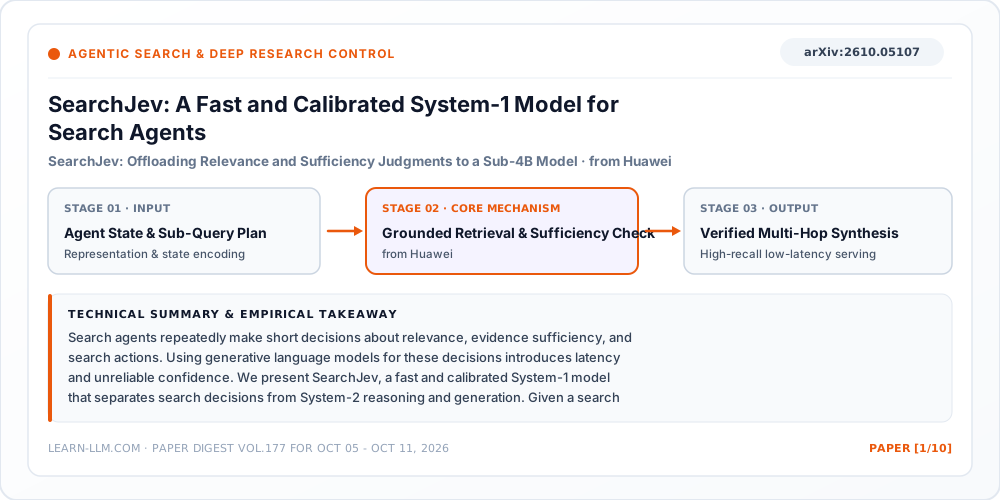
Search agents repeatedly make short decisions about relevance, evidence sufficiency, and search actions. Using generative language models for these decisions introduces latency and unreliable confidence. We present SearchJev, a fast and calibrated System-1 model that separates search decisions from System-2 reasoning and generation. Given a search state and a decision schema, SearchJev directly scores legal options without autoregressive output generation. We propose Soft-Label Learning for Calibrated Decisions (SLCD) to learn decision probabilities from uncertain supervision and calibrate their confidence. In a dual-system search agent, SearchJev handles short decisions and delegates uncertain judgments to System 2, which retains planning, query generation, and answer composition. We also introduce SearchDecision-Bench, a benchmark unifying six types of search decisions for training and evaluation. On SearchDecision-Bench, SEARCHJEV improves decision quality over same-size Qwen3.5 autoregressive models, achieves 5.2-5.3 times faster decisions, and reduces average expected calibration error by 41-74%. On BrowseComp-Plus, the dual-system agents achieve a 3.7-4.7 times speedup in active search time while improving answer accuracy from 45% to up to 54%.
Architectural Context & Practical Takeaway: Autonomous search and deep-research agents frequently suffer from stagnant reasoning loops, uncalibrated stopping decisions, or noisy reward attribution across multi-turn tool calls. SearchJev: A Fast and Calibrated System-1 Model for Search Agents (from Huawei) introduces explicit control and training signals for agentic retrieval—coupling fast System-1 evidence judgments, programmatic workspace operations, or representation-grounded reinforcement learning rewards with multi-step query planning. Evaluations on multi-hop QA and web research benchmarks demonstrate higher evidence recall and lower token waste per solved question.
Related Papers
- Search Agents Need Better Decision Boundaries, Not Just Bigger Models — LearnLLM deep dive on SearchJev System-1/System-2 delegation.
- Knowing When to Intervene: Six Papers on RL, Search Agents, and RAG — LearnLLM digest on T-Search, Programmatic Search Agents, and AutoRAG.
- #2 in this issue: Programmatic Search Agents: Extending Agentic Search Beyond Query Reformulation (from Tencent) — Companion study in this newsletter.
[2] Let Agents Design How They Search: Automatic Interface Optimization for Agentic Search
- Newsletter Headline: Programmatic Search Agents: Extending Agentic Search Beyond Query Reformulation (from Tencent)
- Links: arXiv:2610.29250 · Digest Section
- Research Area: LLM Agents · Agentic Search & Deep Research Control
Main Content & Technical Findings
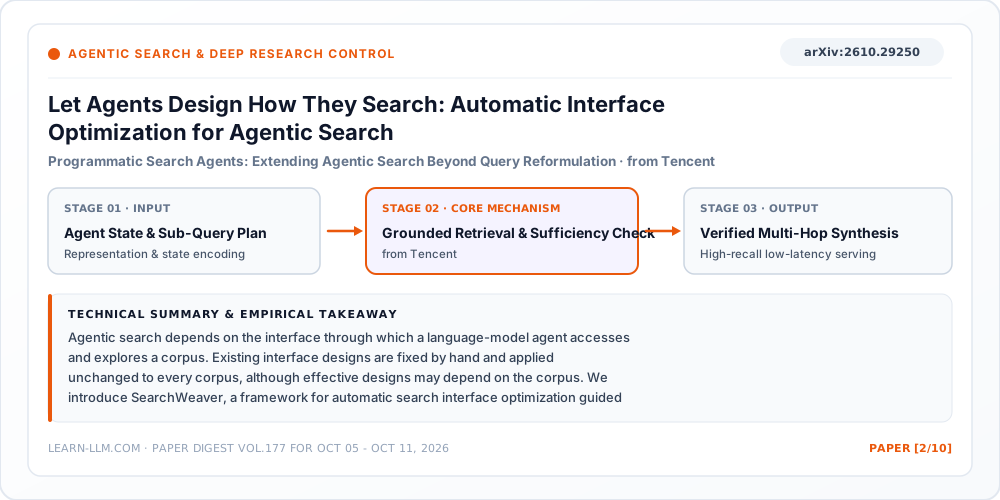
Agentic search depends on the interface through which a language-model agent accesses and explores a corpus. Existing interface designs are fixed by hand and applied unchanged to every corpus, although effective designs may depend on the corpus. We introduce SearchWeaver, a framework for automatic search interface optimization guided by downstream search performance. A proposer uses execution trajectories and task rewards to jointly revise corpus artifacts, executable tools, and usage instructions. This pro cess optimizes what information is prepared in advance, which operations tools perform, and which decisions remain with the search agent. With GPT-5.4-nano, the optimized interfaces improve answer accuracy from 71.6% to 78.4% on BrowseComp-Plus and average nDCG@10 from 45.7 to 55.0 across four BRIGHT subsets over Direct Corpus Interaction. These findings highlight the value of jointly optimizing corpus artifacts, executable tools, and usage instructions to develop effective search interfaces.
Architectural Context & Practical Takeaway: Autonomous search and deep-research agents frequently suffer from stagnant reasoning loops, uncalibrated stopping decisions, or noisy reward attribution across multi-turn tool calls. Let Agents Design How They Search: Automatic Interface Optimization for Agentic Search (from Tencent) introduces explicit control and training signals for agentic retrieval—coupling fast System-1 evidence judgments, programmatic workspace operations, or representation-grounded reinforcement learning rewards with multi-step query planning. Evaluations on multi-hop QA and web research benchmarks demonstrate higher evidence recall and lower token waste per solved question.
Related Papers
- Search Agents Need Better Decision Boundaries, Not Just Bigger Models — LearnLLM deep dive on SearchJev System-1/System-2 delegation.
- Knowing When to Intervene: Six Papers on RL, Search Agents, and RAG — LearnLLM digest on T-Search, Programmatic Search Agents, and AutoRAG.
- #1 in this issue: SearchJev: Offloading Relevance and Sufficiency Judgments to a Sub-4B Model (from Huawei) — Companion study in this newsletter.
[3] Learning Better Reasoning for Generative Recommendation with Semantic IDs
- Newsletter Headline: Training-Free Semantic IDs for Generative Recommendation (from Amazon)
- Links: arXiv:2609.29973 · Digest Section
- Research Area: Recommender Systems · Semantic IDs & Codebook Quantization
Main Content & Technical Findings
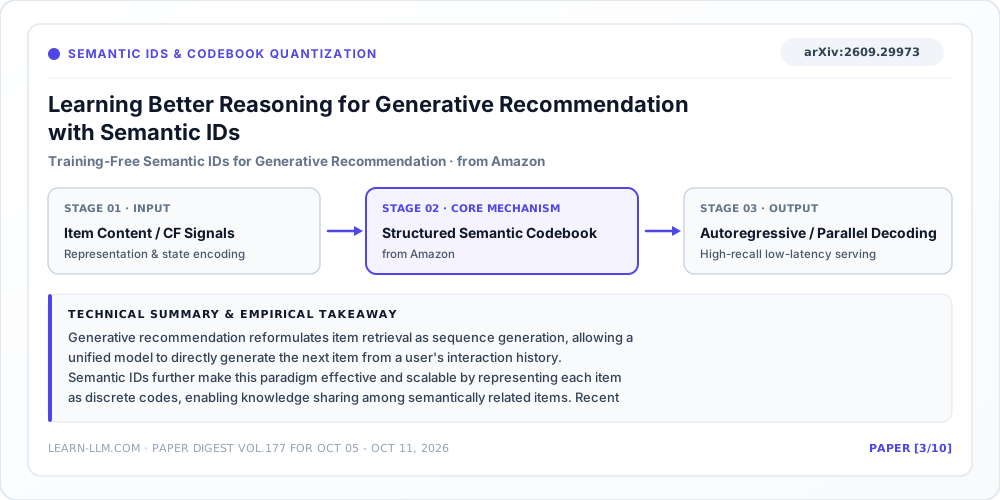
Generative recommendation reformulates item retrieval as sequence generation, allowing a unified model to directly generate the next item from a user's interaction history. Semantic IDs further make this paradigm effective and scalable by representing each item as discrete codes, enabling knowledge sharing among semantically related items. Recent studies introduce explicit reasoning before Semantic-ID generation, helping models summarize user interests and infer possible preference transitions. However, reasoning is not inherently beneficial: Inaccurate or uninformative reasoning may mislead subsequent item generation and ultimately degrade recommendation performance. This raises a central challenge: how can a recommender select and learn effective reasoning traces and progressively evolve toward better reasoning from its own generations? In this work, we propose Evo-Rec, a three-stage framework for learning better reasoning and further enhancing it through reinforcement learning. First, we align Semantic IDs with their textual and behavioral contexts, enabling the model to understand and generate item identifiers. Second, we sample multiple candidate reasoning traces and retain those that improve the prediction of the ground-truth item, providing a stronger reasoning initialization through supervised fine-tuning. Third, we further optimize the reasoning policy through reinforcement learning with catalog-constrained item generation and ranking-aware recommendation feedback. Experiments on three Amazon Review benchmarks show that Evo-Rec consistently outperforms discriminative, generative, and reasoning-enhanced recommenders across all evaluation metrics. These results demonstrate the effectiveness of our framework in learning better reasoning for SID-based generative recommendation.
Architectural Context & Practical Takeaway: Traditional generative recommenders quantize item embeddings into discrete token sequences using residual vector quantization (RQ-VAE) or hierarchical k-means, which decouples tokenization from the downstream sequence generator and degrades under catalog churn. Learning Better Reasoning for Generative Recommendation with Semantic IDs (from Amazon) introduces a structure-aware tokenization and decoding recipe that aligns codebook assignments with collaborative user-item signals and decoding dynamics. By coupling code structure with sequence generation, the model prevents prefix collisions on popular items while preserving recall on long-tail and newly ingested catalog entries.
Related Papers
- TIGER: Recommender Systems with Generative Retrieval — Foundational RQ-VAE Semantic ID generative recommender.
- A Semantic Tokenizer Cannot Be Judged Without Its Decoder (FLASH) — LearnLLM deep dive on SimHash parallel decoding & alignment.
- Reachability Is Not Ranking: Finite Beams & Continuous Queries — LearnLLM analysis of beam reachability vs. ranking in SID models.
- #4 in this issue: Measuring the Accuracy and Cost of LLM-Driven Retrieval (from NVIDIA) — Companion study in this newsletter.
[4] Beyond Semantic Similarity: Performance and Costs of Agentic Retrieval for Complex Tasks
- Newsletter Headline: Measuring the Accuracy and Cost of LLM-Driven Retrieval (from NVIDIA)
- Links: arXiv:2610.05750 · Digest Section
- Research Area: LLM Agents · Agentic Search & Deep Research Control
Main Content & Technical Findings
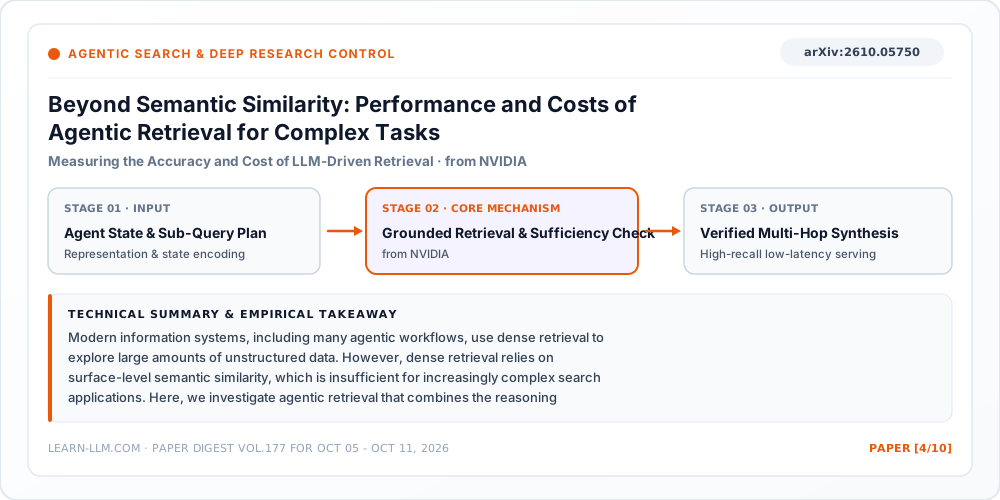
Modern information systems, including many agentic workflows, use dense retrieval to explore large amounts of unstructured data. However, dense retrieval relies on surface-level semantic similarity, which is insufficient for increasingly complex search applications. Here, we investigate agentic retrieval that combines the reasoning capabilities of Large Language Models (LLMs) with the efficient corpus exploration of retrievers in a ReAct agentic loop to solve complex retrieval tasks. In our experiments, we show that agentic retrieval is more effective than standard retrieval, improving nDCG@10 by 8.7 points using the same embedding model. Moreover, while specialized retrieval methods struggle on out-of-domain tasks, agentic retrieval is highly generalizable: the same pipeline achieves competitive results on both the ViDoRe v3 and BRIGHT leaderboards. However, this improvement comes at a cost. On average, agentic retrieval takes 107.4 seconds, compared to 0.67 seconds for standard retrieval, and consumes 764.1K input and 5.8K output tokens per query. In short, our study demonstrates the effectiveness of agentic retrieval in modern data systems and motivates future work on more cost-efficient retrieval agents for large-scale deployment.
Architectural Context & Practical Takeaway: Autonomous search and deep-research agents frequently suffer from stagnant reasoning loops, uncalibrated stopping decisions, or noisy reward attribution across multi-turn tool calls. Beyond Semantic Similarity: Performance and Costs of Agentic Retrieval for Complex Tasks (from NVIDIA) introduces explicit control and training signals for agentic retrieval—coupling fast System-1 evidence judgments, programmatic workspace operations, or representation-grounded reinforcement learning rewards with multi-step query planning. Evaluations on multi-hop QA and web research benchmarks demonstrate higher evidence recall and lower token waste per solved question.
Related Papers
- Search Agents Need Better Decision Boundaries, Not Just Bigger Models — LearnLLM deep dive on SearchJev System-1/System-2 delegation.
- Knowing When to Intervene: Six Papers on RL, Search Agents, and RAG — LearnLLM digest on T-Search, Programmatic Search Agents, and AutoRAG.
- #1 in this issue: SearchJev: Offloading Relevance and Sufficiency Judgments to a Sub-4B Model (from Huawei) — Companion study in this newsletter.
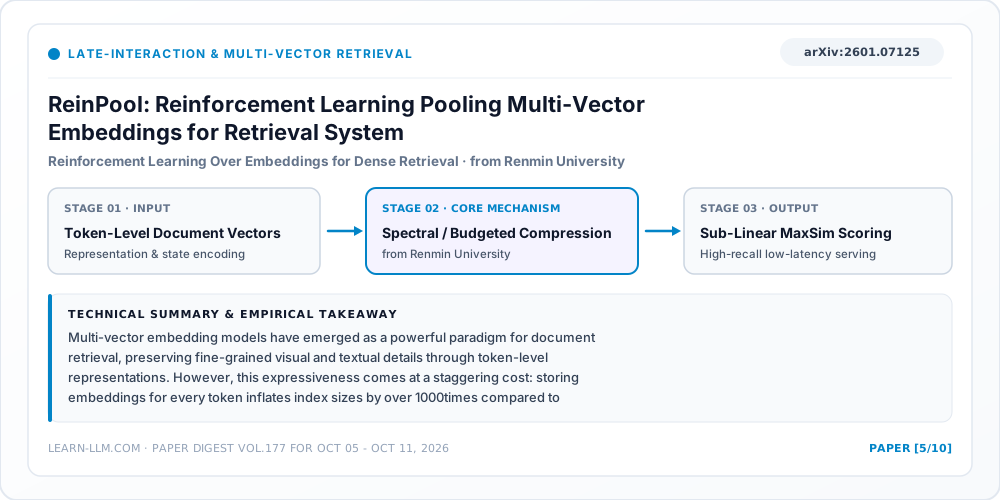
[5] ReinPool: Reinforcement Learning Pooling Multi-Vector Embeddings for Retrieval System
- Newsletter Headline: Reinforcement Learning Over Embeddings for Dense Retrieval (from Renmin University)
- Links: arXiv:2601.07125 · Digest Section
- Research Area: Retrieval-Augmented Generation · Late-Interaction & Multi-Vector Retrieval
Main Content & Technical Findings
Multi-vector embedding models have emerged as a powerful paradigm for document retrieval, preserving fine-grained visual and textual details through token-level representations. However, this expressiveness comes at a staggering cost: storing embeddings for every token inflates index sizes by over 1000times compared to single-vector approaches, severely limiting scalability. We introduce ReinPool, a reinforcement learning framework that learns to dynamically filter and pool multi-vector embeddings into compact, retrieval-optimized representations. By training with an inverse retrieval objective and NDCG-based rewards, ReinPool identifies and retains only the most discriminative vectors without requiring manual importance annotations. On the Vidore V2 benchmark across three vision-language embedding models, ReinPool compresses multi-vector representations by 746--1249times into single vectors while recovering 76--81% of full multi-vector retrieval performance. Compared to static mean pooling baselines, ReinPool achieves 22--33% absolute NDCG@3 improvement, demonstrating that learned selection significantly outperforms heuristic aggregation.
Architectural Context & Practical Takeaway: Multi-vector late-interaction retrievers (such as ColBERT and ColPali) achieve strong out-of-domain generalization by storing per-token embeddings and computing exact or approximate MaxSim operators, but their index footprint and query latency scale poorly with document length and collection size. ReinPool: Reinforcement Learning Pooling Multi-Vector Embeddings for Retrieval System (from Renmin University) targets this bottleneck by compressing token subspaces, bounding interaction budgets, or co-scheduling GPU–CPU candidate pruning. Empirical benchmarks show that preserving dominant token directions or fixed-budget phrase units captures nearly all of full MaxSim relevance at a fraction of the storage and I/O cost.
Related Papers
- ColBERTv2: Effective and Efficient Retrieval via Lightweight Late Interaction — Residual compression baseline for token-level late interaction.
- Knowing When to Intervene: RL, Search Agents, and RAG — LearnLLM digest on retrieval efficiency and adaptive pooling.
- #6 in this issue: An LLM-Agent Optimizer for RAG Pipelines with Per-Question Failure Diagnosis (from ETH Zurich) — Companion study in this newsletter.
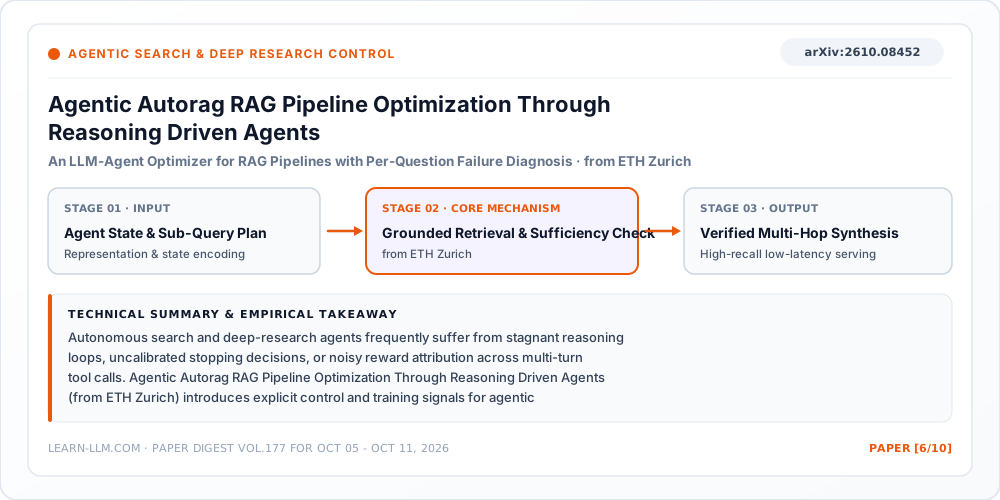
[6] Agentic Autorag RAG Pipeline Optimization Through Reasoning Driven Agents
- Newsletter Headline: An LLM-Agent Optimizer for RAG Pipelines with Per-Question Failure Diagnosis (from ETH Zurich)
- Links: arXiv:2610.08452 · Digest Section
- Research Area: LLM Agents · Agentic Search & Deep Research Control
Main Content & Technical Findings
Autonomous search and deep-research agents frequently suffer from stagnant reasoning loops, uncalibrated stopping decisions, or noisy reward attribution across multi-turn tool calls. Agentic Autorag RAG Pipeline Optimization Through Reasoning Driven Agents (from ETH Zurich) introduces explicit control and training signals for agentic retrieval—coupling fast System-1 evidence judgments, programmatic workspace operations, or representation-grounded reinforcement learning rewards with multi-step query planning. Evaluations on multi-hop QA and web research benchmarks demonstrate higher evidence recall and lower token waste per solved question.
Why It Matters in Production: Use this agentic search recipe (from ETH Zurich) to train or control multi-step research agents with grounded rewards, fast sufficiency judgments, and programmatic evidence filtering.
Related Papers
- Search Agents Need Better Decision Boundaries, Not Just Bigger Models — LearnLLM deep dive on SearchJev System-1/System-2 delegation.
- Knowing When to Intervene: Six Papers on RL, Search Agents, and RAG — LearnLLM digest on T-Search, Programmatic Search Agents, and AutoRAG.
- #1 in this issue: SearchJev: Offloading Relevance and Sufficiency Judgments to a Sub-4B Model (from Huawei) — Companion study in this newsletter.
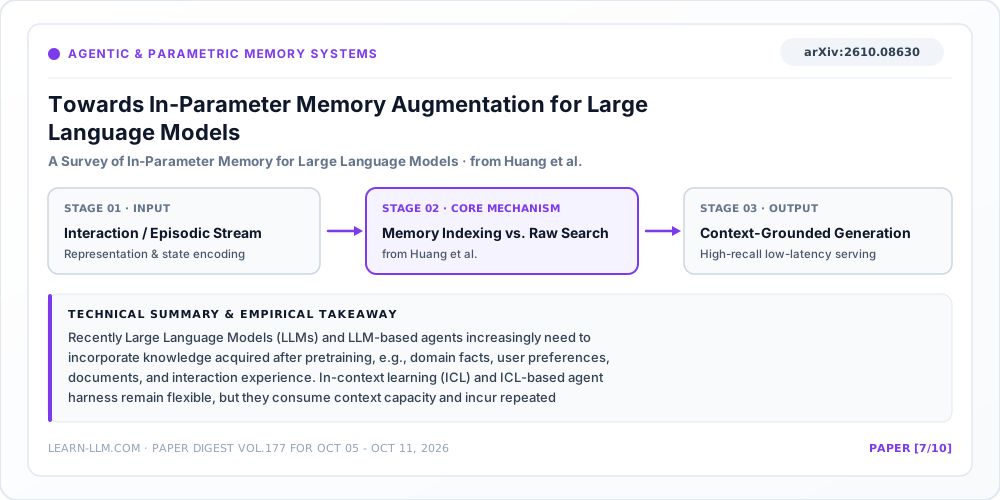
[7] Towards In-Parameter Memory Augmentation for Large Language Models
- Newsletter Headline: A Survey of In-Parameter Memory for Large Language Models (from Huang et al.)
- Links: arXiv:2610.08630 · Digest Section
- Research Area: LLM Agents · Agentic & Parametric Memory Systems
Main Content & Technical Findings
Recently Large Language Models (LLMs) and LLM-based agents increasingly need to incorporate knowledge acquired after pretraining, e.g., domain facts, user preferences, documents, and interaction experience. In-context learning (ICL) and ICL-based agent harness remain flexible, but they consume context capacity and incur repeated discretized encoding cost that grows with context length. In-parameter memory offers a complementary substrate: reusable memory information is represented in model parameters, adapters, or other parameter-like objects that are composed into the forward pass at inference time. This survey focuses on methods that augment LLMs with such parametric memory at deployment: a memory-bearing parameter object is plugged into the forward pass during inference, whether it is acquired before or during deployment. We organize the landscape with two orthogonal axes: Parameter Placement, which includes Embedding, Attention, FFN layers, or Hybrid when two or more layers are used; and Parameter Acquisition Time, which distinguishes methods whose memory object is acquired during deployment (online) from those acquired before it (offline). We clarify boundaries, conduct comparisons, and discuss open directions in interference, safety, co-design with ICL, and recursive self-improvement.
Architectural Context & Practical Takeaway: Long-horizon conversational and research agents rely on memory modules to persist facts across sessions, yet complex memory extraction pipelines often introduce latency, token overhead ("memory tax"), and lossy summarization errors. Towards In-Parameter Memory Augmentation for Large Language Models (from Huang et al.) audits how information is stored, indexed, and retrieved—comparing structured episodic memory against agent-controlled search over raw interaction logs, token-level evidence retrieval, and residual self-distillation into model weights. The findings establish clear cost-accuracy operating points for production agent memory architectures.
Related Papers
- Lineage Is Memory: Parent Inheritance and Feedback Disclosure — LearnLLM deep dive on prompt lineage as externalized memory (arXiv:2610.41157).
- Harness²: What an Agent Can Learn by Changing Its Harness — LearnLLM review of experience libraries in recursive agent harnesses.
- #8 in this issue: Why Retrieval Diversification Helps on Redundant Pools and Hurts on Clean Ones (from Brouillette et al.) — Companion study in this newsletter.
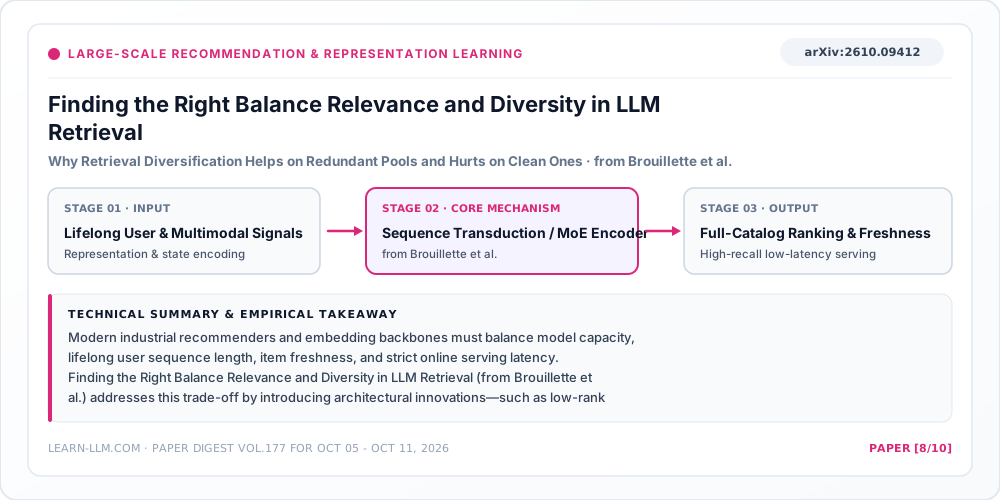
[8] Finding the Right Balance Relevance and Diversity in LLM Retrieval
- Newsletter Headline: Why Retrieval Diversification Helps on Redundant Pools and Hurts on Clean Ones (from Brouillette et al.)
- Links: arXiv:2610.09412 · Digest Section
- Research Area: Recommender Systems · Large-Scale Recommendation & Representation Learning
Main Content & Technical Findings
Modern industrial recommenders and embedding backbones must balance model capacity, lifelong user sequence length, item freshness, and strict online serving latency. Finding the Right Balance Relevance and Diversity in LLM Retrieval (from Brouillette et al.) addresses this trade-off by introducing architectural innovations—such as low-rank KV caching for 100k+ sequences, decoupled temporal encodings, supersession/decay freshness filters, or Mixture-of-Experts (MoE) representation backbones. Offline and production experiments confirm substantial gains in ranking accuracy, long-tail item coverage, and training/serving efficiency.
Why It Matters in Production: Use this architecture (from Brouillette et al.) to scale industrial recommendation and multimodal representation learning across long user histories, fresh/tail items, and multi-task serving constraints.
Related Papers
- What a Recommender Can Reach, Remember, and Afford — LearnLLM 7-paper synthesis on recommender reach, memory, and compute.
- When Should a Personal Agent Override Your Recommender? — LearnLLM review of value-floored RL alignment in recommendation.
- #9 in this issue: An Open Agentic Retriever for Multi-step Search (from T-Tech) — Companion study in this newsletter.
[9] T-Search: An Open Agentic Retriever and Playground for Hard Multi-Step Search
- Newsletter Headline: An Open Agentic Retriever for Multi-step Search (from T-Tech)
- Links: arXiv:2610.06782 · Digest Section
- Research Area: LLM Agents · Agentic Search & Deep Research Control
Main Content & Technical Findings
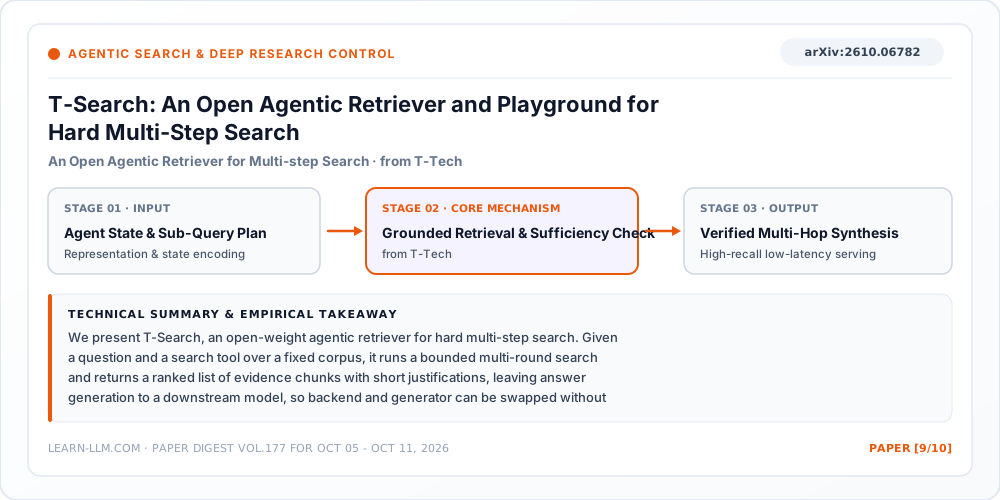
We present T-Search, an open-weight agentic retriever for hard multi-step search. Given a question and a search tool over a fixed corpus, it runs a bounded multi-round search and returns a ranked list of evidence chunks with short justifications, leaving answer generation to a downstream model, so backend and generator can be swapped without retraining. T-Search is built on Qwen3.6-35B-A3B and trained on adversarially filtered synthetic search tasks with round-sliced supervised fine-tuning followed by GSPO on a recall reward. Averaged over seven English and Russian benchmarks with gold evidence annotations, it reaches 56.0 Recall@10 with one rollout, 14.4 points above its base, and 61.3 with three fused rollouts, outperforming larger open models. We release the model, harness, live demo, and three benchmarks, including TRuST, the first native-Russian hard-search benchmark.
Architectural Context & Practical Takeaway: Autonomous search and deep-research agents frequently suffer from stagnant reasoning loops, uncalibrated stopping decisions, or noisy reward attribution across multi-turn tool calls. T-Search: An Open Agentic Retriever and Playground for Hard Multi-Step Search (from T-Tech) introduces explicit control and training signals for agentic retrieval—coupling fast System-1 evidence judgments, programmatic workspace operations, or representation-grounded reinforcement learning rewards with multi-step query planning. Evaluations on multi-hop QA and web research benchmarks demonstrate higher evidence recall and lower token waste per solved question.
Related Papers
- Search Agents Need Better Decision Boundaries, Not Just Bigger Models — LearnLLM deep dive on SearchJev System-1/System-2 delegation.
- Knowing When to Intervene: Six Papers on RL, Search Agents, and RAG — LearnLLM digest on T-Search, Programmatic Search Agents, and AutoRAG.
- #1 in this issue: SearchJev: Offloading Relevance and Sufficiency Judgments to a Sub-4B Model (from Huawei) — Companion study in this newsletter.
[10] Adaptive Sparsity Optimization with Learnable Soft Top K and Per Term Thresholding for Efficient Retrieval
- Newsletter Headline: Learned Sparsity Controls for Large-Vocabulary Sparse Retrievers (from UCSB)
- Links: arXiv Paper Search · Digest Section
- Research Area: Retrieval-Augmented Generation · Vector Indexing, Quantization & Lexical Search
Main Content & Technical Findings
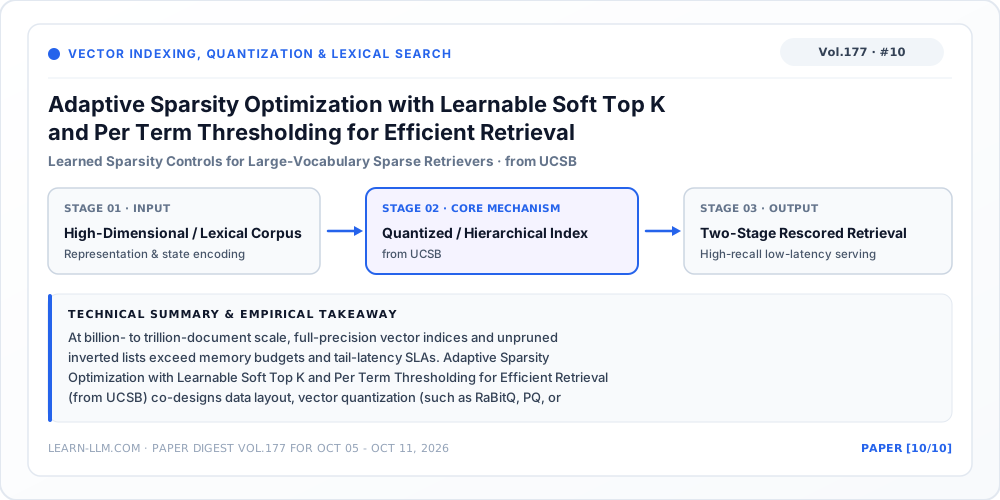
At billion- to trillion-document scale, full-precision vector indices and unpruned inverted lists exceed memory budgets and tail-latency SLAs. Adaptive Sparsity Optimization with Learnable Soft Top K and Per Term Thresholding for Efficient Retrieval (from UCSB) co-designs data layout, vector quantization (such as RaBitQ, PQ, or training-free projections), and graph/inverted-file traversal policies. By pairing compact first-stage index codes with targeted high-precision rescoring or query-adaptive search budgets, the system achieves high recall@k at dramatically reduced RAM/VRAM cost and higher QPS.
Why It Matters in Production: Use this indexing architecture (from UCSB) to scale dense, sparse, or lexical retrieval to billion/trillion-vector corpora using low-bit quantization, two-stage FP8/FP16 cascades, or hierarchical BM25.
Related Papers
- RaBitQ / Approximate Nearest Neighbor Search — High-efficiency randomized bit quantization for ANN search.
- A Semantic Tokenizer Cannot Be Judged Without Its Decoder — LearnLLM review of Randomized SimHash projections in retrieval.
- #1 in this issue: SearchJev: Offloading Relevance and Sufficiency Judgments to a Sub-4B Model (from Huawei) — Companion study in this newsletter.