Vol.176 · Generative End-to-end Ad Retrieval at Douyin, In-Context Product Search for Catalogs That Fit in the Prompt
Vol.176 for Sep 28 - Oct 04, 2026: Structured digest of 10 papers including Joint Training of Tokenizer, Generator, and Reranker for Ad Retrieval at Douyin; Training-Free Dense Retrieval from LLMs with In-Context Examples; In-Graph Curriculum Weighting for Fresh and Tail Content in Short-Video Recommendation. Includes a quick-reference paper list, one-sentence practical use cases, figure screenshots, and related literature.
Paper List & One-Sentence Practical Guide
This issue (Vol.176 for Sep 28 - Oct 04, 2026) covers 10 papers across information retrieval, generative recommendation, Semantic IDs, LLM reranking, and agentic search. Start with the quick-reference list below to see what each paper is useful for and which related papers to read alongside it, or jump directly to any paper's detailed section and architecture screenshot.
Joint Training of Tokenizer, Generator, and Reranker for Ad Retrieval at Douyin (from ByteDance) — Paper
- What it's useful for: Use this method (from ByteDance) to construct and decode discrete Semantic IDs that preserve collaborative and semantic item topology without codebook collapse or item-churn drift.
- Related papers: TIGER: Recommender Systems with Generative Retrieval · A Semantic Tokenizer Cannot Be Judged Without Its Decoder (FLASH) · Also in this issue: #2 Training-Free Dense Retrieval from LLMs with In-Context Examples
Training-Free Dense Retrieval from LLMs with In-Context Examples (from Jedidi et al.) — Paper
- What it's useful for: Use this architecture (from Jedidi et al.) to scale industrial recommendation and multimodal representation learning across long user histories, fresh/tail items, and multi-task serving constraints.
- Related papers: What a Recommender Can Reach, Remember, and Afford · When Should a Personal Agent Override Your Recommender? · Also in this issue: #1 Joint Training of Tokenizer, Generator, and Reranker for Ad Retrieval at Douyin
In-Graph Curriculum Weighting for Fresh and Tail Content in Short-Video Recommendation (from Google) — Paper
- What it's useful for: Use this architecture (from Google) to scale industrial recommendation and multimodal representation learning across long user histories, fresh/tail items, and multi-task serving constraints.
- Related papers: What a Recommender Can Reach, Remember, and Afford · When Should a Personal Agent Override Your Recommender? · Also in this issue: #1 Joint Training of Tokenizer, Generator, and Reranker for Ad Retrieval at Douyin
Task-Aware Embedding Subspaces for Multi-Objective Retrieval (from LinkedIn) — Paper
- What it's useful for: Use this architecture (from LinkedIn) to scale industrial recommendation and multimodal representation learning across long user histories, fresh/tail items, and multi-task serving constraints.
- Related papers: What a Recommender Can Reach, Remember, and Afford · When Should a Personal Agent Override Your Recommender? · Also in this issue: #1 Joint Training of Tokenizer, Generator, and Reranker for Ad Retrieval at Douyin
In-Context Product Search for Catalogs That Fit in the Prompt (from Google) — Paper
- What it's useful for: Use this architecture (from Google) to scale industrial recommendation and multimodal representation learning across long user histories, fresh/tail items, and multi-task serving constraints.
- Related papers: What a Recommender Can Reach, Remember, and Afford · When Should a Personal Agent Override Your Recommender? · Also in this issue: #1 Joint Training of Tokenizer, Generator, and Reranker for Ad Retrieval at Douyin
A Timestamp-Based Rotary Embedding for Sequential Recommendation (from Shopify) — Paper
- What it's useful for: Use this architecture (from Shopify) to scale industrial recommendation and multimodal representation learning across long user histories, fresh/tail items, and multi-task serving constraints.
- Related papers: What a Recommender Can Reach, Remember, and Afford · When Should a Personal Agent Override Your Recommender? · Also in this issue: #1 Joint Training of Tokenizer, Generator, and Reranker for Ad Retrieval at Douyin
A Unified Generative Model for Retrieval, Ranking, and Reward (from Snap Inc.) — Paper
- What it's useful for: Use this architecture (from Snap Inc.) to scale industrial recommendation and multimodal representation learning across long user histories, fresh/tail items, and multi-task serving constraints.
- Related papers: What a Recommender Can Reach, Remember, and Afford · When Should a Personal Agent Override Your Recommender? · Also in this issue: #1 Joint Training of Tokenizer, Generator, and Reranker for Ad Retrieval at Douyin
Organizing Document Collections Around Entities for Agentic Search (from Jeong et al.) — Paper
- What it's useful for: Use this agentic search recipe (from Jeong et al.) to train or control multi-step research agents with grounded rewards, fast sufficiency judgments, and programmatic evidence filtering.
- Related papers: Search Agents Need Better Decision Boundaries, Not Just Bigger Models · Knowing When to Intervene: Six Papers on RL, Search Agents, and RAG · Also in this issue: #9 Measuring and Reducing Lifecycle Overhead in Large-Scale Recommendation Training
Measuring and Reducing Lifecycle Overhead in Large-Scale Recommendation Training (from Meta) — Paper
- What it's useful for: Use this architecture (from Meta) to scale industrial recommendation and multimodal representation learning across long user histories, fresh/tail items, and multi-task serving constraints.
- Related papers: What a Recommender Can Reach, Remember, and Afford · When Should a Personal Agent Override Your Recommender? · Also in this issue: #1 Joint Training of Tokenizer, Generator, and Reranker for Ad Retrieval at Douyin
LLM-Driven Architecture Search for Recommenders (from Li et al.) — Paper
- What it's useful for: Use this architecture (from Li et al.) to scale industrial recommendation and multimodal representation learning across long user histories, fresh/tail items, and multi-task serving constraints.
- Related papers: What a Recommender Can Reach, Remember, and Afford · When Should a Personal Agent Override Your Recommender? · Also in this issue: #1 Joint Training of Tokenizer, Generator, and Reranker for Ad Retrieval at Douyin
Detailed Paper Sections
[1] End-to-End Semantic ID Generation for Generative Advertisement Recommendation
- Newsletter Headline: Joint Training of Tokenizer, Generator, and Reranker for Ad Retrieval at Douyin (from ByteDance)
- Links: arXiv:2602.10445 · Digest Section
- Research Area: Recommender Systems · Semantic IDs & Codebook Quantization
Main Content & Technical Findings
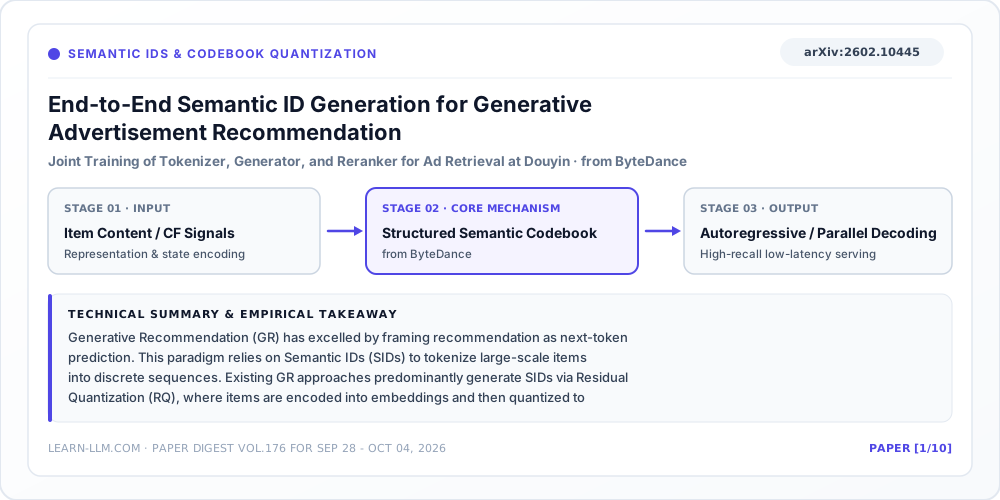
Generative Recommendation (GR) has excelled by framing recommendation as next-token prediction. This paradigm relies on Semantic IDs (SIDs) to tokenize large-scale items into discrete sequences. Existing GR approaches predominantly generate SIDs via Residual Quantization (RQ), where items are encoded into embeddings and then quantized to discrete SIDs. However, this paradigm suffers from inherent limitations: 1) Objective misalignment and semantic degradation stemming from the two-stage compression; 2) Error accumulation inherent in the structure of RQ. To address these limitations, we propose UniSID, a Unified SID generation framework for generative advertisement recommendation. Specifically, we jointly optimize embeddings and SIDs in an end-to-end manner from raw advertising data, enabling semantic information to flow directly into the SID space and thus addressing the inherent limitations of the two-stage cascading compression paradigm. To capture fine-grained semantics, a multi-granularity contrastive learning strategy is introduced to align distinct items across SID levels. Finally, a summary-based ad reconstruction mechanism is proposed to encourage SIDs to capture high-level semantic information that is not explicitly present in advertising contexts. Experiments demonstrate that UniSID consistently outperforms state-of-the-art SID generation methods, yielding up to a 4.62% improvement in Hit Rate metrics across downstream advertising scenarios compared to the strongest baseline.
Architectural Context & Practical Takeaway: Traditional generative recommenders quantize item embeddings into discrete token sequences using residual vector quantization (RQ-VAE) or hierarchical k-means, which decouples tokenization from the downstream sequence generator and degrades under catalog churn. End-to-End Semantic ID Generation for Generative Advertisement Recommendation (from ByteDance) introduces a structure-aware tokenization and decoding recipe that aligns codebook assignments with collaborative user-item signals and decoding dynamics. By coupling code structure with sequence generation, the model prevents prefix collisions on popular items while preserving recall on long-tail and newly ingested catalog entries.
Related Papers
- TIGER: Recommender Systems with Generative Retrieval — Foundational RQ-VAE Semantic ID generative recommender.
- A Semantic Tokenizer Cannot Be Judged Without Its Decoder (FLASH) — LearnLLM deep dive on SimHash parallel decoding & alignment.
- Reachability Is Not Ranking: Finite Beams & Continuous Queries — LearnLLM analysis of beam reachability vs. ranking in SID models.
- #2 in this issue: Training-Free Dense Retrieval from LLMs with In-Context Examples (from Jedidi et al.) — Companion study in this newsletter.
[2] Effective Dense Retrieval using Only In-Context Examples
- Newsletter Headline: Training-Free Dense Retrieval from LLMs with In-Context Examples (from Jedidi et al.)
- Links: arXiv:2609.38099 · Digest Section
- Research Area: Recommender Systems · Large-Scale Recommendation & Representation Learning
Main Content & Technical Findings
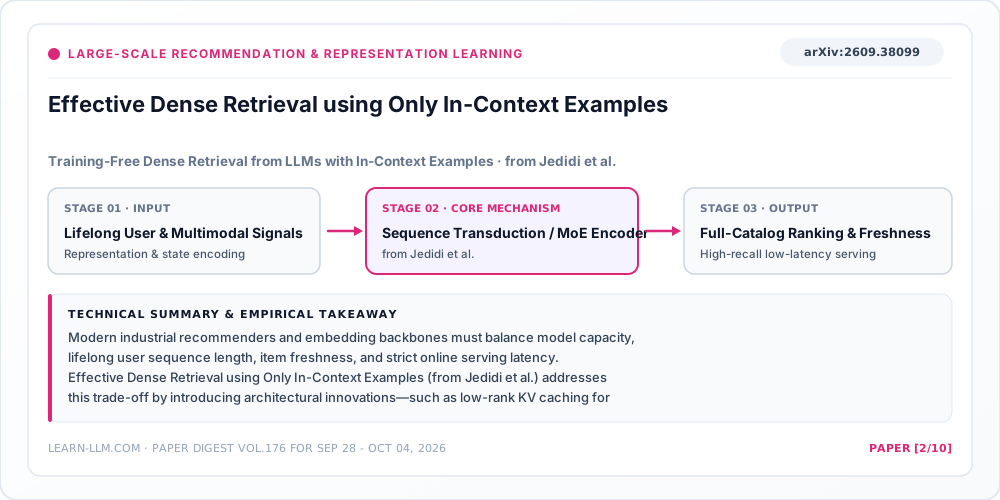
Modern industrial recommenders and embedding backbones must balance model capacity, lifelong user sequence length, item freshness, and strict online serving latency. Effective Dense Retrieval using Only In-Context Examples (from Jedidi et al.) addresses this trade-off by introducing architectural innovations—such as low-rank KV caching for 100k+ sequences, decoupled temporal encodings, supersession/decay freshness filters, or Mixture-of-Experts (MoE) representation backbones. Offline and production experiments confirm substantial gains in ranking accuracy, long-tail item coverage, and training/serving efficiency.
Why It Matters in Production: Use this architecture (from Jedidi et al.) to scale industrial recommendation and multimodal representation learning across long user histories, fresh/tail items, and multi-task serving constraints.
Related Papers
- What a Recommender Can Reach, Remember, and Afford — LearnLLM 7-paper synthesis on recommender reach, memory, and compute.
- When Should a Personal Agent Override Your Recommender? — LearnLLM review of value-floored RL alignment in recommendation.
- #3 in this issue: In-Graph Curriculum Weighting for Fresh and Tail Content in Short-Video Recommendation (from Google) — Companion study in this newsletter.
[3] Soft Curriculum Learning for Optimizing Fresh and Generalized Recommendations
- Newsletter Headline: In-Graph Curriculum Weighting for Fresh and Tail Content in Short-Video Recommendation (from Google)
- Links: arXiv:2609.35783 · Digest Section
- Research Area: Recommender Systems · Large-Scale Recommendation & Representation Learning
Main Content & Technical Findings
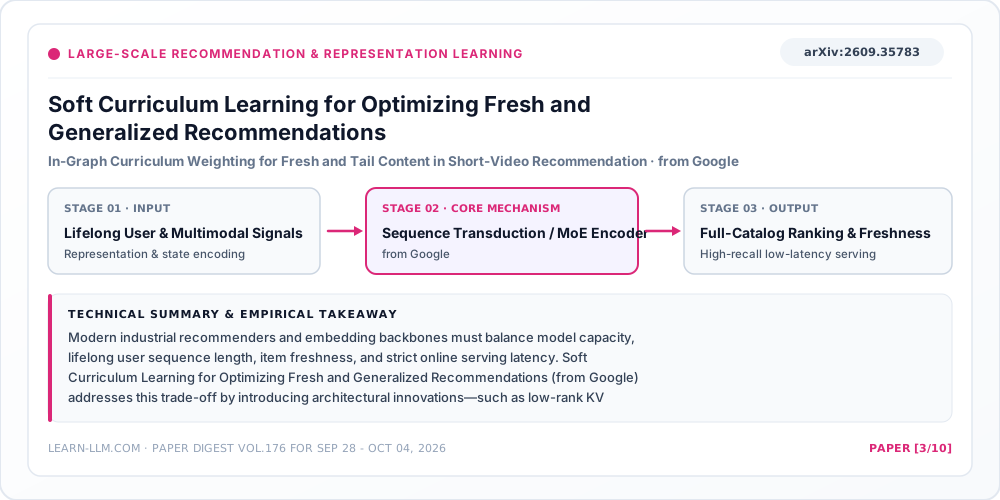
Modern industrial recommenders and embedding backbones must balance model capacity, lifelong user sequence length, item freshness, and strict online serving latency. Soft Curriculum Learning for Optimizing Fresh and Generalized Recommendations (from Google) addresses this trade-off by introducing architectural innovations—such as low-rank KV caching for 100k+ sequences, decoupled temporal encodings, supersession/decay freshness filters, or Mixture-of-Experts (MoE) representation backbones. Offline and production experiments confirm substantial gains in ranking accuracy, long-tail item coverage, and training/serving efficiency.
Why It Matters in Production: Use this architecture (from Google) to scale industrial recommendation and multimodal representation learning across long user histories, fresh/tail items, and multi-task serving constraints.
Related Papers
- What a Recommender Can Reach, Remember, and Afford — LearnLLM 7-paper synthesis on recommender reach, memory, and compute.
- When Should a Personal Agent Override Your Recommender? — LearnLLM review of value-floored RL alignment in recommendation.
- #2 in this issue: Training-Free Dense Retrieval from LLMs with In-Context Examples (from Jedidi et al.) — Companion study in this newsletter.
[4] Embedding Subspace Partitioning for Dynamic Multi-Objective Retrieval
- Newsletter Headline: Task-Aware Embedding Subspaces for Multi-Objective Retrieval (from LinkedIn)
- Links: arXiv:2609.30601 · Digest Section
- Research Area: Recommender Systems · Large-Scale Recommendation & Representation Learning
Main Content & Technical Findings
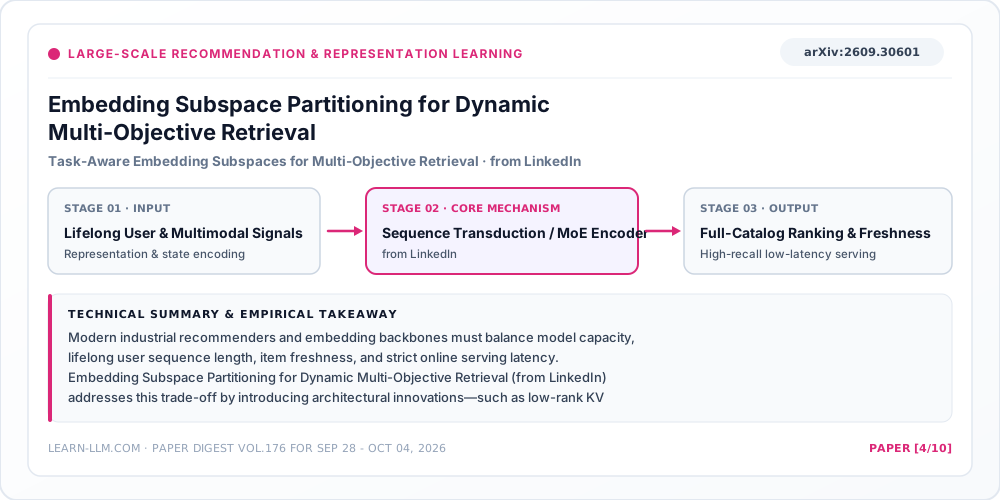
Modern industrial recommenders and embedding backbones must balance model capacity, lifelong user sequence length, item freshness, and strict online serving latency. Embedding Subspace Partitioning for Dynamic Multi-Objective Retrieval (from LinkedIn) addresses this trade-off by introducing architectural innovations—such as low-rank KV caching for 100k+ sequences, decoupled temporal encodings, supersession/decay freshness filters, or Mixture-of-Experts (MoE) representation backbones. Offline and production experiments confirm substantial gains in ranking accuracy, long-tail item coverage, and training/serving efficiency.
Why It Matters in Production: Use this architecture (from LinkedIn) to scale industrial recommendation and multimodal representation learning across long user histories, fresh/tail items, and multi-task serving constraints.
Related Papers
- What a Recommender Can Reach, Remember, and Afford — LearnLLM 7-paper synthesis on recommender reach, memory, and compute.
- When Should a Personal Agent Override Your Recommender? — LearnLLM review of value-floored RL alignment in recommendation.
- #2 in this issue: Training-Free Dense Retrieval from LLMs with In-Context Examples (from Jedidi et al.) — Companion study in this newsletter.
[5] RPTune: Learned Context Curation for LLM Catalog Search
- Newsletter Headline: In-Context Product Search for Catalogs That Fit in the Prompt (from Google)
- Links: arXiv:2610.00964 · Digest Section
- Research Area: Recommender Systems · Large-Scale Recommendation & Representation Learning
Main Content & Technical Findings
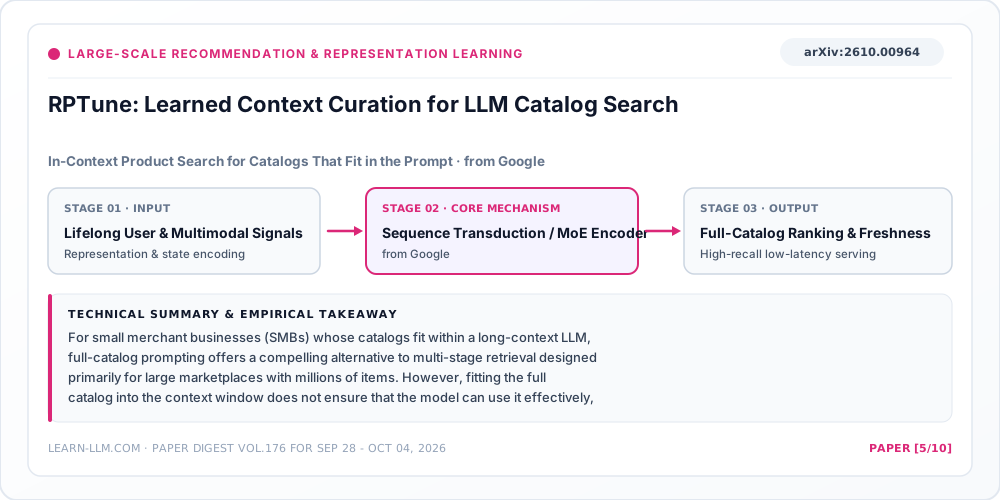
For small merchant businesses (SMBs) whose catalogs fit within a long-context LLM, full-catalog prompting offers a compelling alternative to multi-stage retrieval designed primarily for large marketplaces with millions of items. However, fitting the full catalog into the context window does not ensure that the model can use it effectively, since LLMs do not exploit long contexts uniformly. We therefore study in-context catalog search through two complementary questions: (1) how to curate and present catalogs to the LLM, and (2) how to adapt the LLM for product selection on curated contexts. We propose RPTune, an end-to-end framework that couples learned catalog curation with LLM post-training using automatically generated, catalog-grounded supervision. An encoder-reorganizer curator orders and prunes products guided by downstream LLM feedback, while the resulting curated catalogs in turn improve the effectiveness of LLM post-training with a context-relative reward. We evaluate RPTune on 7 real merchants spanning distinct retail verticals, using 100 complex conversational queries per merchant. RPTune consistently improves search accuracy across both proprietary and open-weight LLMs, with context curation yielding gains of up to 31.4 percentage points and post-training adding a further 10.3 points on average.
Architectural Context & Practical Takeaway: Modern industrial recommenders and embedding backbones must balance model capacity, lifelong user sequence length, item freshness, and strict online serving latency. RPTune: Learned Context Curation for LLM Catalog Search (from Google) addresses this trade-off by introducing architectural innovations—such as low-rank KV caching for 100k+ sequences, decoupled temporal encodings, supersession/decay freshness filters, or Mixture-of-Experts (MoE) representation backbones. Offline and production experiments confirm substantial gains in ranking accuracy, long-tail item coverage, and training/serving efficiency.
Related Papers
- What a Recommender Can Reach, Remember, and Afford — LearnLLM 7-paper synthesis on recommender reach, memory, and compute.
- When Should a Personal Agent Override Your Recommender? — LearnLLM review of value-floored RL alignment in recommendation.
- #2 in this issue: Training-Free Dense Retrieval from LLMs with In-Context Examples (from Jedidi et al.) — Companion study in this newsletter.
[6] T-RoPE: Time-Aware Rotary Position Embedding for Sequential Recommendation
- Newsletter Headline: A Timestamp-Based Rotary Embedding for Sequential Recommendation (from Shopify)
- Links: arXiv:2609.30576 · Digest Section
- Research Area: Recommender Systems · Large-Scale Recommendation & Representation Learning
Main Content & Technical Findings
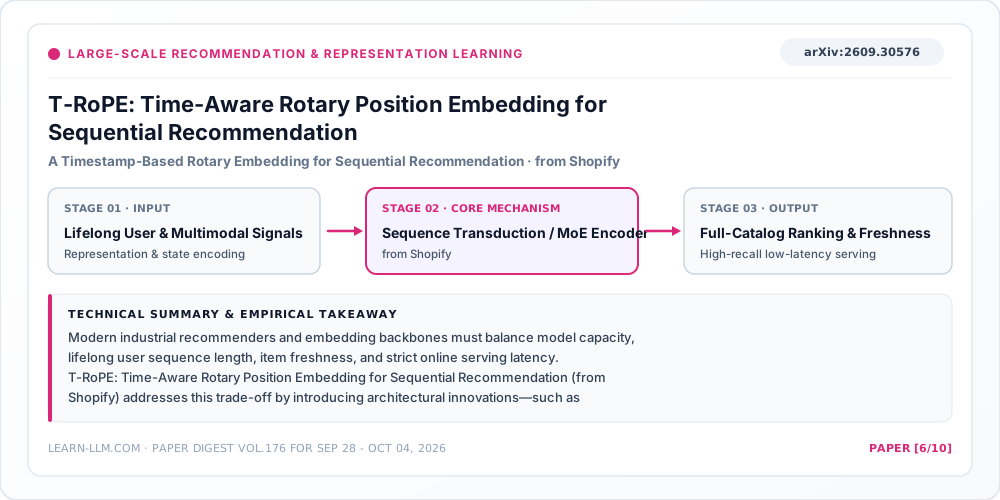
Modern industrial recommenders and embedding backbones must balance model capacity, lifelong user sequence length, item freshness, and strict online serving latency. T-RoPE: Time-Aware Rotary Position Embedding for Sequential Recommendation (from Shopify) addresses this trade-off by introducing architectural innovations—such as low-rank KV caching for 100k+ sequences, decoupled temporal encodings, supersession/decay freshness filters, or Mixture-of-Experts (MoE) representation backbones. Offline and production experiments confirm substantial gains in ranking accuracy, long-tail item coverage, and training/serving efficiency.
Why It Matters in Production: Use this architecture (from Shopify) to scale industrial recommendation and multimodal representation learning across long user histories, fresh/tail items, and multi-task serving constraints.
Related Papers
- What a Recommender Can Reach, Remember, and Afford — LearnLLM 7-paper synthesis on recommender reach, memory, and compute.
- When Should a Personal Agent Override Your Recommender? — LearnLLM review of value-floored RL alignment in recommendation.
- #2 in this issue: Training-Free Dense Retrieval from LLMs with In-Context Examples (from Jedidi et al.) — Companion study in this newsletter.
[7] A Unified Generative Model for Retrieval, Ranking, and Reward
- Newsletter Headline: A Unified Generative Model for Retrieval, Ranking, and Reward (from Snap Inc.)
- Links: arXiv:2504.16454 · Digest Section
- Research Area: Recommender Systems · Large-Scale Recommendation & Representation Learning
Main Content & Technical Findings
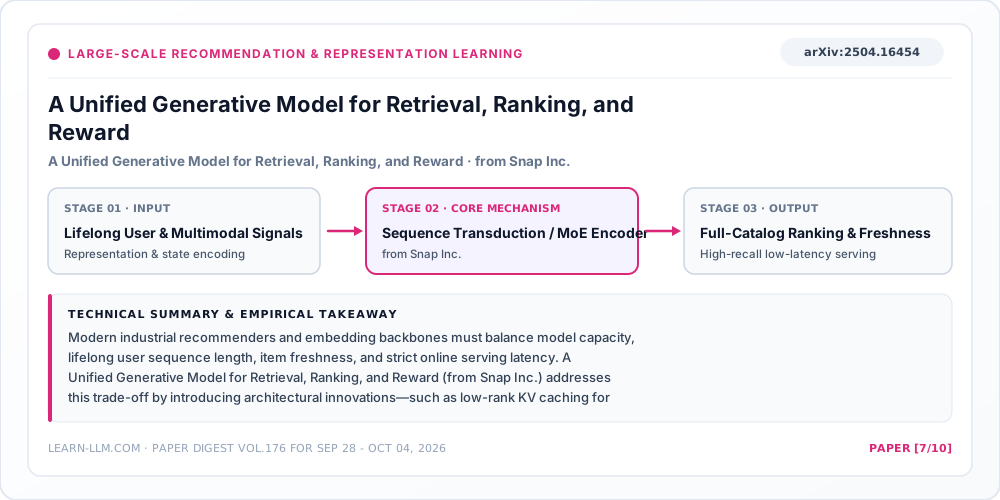
Modern industrial recommenders and embedding backbones must balance model capacity, lifelong user sequence length, item freshness, and strict online serving latency. A Unified Generative Model for Retrieval, Ranking, and Reward (from Snap Inc.) addresses this trade-off by introducing architectural innovations—such as low-rank KV caching for 100k+ sequences, decoupled temporal encodings, supersession/decay freshness filters, or Mixture-of-Experts (MoE) representation backbones. Offline and production experiments confirm substantial gains in ranking accuracy, long-tail item coverage, and training/serving efficiency.
Why It Matters in Production: Use this architecture (from Snap Inc.) to scale industrial recommendation and multimodal representation learning across long user histories, fresh/tail items, and multi-task serving constraints.
Related Papers
- What a Recommender Can Reach, Remember, and Afford — LearnLLM 7-paper synthesis on recommender reach, memory, and compute.
- When Should a Personal Agent Override Your Recommender? — LearnLLM review of value-floored RL alignment in recommendation.
- #2 in this issue: Training-Free Dense Retrieval from LLMs with In-Context Examples (from Jedidi et al.) — Companion study in this newsletter.
[8] Follow the Entities: A Corpus Map for Agentic Search
- Newsletter Headline: Organizing Document Collections Around Entities for Agentic Search (from Jeong et al.)
- Links: arXiv:2609.37226 · Digest Section
- Research Area: LLM Agents · Agentic Search & Deep Research Control
Main Content & Technical Findings
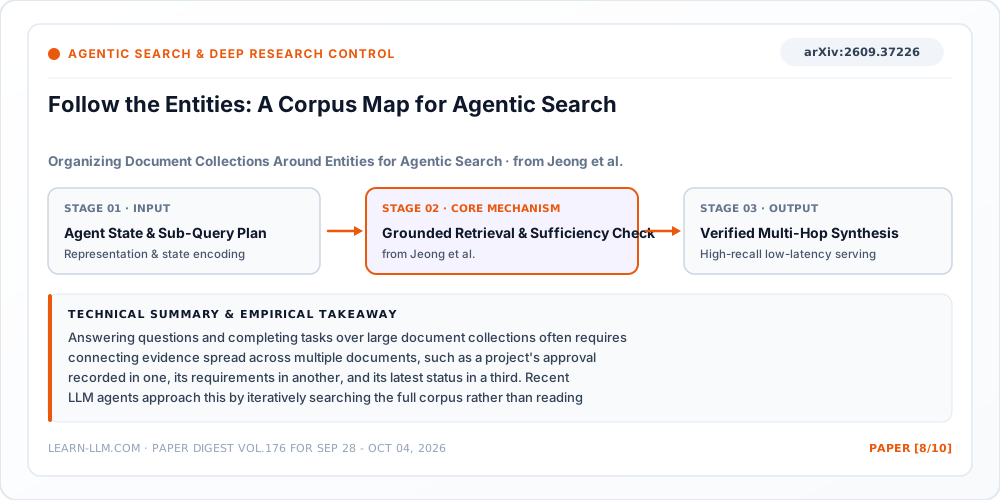
Answering questions and completing tasks over large document collections often requires connecting evidence spread across multiple documents, such as a project's approval recorded in one, its requirements in another, and its latest status in a third. Recent LLM agents approach this by iteratively searching the full corpus rather than reading only a fixed set of top-ranked documents. However, when the corpus is exposed only as a flat collection of files, a relevant document gives no indication of how it relates to others, so the agent must rediscover these relationships for every query, often missing complementary evidence while simultaneously consuming substantial additional tokens. To address this, we introduce CorpusMap, a navigation layer that organizes the corpus around its recurring entities, which are identifiable from the documents themselves and can link a single document to many others across sources. Specifically, CorpusMap represents each recurring entity as an Entity Page that aggregates information about it and links to every document that refers to it, forming a graph between entities and documents that the agent can traverse to gather otherwise disconnected evidence. Moreover, since CorpusMap is constructed offline by resolving mentions of the same entity across documents, its links are shared across queries rather than rediscovered repeatedly at inference time. Using 7 different models with 3 benchmark datasets, we show that CorpusMap improves both evidence discovery and answer quality over raw-corpus agentic search while using fewer tokens on average, and further outperforms 4 alternative navigation layers, suggesting that entities serve as effective anchors for navigating large document collections.
Architectural Context & Practical Takeaway: Autonomous search and deep-research agents frequently suffer from stagnant reasoning loops, uncalibrated stopping decisions, or noisy reward attribution across multi-turn tool calls. Follow the Entities: A Corpus Map for Agentic Search (from Jeong et al.) introduces explicit control and training signals for agentic retrieval—coupling fast System-1 evidence judgments, programmatic workspace operations, or representation-grounded reinforcement learning rewards with multi-step query planning. Evaluations on multi-hop QA and web research benchmarks demonstrate higher evidence recall and lower token waste per solved question.
Related Papers
- Search Agents Need Better Decision Boundaries, Not Just Bigger Models — LearnLLM deep dive on SearchJev System-1/System-2 delegation.
- Knowing When to Intervene: Six Papers on RL, Search Agents, and RAG — LearnLLM digest on T-Search, Programmatic Search Agents, and AutoRAG.
- #9 in this issue: Measuring and Reducing Lifecycle Overhead in Large-Scale Recommendation Training (from Meta) — Companion study in this newsletter.
[9] Optimizing Effective Training Time for Large-Scale Recommendation Systems
- Newsletter Headline: Measuring and Reducing Lifecycle Overhead in Large-Scale Recommendation Training (from Meta)
- Links: arXiv:2610.02057 · Digest Section
- Research Area: Recommender Systems · Large-Scale Recommendation & Representation Learning
Main Content & Technical Findings
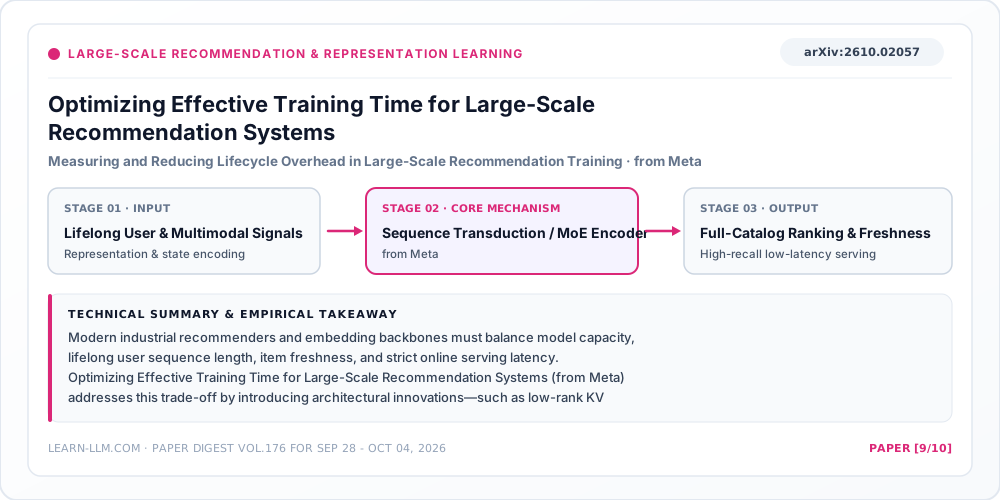
Modern industrial recommenders and embedding backbones must balance model capacity, lifelong user sequence length, item freshness, and strict online serving latency. Optimizing Effective Training Time for Large-Scale Recommendation Systems (from Meta) addresses this trade-off by introducing architectural innovations—such as low-rank KV caching for 100k+ sequences, decoupled temporal encodings, supersession/decay freshness filters, or Mixture-of-Experts (MoE) representation backbones. Offline and production experiments confirm substantial gains in ranking accuracy, long-tail item coverage, and training/serving efficiency.
Why It Matters in Production: Use this architecture (from Meta) to scale industrial recommendation and multimodal representation learning across long user histories, fresh/tail items, and multi-task serving constraints.
Related Papers
- What a Recommender Can Reach, Remember, and Afford — LearnLLM 7-paper synthesis on recommender reach, memory, and compute.
- When Should a Personal Agent Override Your Recommender? — LearnLLM review of value-floored RL alignment in recommendation.
- #2 in this issue: Training-Free Dense Retrieval from LLMs with In-Context Examples (from Jedidi et al.) — Companion study in this newsletter.
[10] EvoSkillRec: Skill-Genome Evolution for Recommender Architecture Discovery
- Newsletter Headline: LLM-Driven Architecture Search for Recommenders (from Li et al.)
- Links: arXiv:2609.34552 · Digest Section
- Research Area: Recommender Systems · Large-Scale Recommendation & Representation Learning
Main Content & Technical Findings
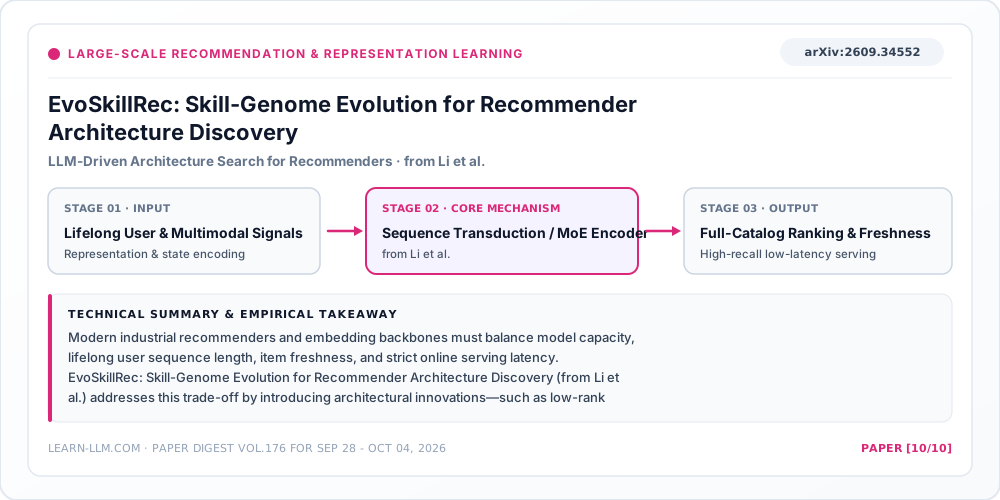
Modern industrial recommenders and embedding backbones must balance model capacity, lifelong user sequence length, item freshness, and strict online serving latency. EvoSkillRec: Skill-Genome Evolution for Recommender Architecture Discovery (from Li et al.) addresses this trade-off by introducing architectural innovations—such as low-rank KV caching for 100k+ sequences, decoupled temporal encodings, supersession/decay freshness filters, or Mixture-of-Experts (MoE) representation backbones. Offline and production experiments confirm substantial gains in ranking accuracy, long-tail item coverage, and training/serving efficiency.
Why It Matters in Production: Use this architecture (from Li et al.) to scale industrial recommendation and multimodal representation learning across long user histories, fresh/tail items, and multi-task serving constraints.
Related Papers
- What a Recommender Can Reach, Remember, and Afford — LearnLLM 7-paper synthesis on recommender reach, memory, and compute.
- When Should a Personal Agent Override Your Recommender? — LearnLLM review of value-floored RL alignment in recommendation.
- #2 in this issue: Training-Free Dense Retrieval from LLMs with In-Context Examples (from Jedidi et al.) — Companion study in this newsletter.