Vol179 · Fixed-budget Late Interaction, Freezing Semantic IDs for Generative Retrieval Under Item Churn
Vol179 for Oct 19 - Oct 25, 2026: Structured digest of 10 papers including Fixed-Budget Late Interaction for Long and Complex Queries; Item-Level Adaptive Depth for Sequential Recommendation; Effective Text Retrieval by Unifying Dense and Late-Interaction Retrieval. Includes a quick-reference paper list, one-sentence practical use cases, figure screenshots, and related literature.
Paper List & One-Sentence Practical Guide
This issue (Vol179 for Oct 19 - Oct 25, 2026) covers 10 papers across information retrieval, generative recommendation, Semantic IDs, LLM reranking, and agentic search. Start with the quick-reference list below to see what each paper is useful for and which related papers to read alongside it, or jump directly to any paper's detailed section and architecture screenshot.
Fixed-Budget Late Interaction for Long and Complex Queries (from Handa et al.) — Paper
- What it's useful for: Use this framework (from Handa et al.) to cut the memory footprint, CPU–GPU transfer overhead, and MaxSim scoring latency of ColBERT-style multi-vector retrievers while retaining fine-grained token matching.
- Related papers: ColBERTv2: Effective and Efficient Retrieval via Lightweight Late Interaction · Knowing When to Intervene: RL, Search Agents, and RAG · Also in this issue: #3 Effective Text Retrieval by Unifying Dense and Late-Interaction Retrieval
Item-Level Adaptive Depth for Sequential Recommendation (from Cao et al.) — Paper
- What it's useful for: Use this architecture (from Cao et al.) to scale industrial recommendation and multimodal representation learning across long user histories, fresh/tail items, and multi-task serving constraints.
- Related papers: What a Recommender Can Reach, Remember, and Afford · When Should a Personal Agent Override Your Recommender? · Also in this issue: #4 Freezing Semantic IDs for Generative Retrieval Under Item Churn
Effective Text Retrieval by Unifying Dense and Late-Interaction Retrieval (from Abdallah et al.) — Paper
- What it's useful for: Use this framework (from Abdallah et al.) to cut the memory footprint, CPU–GPU transfer overhead, and MaxSim scoring latency of ColBERT-style multi-vector retrievers while retaining fine-grained token matching.
- Related papers: ColBERTv2: Effective and Efficient Retrieval via Lightweight Late Interaction · Knowing When to Intervene: RL, Search Agents, and RAG · Also in this issue: #1 Fixed-Budget Late Interaction for Long and Complex Queries
Freezing Semantic IDs for Generative Retrieval Under Item Churn (from Alibaba) — Paper
- What it's useful for: Use this method (from Alibaba) to construct and decode discrete Semantic IDs that preserve collaborative and semantic item topology without codebook collapse or item-churn drift.
- Related papers: TIGER: Recommender Systems with Generative Retrieval · A Semantic Tokenizer Cannot Be Judged Without Its Decoder (FLASH) · Also in this issue: #2 Item-Level Adaptive Depth for Sequential Recommendation
Representation Distillation for Multimodal Late-Interaction Retrieval (from Perplexity AI) — Paper
- What it's useful for: Use this framework (from Perplexity AI) to cut the memory footprint, CPU–GPU transfer overhead, and MaxSim scoring latency of ColBERT-style multi-vector retrievers while retaining fine-grained token matching.
- Related papers: ColBERTv2: Effective and Efficient Retrieval via Lightweight Late Interaction · Knowing When to Intervene: RL, Search Agents, and RAG · Also in this issue: #1 Fixed-Budget Late Interaction for Long and Complex Queries
Recovering Long-Tail Items in Generative Recommenders Without Retraining (from Huang et al.) — Paper
- What it's useful for: Use this architecture (from Huang et al.) to scale industrial recommendation and multimodal representation learning across long user histories, fresh/tail items, and multi-task serving constraints.
- Related papers: What a Recommender Can Reach, Remember, and Afford · When Should a Personal Agent Override Your Recommender? · Also in this issue: #2 Item-Level Adaptive Depth for Sequential Recommendation
Training Search Agents to Write Their Own Retrieval Pipelines (from Meta) — Paper
- What it's useful for: Use this agentic search recipe (from Meta) to train or control multi-step research agents with grounded rewards, fast sufficiency judgments, and programmatic evidence filtering.
- Related papers: Search Agents Need Better Decision Boundaries, Not Just Bigger Models · Knowing When to Intervene: Six Papers on RL, Search Agents, and RAG · Also in this issue: #8 Self-Assessment as a Training Signal for Search Agents
Self-Assessment as a Training Signal for Search Agents (from Lee et al.) — Paper
- What it's useful for: Use this agentic search recipe (from Lee et al.) to train or control multi-step research agents with grounded rewards, fast sufficiency judgments, and programmatic evidence filtering.
- Related papers: Search Agents Need Better Decision Boundaries, Not Just Bigger Models · Knowing When to Intervene: Six Papers on RL, Search Agents, and RAG · Also in this issue: #7 Training Search Agents to Write Their Own Retrieval Pipelines
Coupling Semantic ID Construction and History Supervision in Generative Recommenders (from Wei et al.) — Paper
- What it's useful for: Use this method (from Wei et al.) to construct and decode discrete Semantic IDs that preserve collaborative and semantic item topology without codebook collapse or item-churn drift.
- Related papers: TIGER: Recommender Systems with Generative Retrieval · A Semantic Tokenizer Cannot Be Judged Without Its Decoder (FLASH) · Also in this issue: #2 Item-Level Adaptive Depth for Sequential Recommendation
Explicit Memory versus Raw-History Retrieval for Long-Term Conversational Agents (from Zhou et al.) — Paper
- What it's useful for: Use this study (from Zhou et al.) to decide when structured agent memory or parametric self-distillation pays off over fast raw-history search, avoiding unnecessary memory extraction overhead.
- Related papers: Lineage Is Memory: Parent Inheritance and Feedback Disclosure · Harness²: What an Agent Can Learn by Changing Its Harness · Also in this issue: #7 Training Search Agents to Write Their Own Retrieval Pipelines
Detailed Paper Sections
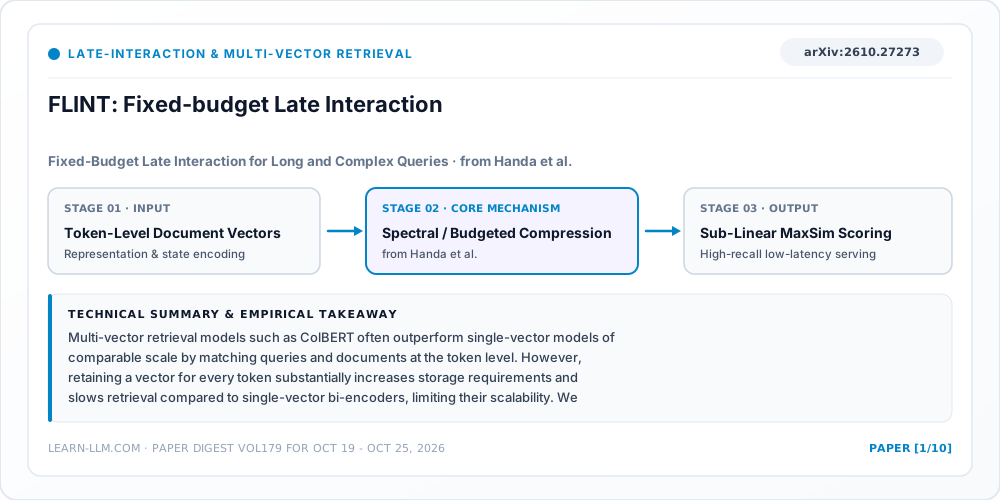
[1] FLINT: Fixed-budget Late Interaction
- Newsletter Headline: Fixed-Budget Late Interaction for Long and Complex Queries (from Handa et al.)
- Links: arXiv:2610.27273 · Digest Section
- Research Area: Retrieval-Augmented Generation · Late-Interaction & Multi-Vector Retrieval
Main Content & Technical Findings
Multi-vector retrieval models such as ColBERT often outperform single-vector models of comparable scale by matching queries and documents at the token level. However, retaining a vector for every token substantially increases storage requirements and slows retrieval compared to single-vector bi-encoders, limiting their scalability. We introduce FLINT (Fixed-budget Late INTeraction), an architecture that uses attention-based pooling to represent each query and document with a fixed number of embedding vectors. Unlike architectures that pool only document representations while retaining token-level queries, FLINT applies pooling symmetrically to both sides, limiting document storage and the number of vector comparisons needed during retrieval. FLINT achieves comparable ranking effectiveness to the closest baselines on BEIR and outperforms them on several benchmarks with longer and more complex queries, including BrowseComp+, CRUMB, and TREC Tip-of-the-Tongue 2025. We demonstrate that FLINT's effectiveness-efficiency benefits extend across encoder architectures, testing it on two separate backbones (BERT and ModernBERT). On long-query corpora, FLINT delivers 1.5-2.8 times faster end-to-end retrieval than ConstBERT, the closest baseline. FLINT also reduces index size by 5.3-9.3 times relative to token-level late-interaction models such as ColBERTv2.
Architectural Context & Practical Takeaway: Multi-vector late-interaction retrievers (such as ColBERT and ColPali) achieve strong out-of-domain generalization by storing per-token embeddings and computing exact or approximate MaxSim operators, but their index footprint and query latency scale poorly with document length and collection size. FLINT: Fixed-budget Late Interaction (from Handa et al.) targets this bottleneck by compressing token subspaces, bounding interaction budgets, or co-scheduling GPU–CPU candidate pruning. Empirical benchmarks show that preserving dominant token directions or fixed-budget phrase units captures nearly all of full MaxSim relevance at a fraction of the storage and I/O cost.
Related Papers
- ColBERTv2: Effective and Efficient Retrieval via Lightweight Late Interaction — Residual compression baseline for token-level late interaction.
- Knowing When to Intervene: RL, Search Agents, and RAG — LearnLLM digest on retrieval efficiency and adaptive pooling.
- #3 in this issue: Effective Text Retrieval by Unifying Dense and Late-Interaction Retrieval (from Abdallah et al.) — Companion study in this newsletter.
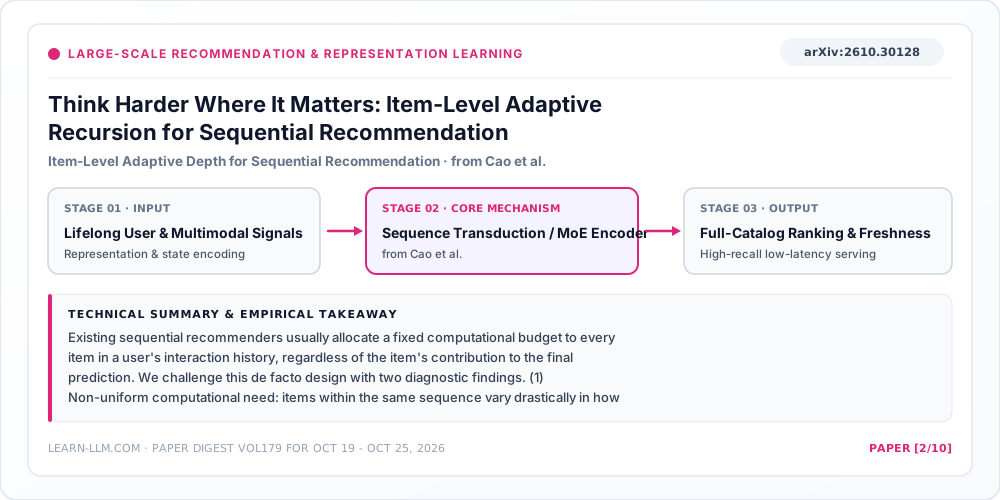
[2] Think Harder Where It Matters: Item-Level Adaptive Recursion for Sequential Recommendation
- Newsletter Headline: Item-Level Adaptive Depth for Sequential Recommendation (from Cao et al.)
- Links: arXiv:2610.30128 · Digest Section
- Research Area: Recommender Systems · Large-Scale Recommendation & Representation Learning
Main Content & Technical Findings
Existing sequential recommenders usually allocate a fixed computational budget to every item in a user's interaction history, regardless of the item's contribution to the final prediction. We challenge this de facto design with two diagnostic findings. (1) Non-uniform computational need: items within the same sequence vary drastically in how much computation they require. Most converge after shallow processing while a critical minority only stabilizes at full depth. (2) Suboptimality of fixed allocation: given oracle access to the target item, a non-uniform depth assignment consistently outranks the fixed one, indicating that existing uniform computation both wastes capacity on already-converged items and sacrifices overall recommendation quality. These observations motivate a shift from fixed-depth computation to item-level adaptive reasoning. To this end, we propose LoopRec. LoopRec recursively applies a single weight-shared block and introduces a lightweight gate at each recursion boundary that makes a binary exit-or-continue decision for every item independently. Items whose representations have sufficiently matured exit early, while those requiring deeper reasoning continue to subsequent recursions. This design converts the fixed global depth into a learned, per-item property without auxiliary depth labels, and is readily adaptable to diverse backbone architectures. Extensive experiments on public benchmarks with four backbone families demonstrate that LoopRec consistently outperforms matched fixed-depth counterparts. Further analysis reveals that LoopRec's learned allocation exhibits interpretable patterns aligned with our post-hoc oracle analysis: lower-frequency items and more recent interactions naturally receive deeper computation. Our code is available at https://github.com/Elpmis117/LoopRec.
Architectural Context & Practical Takeaway: Modern industrial recommenders and embedding backbones must balance model capacity, lifelong user sequence length, item freshness, and strict online serving latency. Think Harder Where It Matters: Item-Level Adaptive Recursion for Sequential Recommendation (from Cao et al.) addresses this trade-off by introducing architectural innovations—such as low-rank KV caching for 100k+ sequences, decoupled temporal encodings, supersession/decay freshness filters, or Mixture-of-Experts (MoE) representation backbones. Offline and production experiments confirm substantial gains in ranking accuracy, long-tail item coverage, and training/serving efficiency.
Related Papers
- What a Recommender Can Reach, Remember, and Afford — LearnLLM 7-paper synthesis on recommender reach, memory, and compute.
- When Should a Personal Agent Override Your Recommender? — LearnLLM review of value-floored RL alignment in recommendation.
- #6 in this issue: Recovering Long-Tail Items in Generative Recommenders Without Retraining (from Huang et al.) — Companion study in this newsletter.
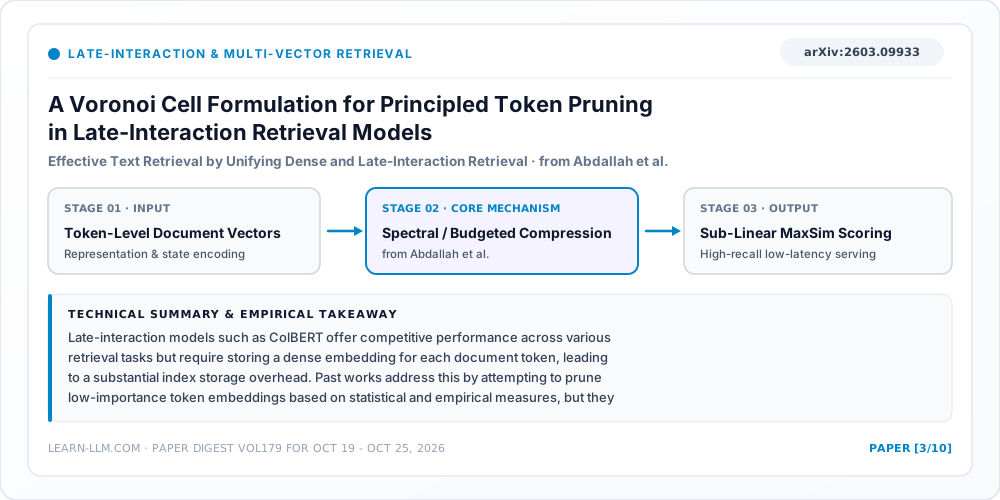
[3] A Voronoi Cell Formulation for Principled Token Pruning in Late-Interaction Retrieval Models
- Newsletter Headline: Effective Text Retrieval by Unifying Dense and Late-Interaction Retrieval (from Abdallah et al.)
- Links: arXiv:2603.09933 · Digest Section
- Research Area: Retrieval-Augmented Generation · Late-Interaction & Multi-Vector Retrieval
Main Content & Technical Findings
Late-interaction models such as ColBERT offer competitive performance across various retrieval tasks but require storing a dense embedding for each document token, leading to a substantial index storage overhead. Past works address this by attempting to prune low-importance token embeddings based on statistical and empirical measures, but they often either lack formal grounding or are ineffective. To address these shortcomings, we introduce a framework grounded in hyperspace geometry and cast token pruning as a Voronoi cell estimation problem in the embedding space. By interpreting each token's influence as a measure of its Voronoi region, our approach enables principled pruning that retains retrieval quality while reducing index size. Through our experiments, we demonstrate that this approach serves not only as a competitive pruning strategy but also as a valuable tool for improving and interpreting token-level behavior within dense retrieval systems.
Architectural Context & Practical Takeaway: Multi-vector late-interaction retrievers (such as ColBERT and ColPali) achieve strong out-of-domain generalization by storing per-token embeddings and computing exact or approximate MaxSim operators, but their index footprint and query latency scale poorly with document length and collection size. A Voronoi Cell Formulation for Principled Token Pruning in Late-Interaction Retrieval Models (from Abdallah et al.) targets this bottleneck by compressing token subspaces, bounding interaction budgets, or co-scheduling GPU–CPU candidate pruning. Empirical benchmarks show that preserving dominant token directions or fixed-budget phrase units captures nearly all of full MaxSim relevance at a fraction of the storage and I/O cost.
Related Papers
- ColBERTv2: Effective and Efficient Retrieval via Lightweight Late Interaction — Residual compression baseline for token-level late interaction.
- Knowing When to Intervene: RL, Search Agents, and RAG — LearnLLM digest on retrieval efficiency and adaptive pooling.
- #1 in this issue: Fixed-Budget Late Interaction for Long and Complex Queries (from Handa et al.) — Companion study in this newsletter.
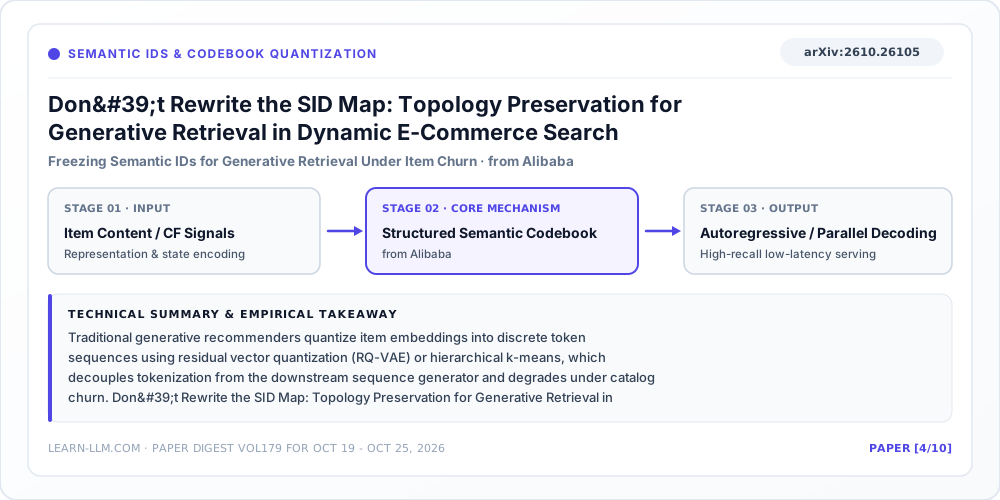
[4] Don't Rewrite the SID Map: Topology Preservation for Generative Retrieval in Dynamic E-Commerce Search
- Newsletter Headline: Freezing Semantic IDs for Generative Retrieval Under Item Churn (from Alibaba)
- Links: arXiv:2610.26105 · Digest Section
- Research Area: Recommender Systems · Semantic IDs & Codebook Quantization
Main Content & Technical Findings
Traditional generative recommenders quantize item embeddings into discrete token sequences using residual vector quantization (RQ-VAE) or hierarchical k-means, which decouples tokenization from the downstream sequence generator and degrades under catalog churn. Don't Rewrite the SID Map: Topology Preservation for Generative Retrieval in Dynamic E-Commerce Search (from Alibaba) introduces a structure-aware tokenization and decoding recipe that aligns codebook assignments with collaborative user-item signals and decoding dynamics. By coupling code structure with sequence generation, the model prevents prefix collisions on popular items while preserving recall on long-tail and newly ingested catalog entries.
Why It Matters in Production: Use this method (from Alibaba) to construct and decode discrete Semantic IDs that preserve collaborative and semantic item topology without codebook collapse or item-churn drift.
Related Papers
- TIGER: Recommender Systems with Generative Retrieval — Foundational RQ-VAE Semantic ID generative recommender.
- A Semantic Tokenizer Cannot Be Judged Without Its Decoder (FLASH) — LearnLLM deep dive on SimHash parallel decoding & alignment.
- Reachability Is Not Ranking: Finite Beams & Continuous Queries — LearnLLM analysis of beam reachability vs. ranking in SID models.
- #9 in this issue: Coupling Semantic ID Construction and History Supervision in Generative Recommenders (from Wei et al.) — Companion study in this newsletter.
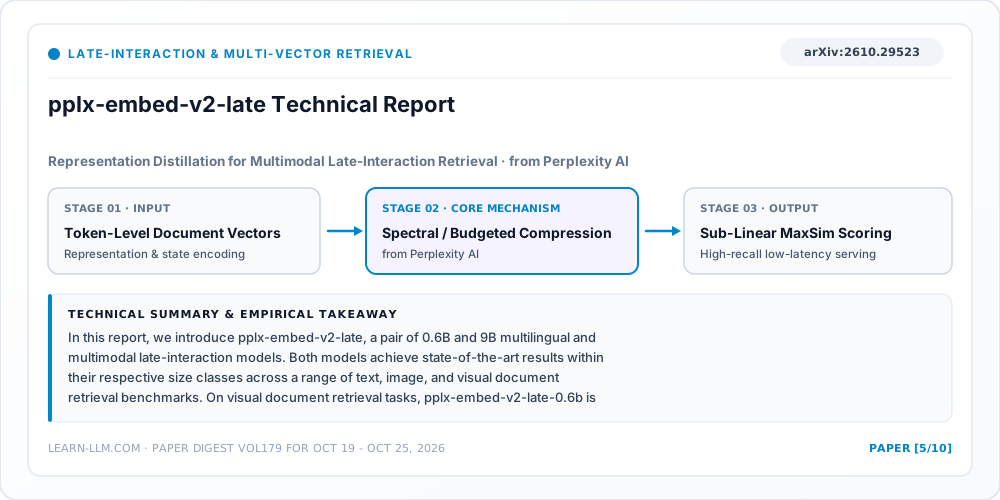
[5] pplx-embed-v2-late Technical Report
- Newsletter Headline: Representation Distillation for Multimodal Late-Interaction Retrieval (from Perplexity AI)
- Links: arXiv:2610.29523 · Digest Section
- Research Area: Retrieval-Augmented Generation · Late-Interaction & Multi-Vector Retrieval
Main Content & Technical Findings
In this report, we introduce pplx-embed-v2-late, a pair of 0.6B and 9B multilingual and multimodal late-interaction models. Both models achieve state-of-the-art results within their respective size classes across a range of text, image, and visual document retrieval benchmarks. On visual document retrieval tasks, pplx-embed-v2-late-0.6b is competitive with models several times larger than itself. The models are trained via representation distillation from an 18B teacher. Consequently, they share an embedding space that supports asymmetric deployment: documents can be indexed with the 9B model and queried with the low-latency 0.6B model. Both models are available at https://huggingface.co/collections/perplexity-ai/pplx-embed-v2.
Architectural Context & Practical Takeaway: Multi-vector late-interaction retrievers (such as ColBERT and ColPali) achieve strong out-of-domain generalization by storing per-token embeddings and computing exact or approximate MaxSim operators, but their index footprint and query latency scale poorly with document length and collection size. pplx-embed-v2-late Technical Report (from Perplexity AI) targets this bottleneck by compressing token subspaces, bounding interaction budgets, or co-scheduling GPU–CPU candidate pruning. Empirical benchmarks show that preserving dominant token directions or fixed-budget phrase units captures nearly all of full MaxSim relevance at a fraction of the storage and I/O cost.
Related Papers
- ColBERTv2: Effective and Efficient Retrieval via Lightweight Late Interaction — Residual compression baseline for token-level late interaction.
- Knowing When to Intervene: RL, Search Agents, and RAG — LearnLLM digest on retrieval efficiency and adaptive pooling.
- #1 in this issue: Fixed-Budget Late Interaction for Long and Complex Queries (from Handa et al.) — Companion study in this newsletter.
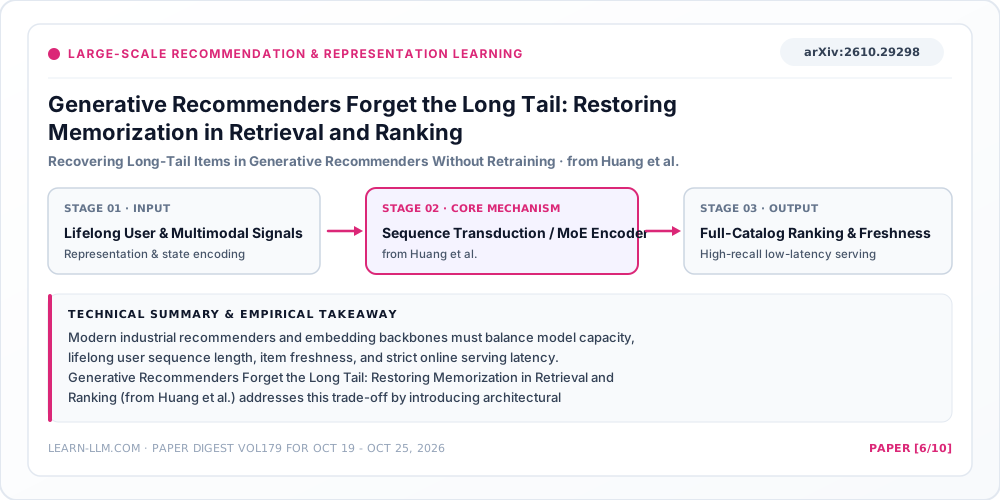
[6] Generative Recommenders Forget the Long Tail: Restoring Memorization in Retrieval and Ranking
- Newsletter Headline: Recovering Long-Tail Items in Generative Recommenders Without Retraining (from Huang et al.)
- Links: arXiv:2610.29298 · Digest Section
- Research Area: Recommender Systems · Large-Scale Recommendation & Representation Learning
Main Content & Technical Findings
Modern industrial recommenders and embedding backbones must balance model capacity, lifelong user sequence length, item freshness, and strict online serving latency. Generative Recommenders Forget the Long Tail: Restoring Memorization in Retrieval and Ranking (from Huang et al.) addresses this trade-off by introducing architectural innovations—such as low-rank KV caching for 100k+ sequences, decoupled temporal encodings, supersession/decay freshness filters, or Mixture-of-Experts (MoE) representation backbones. Offline and production experiments confirm substantial gains in ranking accuracy, long-tail item coverage, and training/serving efficiency.
Why It Matters in Production: Use this architecture (from Huang et al.) to scale industrial recommendation and multimodal representation learning across long user histories, fresh/tail items, and multi-task serving constraints.
Related Papers
- What a Recommender Can Reach, Remember, and Afford — LearnLLM 7-paper synthesis on recommender reach, memory, and compute.
- When Should a Personal Agent Override Your Recommender? — LearnLLM review of value-floored RL alignment in recommendation.
- #2 in this issue: Item-Level Adaptive Depth for Sequential Recommendation (from Cao et al.) — Companion study in this newsletter.
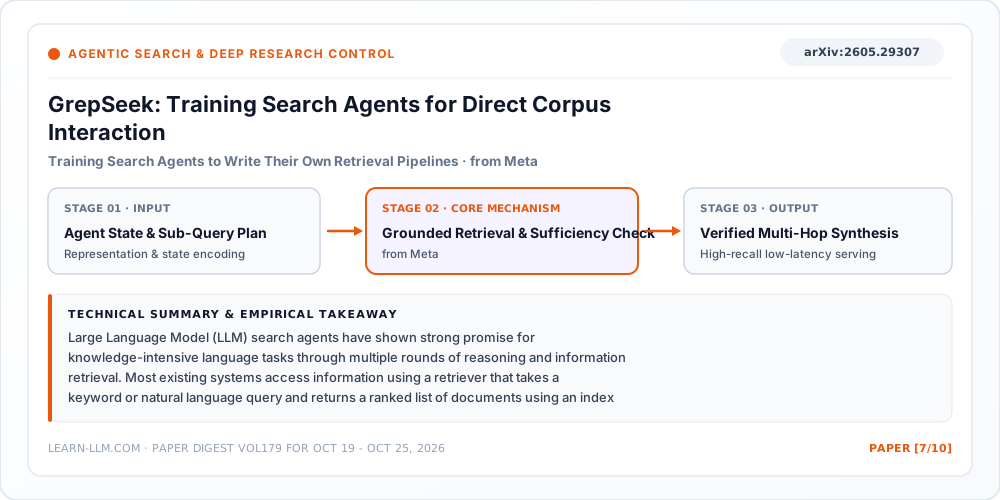
[7] GrepSeek: Training Search Agents for Direct Corpus Interaction
- Newsletter Headline: Training Search Agents to Write Their Own Retrieval Pipelines (from Meta)
- Links: arXiv:2605.29307 · Digest Section
- Research Area: LLM Agents · Agentic Search & Deep Research Control
Main Content & Technical Findings
Large Language Model (LLM) search agents have shown strong promise for knowledge-intensive language tasks through multiple rounds of reasoning and information retrieval. Most existing systems access information using a retriever that takes a keyword or natural language query and returns a ranked list of documents using an index of pre-computed document representations. In this work, we explore a complementary perspective in which the search agent treats the corpus itself as the search environment and finds evidence by issuing executable shell commands. We introduce GrepSeek, an optimized direct corpus interaction (DCI) search agent that trains a compact search agent to find, filter, and compose evidence from large text corpora. To address the instability of learning behavior directly with reinforcement learning on large corpora, we propose a two-stage training pipeline. First, we construct a cold-start dataset using an answer-aware Tutor and answer-blind Planner to generate verified, causally grounded search trajectories. Second, we refine the initialized policy with Group Relative Policy Optimization (GRPO), allowing the agent to improve its task-oriented search behavior through direct interaction with the corpus. To make DCI practical at scale, we further use a semantics-preserving sharded-parallel execution engine that accelerates shell-based retrieval by up to 7.6times while preserving byte-exact equivalence with sequential execution of the shell command. Experiments across seven open-domain question answering benchmarks show that GrepSeek achieves the strongest overall token-level F_1 and Exact Match. Our analysis also highlights the limitations of purely lexical interaction on queries with substantial surface-form variation, suggesting DCI as a practical and competitive method for search agents that can complement existing retrieval paradigms in the real world.
Architectural Context & Practical Takeaway: Autonomous search and deep-research agents frequently suffer from stagnant reasoning loops, uncalibrated stopping decisions, or noisy reward attribution across multi-turn tool calls. GrepSeek: Training Search Agents for Direct Corpus Interaction (from Meta) introduces explicit control and training signals for agentic retrieval—coupling fast System-1 evidence judgments, programmatic workspace operations, or representation-grounded reinforcement learning rewards with multi-step query planning. Evaluations on multi-hop QA and web research benchmarks demonstrate higher evidence recall and lower token waste per solved question.
Related Papers
- Search Agents Need Better Decision Boundaries, Not Just Bigger Models — LearnLLM deep dive on SearchJev System-1/System-2 delegation.
- Knowing When to Intervene: Six Papers on RL, Search Agents, and RAG — LearnLLM digest on T-Search, Programmatic Search Agents, and AutoRAG.
- #8 in this issue: Self-Assessment as a Training Signal for Search Agents (from Lee et al.) — Companion study in this newsletter.
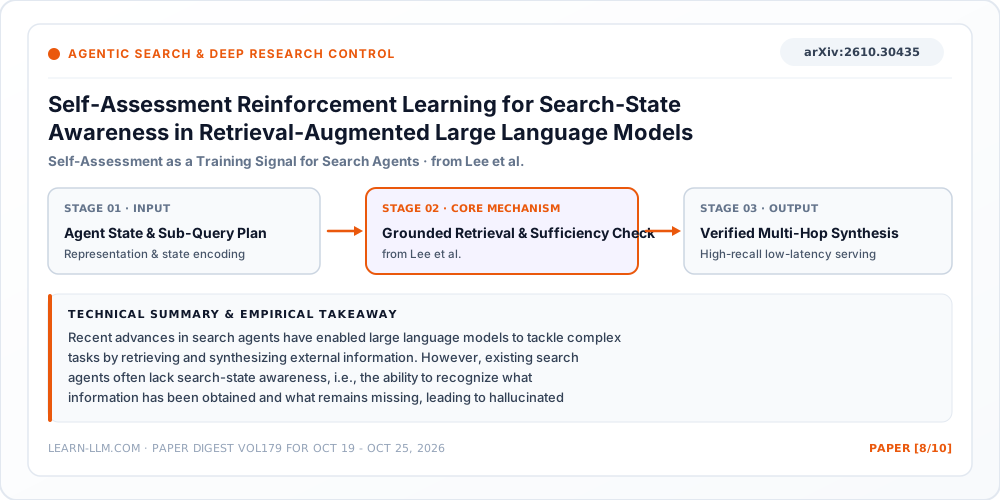
[8] Self-Assessment Reinforcement Learning for Search-State Awareness in Retrieval-Augmented Large Language Models
- Newsletter Headline: Self-Assessment as a Training Signal for Search Agents (from Lee et al.)
- Links: arXiv:2610.30435 · Digest Section
- Research Area: LLM Agents · Agentic Search & Deep Research Control
Main Content & Technical Findings
Recent advances in search agents have enabled large language models to tackle complex tasks by retrieving and synthesizing external information. However, existing search agents often lack search-state awareness, i.e., the ability to recognize what information has been obtained and what remains missing, leading to hallucinated reasoning and prematurely terminated search. To address this limitation, we propose Self-Assessment Reinforcement Learning (SARL), a reinforcement learning framework in which models learn to recognize their own search state during training and improve their search behavior accordingly, without requiring additional assessment at test time. SARL achieves this through a dual reward design that captures the corrective effect of each assessment while penalizing excessive reliance on it, jointly encouraging effective and efficient search trajectories. Under this setup, SARL achieves a 24.3% relative improvement over the strongest baseline, with average gains of 35.9% on multi-hop reasoning and 27.9% on deep research benchmarks against the strongest per-benchmark baselines. SARL further surpasses methods built on auxiliary supervision or multi-agent coordination, despite operating as a standalone RL framework with no inference-time scaffolding. Beyond final performance, SARL maintains training stability under extended search horizons, a regime where existing methods consistently degrade, enabling sustained gains as task complexity grows.
Architectural Context & Practical Takeaway: Autonomous search and deep-research agents frequently suffer from stagnant reasoning loops, uncalibrated stopping decisions, or noisy reward attribution across multi-turn tool calls. Self-Assessment Reinforcement Learning for Search-State Awareness in Retrieval-Augmented Large Language Models (from Lee et al.) introduces explicit control and training signals for agentic retrieval—coupling fast System-1 evidence judgments, programmatic workspace operations, or representation-grounded reinforcement learning rewards with multi-step query planning. Evaluations on multi-hop QA and web research benchmarks demonstrate higher evidence recall and lower token waste per solved question.
Related Papers
- Search Agents Need Better Decision Boundaries, Not Just Bigger Models — LearnLLM deep dive on SearchJev System-1/System-2 delegation.
- Knowing When to Intervene: Six Papers on RL, Search Agents, and RAG — LearnLLM digest on T-Search, Programmatic Search Agents, and AutoRAG.
- #7 in this issue: Training Search Agents to Write Their Own Retrieval Pipelines (from Meta) — Companion study in this newsletter.
[9] Learning Better Reasoning for Generative Recommendation with Semantic IDs
- Newsletter Headline: Coupling Semantic ID Construction and History Supervision in Generative Recommenders (from Wei et al.)
- Links: arXiv:2609.29973 · Digest Section
- Research Area: Recommender Systems · Semantic IDs & Codebook Quantization
Main Content & Technical Findings
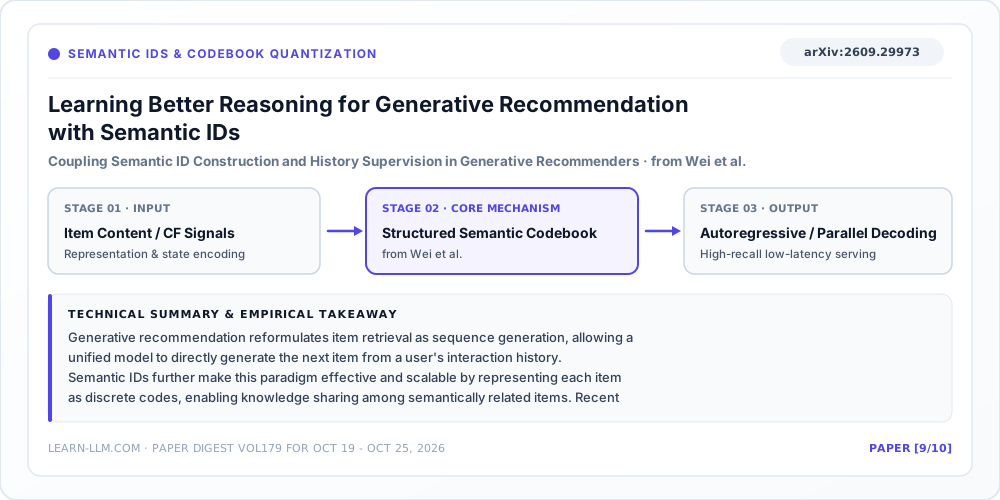
Generative recommendation reformulates item retrieval as sequence generation, allowing a unified model to directly generate the next item from a user's interaction history. Semantic IDs further make this paradigm effective and scalable by representing each item as discrete codes, enabling knowledge sharing among semantically related items. Recent studies introduce explicit reasoning before Semantic-ID generation, helping models summarize user interests and infer possible preference transitions. However, reasoning is not inherently beneficial: Inaccurate or uninformative reasoning may mislead subsequent item generation and ultimately degrade recommendation performance. This raises a central challenge: how can a recommender select and learn effective reasoning traces and progressively evolve toward better reasoning from its own generations? In this work, we propose Evo-Rec, a three-stage framework for learning better reasoning and further enhancing it through reinforcement learning. First, we align Semantic IDs with their textual and behavioral contexts, enabling the model to understand and generate item identifiers. Second, we sample multiple candidate reasoning traces and retain those that improve the prediction of the ground-truth item, providing a stronger reasoning initialization through supervised fine-tuning. Third, we further optimize the reasoning policy through reinforcement learning with catalog-constrained item generation and ranking-aware recommendation feedback. Experiments on three Amazon Review benchmarks show that Evo-Rec consistently outperforms discriminative, generative, and reasoning-enhanced recommenders across all evaluation metrics. These results demonstrate the effectiveness of our framework in learning better reasoning for SID-based generative recommendation.
Architectural Context & Practical Takeaway: Traditional generative recommenders quantize item embeddings into discrete token sequences using residual vector quantization (RQ-VAE) or hierarchical k-means, which decouples tokenization from the downstream sequence generator and degrades under catalog churn. Learning Better Reasoning for Generative Recommendation with Semantic IDs (from Wei et al.) introduces a structure-aware tokenization and decoding recipe that aligns codebook assignments with collaborative user-item signals and decoding dynamics. By coupling code structure with sequence generation, the model prevents prefix collisions on popular items while preserving recall on long-tail and newly ingested catalog entries.
Related Papers
- TIGER: Recommender Systems with Generative Retrieval — Foundational RQ-VAE Semantic ID generative recommender.
- A Semantic Tokenizer Cannot Be Judged Without Its Decoder (FLASH) — LearnLLM deep dive on SimHash parallel decoding & alignment.
- Reachability Is Not Ranking: Finite Beams & Continuous Queries — LearnLLM analysis of beam reachability vs. ranking in SID models.
- #4 in this issue: Freezing Semantic IDs for Generative Retrieval Under Item Churn (from Alibaba) — Companion study in this newsletter.
[10] Do Conversational Agents Need Explicit Memory? A Controlled Comparison with Raw-History Retrieval
- Newsletter Headline: Explicit Memory versus Raw-History Retrieval for Long-Term Conversational Agents (from Zhou et al.)
- Links: arXiv:2610.24671 · Digest Section
- Research Area: LLM Agents · Agentic & Parametric Memory Systems
Main Content & Technical Findings
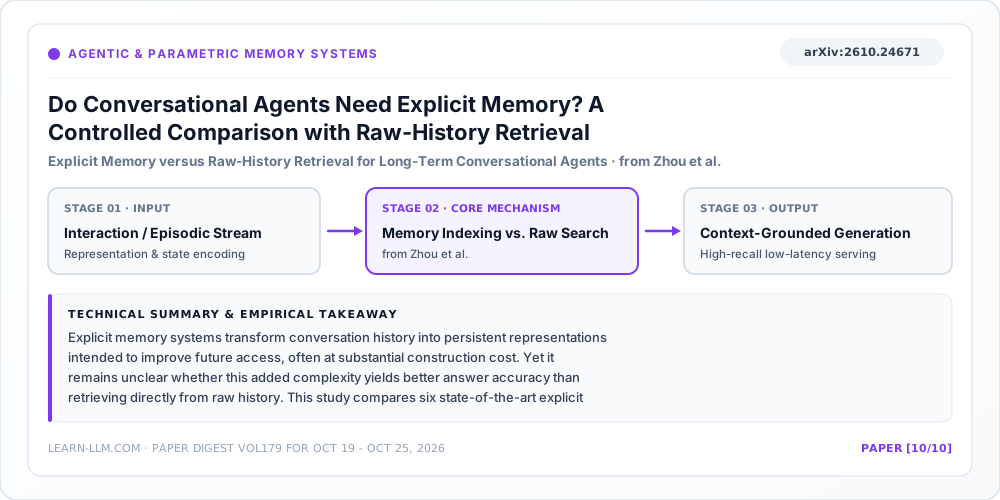
Explicit memory systems transform conversation history into persistent representations intended to improve future access, often at substantial construction cost. Yet it remains unclear whether this added complexity yields better answer accuracy than retrieving directly from raw history. This study compares six state-of-the-art explicit memory systems with raw-history RAG on LongMemEval-S and BEAM-100K under original and controlled retrieval settings. We find only localized gains for particular question types and tight run-time context budgets, with no consistent advantage over strong raw-history RAG baselines. Oracle retrieval shows that some systems fail to preserve answer-supporting information during explicit memory construction, while others preserve it but fail to retrieve it effectively, despite construction costs reaching hours per conversation. Our findings suggest that while many existing memory systems for AI agents emphasize increasingly elaborate explicit memory construction, they are often evaluated without strong controlled comparisons to raw-history RAG and may underemphasize retrieval. Retrieval remains a major bottleneck when useful information is preserved, suggesting that improving access to existing information may be at least as important as constructing richer explicit memory.
Architectural Context & Practical Takeaway: Long-horizon conversational and research agents rely on memory modules to persist facts across sessions, yet complex memory extraction pipelines often introduce latency, token overhead ("memory tax"), and lossy summarization errors. Do Conversational Agents Need Explicit Memory? A Controlled Comparison with Raw-History Retrieval (from Zhou et al.) audits how information is stored, indexed, and retrieved—comparing structured episodic memory against agent-controlled search over raw interaction logs, token-level evidence retrieval, and residual self-distillation into model weights. The findings establish clear cost-accuracy operating points for production agent memory architectures.
Related Papers
- Lineage Is Memory: Parent Inheritance and Feedback Disclosure — LearnLLM deep dive on prompt lineage as externalized memory (arXiv:2610.41157).
- Harness²: What an Agent Can Learn by Changing Its Harness — LearnLLM review of experience libraries in recursive agent harnesses.
- #1 in this issue: Fixed-Budget Late Interaction for Long and Complex Queries (from Handa et al.) — Companion study in this newsletter.