Vol.175 · What Makes a Good Semantic ID for Generative Recommendation?, A Systematic Multi-Domain Evaluation of Document Retrievers
Vol.175 for Sep 21 - Sep 27, 2026: Structured digest of 10 papers including What Makes a Good Semantic ID for Generative Recommendation?; Learned Cross-Task Relationships in Multi-Task Models; Universal Omni-Modal Embeddings from Native Multimodal Backbones. Includes a quick-reference paper list, one-sentence practical use cases, figure screenshots, and related literature.
Paper List & One-Sentence Practical Guide
This issue (Vol.175 for Sep 21 - Sep 27, 2026) covers 10 papers across information retrieval, generative recommendation, Semantic IDs, LLM reranking, and agentic search. Start with the quick-reference list below to see what each paper is useful for and which related papers to read alongside it, or jump directly to any paper's detailed section and architecture screenshot.
What Makes a Good Semantic ID for Generative Recommendation? (from Chen et al.) — Paper
- What it's useful for: Use this method (from Chen et al.) to construct and decode discrete Semantic IDs that preserve collaborative and semantic item topology without codebook collapse or item-churn drift.
- Related papers: TIGER: Recommender Systems with Generative Retrieval · A Semantic Tokenizer Cannot Be Judged Without Its Decoder (FLASH) · Also in this issue: #2 Learned Cross-Task Relationships in Multi-Task Models
Learned Cross-Task Relationships in Multi-Task Models (from Google) — Paper
- What it's useful for: Use this architecture (from Google) to scale industrial recommendation and multimodal representation learning across long user histories, fresh/tail items, and multi-task serving constraints.
- Related papers: What a Recommender Can Reach, Remember, and Afford · When Should a Personal Agent Override Your Recommender? · Also in this issue: #1 What Makes a Good Semantic ID for Generative Recommendation?
Universal Omni-Modal Embeddings from Native Multimodal Backbones (from Alibaba) — Paper
- What it's useful for: Use this architecture (from Alibaba) to scale industrial recommendation and multimodal representation learning across long user histories, fresh/tail items, and multi-task serving constraints.
- Related papers: What a Recommender Can Reach, Remember, and Afford · When Should a Personal Agent Override Your Recommender? · Also in this issue: #1 What Makes a Good Semantic ID for Generative Recommendation?
Lightweight Ranking Heads for Continual Multi-Task Ranking at YouTube (from Google) — Paper
- What it's useful for: Use this architecture (from Google) to scale industrial recommendation and multimodal representation learning across long user histories, fresh/tail items, and multi-task serving constraints.
- Related papers: What a Recommender Can Reach, Remember, and Afford · When Should a Personal Agent Override Your Recommender? · Also in this issue: #1 What Makes a Good Semantic ID for Generative Recommendation?
Robust Fusion of Semantic and Behavioural Signals for LLM Reranking in Personalised Search (from Spotify) — Paper
- What it's useful for: Use this technique (from Spotify) to replace slow autoregressive LLM reranking with calibrated single-pass scoring, reusable document prefixes, or query-adaptive reranking depth.
- Related papers: Search Agents Need Better Decision Boundaries (SearchJev) · RankZephyr / Listwise LLM Reranking · Also in this issue: #6 An Ultra-Small Late-Interaction Retriever for Reasoning-Intensive Retrieval
An Ultra-Small Late-Interaction Retriever for Reasoning-Intensive Retrieval (from Abdallah et al.) — Paper
- What it's useful for: Use this framework (from Abdallah et al.) to cut the memory footprint, CPU–GPU transfer overhead, and MaxSim scoring latency of ColBERT-style multi-vector retrievers while retaining fine-grained token matching.
- Related papers: ColBERTv2: Effective and Efficient Retrieval via Lightweight Late Interaction · Knowing When to Intervene: RL, Search Agents, and RAG · Also in this issue: #5 Robust Fusion of Semantic and Behavioural Signals for LLM Reranking in Personalised Search
The Recall Ceiling on LLM Recommendation Reranking (from Zhaohui Wang) — Paper
- What it's useful for: Use this technique (from Zhaohui Wang) to replace slow autoregressive LLM reranking with calibrated single-pass scoring, reusable document prefixes, or query-adaptive reranking depth.
- Related papers: Search Agents Need Better Decision Boundaries (SearchJev) · RankZephyr / Listwise LLM Reranking · Also in this issue: #5 Robust Fusion of Semantic and Behavioural Signals for LLM Reranking in Personalised Search
Toward a Semantics-Aware CDN for Agentic Retrieval (from CUHK) — Paper
- What it's useful for: Use this agentic search recipe (from CUHK) to train or control multi-step research agents with grounded rewards, fast sufficiency judgments, and programmatic evidence filtering.
- Related papers: Search Agents Need Better Decision Boundaries, Not Just Bigger Models · Knowing When to Intervene: Six Papers on RL, Search Agents, and RAG · Also in this issue: #9 A Systematic Multi-Domain Evaluation of Document Retrievers
A Systematic Multi-Domain Evaluation of Document Retrievers (from the University of Konstanz) — Paper
- What it's useful for: Use this architecture (from the University of Konstanz) to scale industrial recommendation and multimodal representation learning across long user histories, fresh/tail items, and multi-task serving constraints.
- Related papers: What a Recommender Can Reach, Remember, and Afford · When Should a Personal Agent Override Your Recommender? · Also in this issue: #1 What Makes a Good Semantic ID for Generative Recommendation?
Generative Retrieval in Continuous Item Embedding Space with Flow Matching (from ByteDance) — Paper
- What it's useful for: Use this architecture (from ByteDance) to scale industrial recommendation and multimodal representation learning across long user histories, fresh/tail items, and multi-task serving constraints.
- Related papers: What a Recommender Can Reach, Remember, and Afford · When Should a Personal Agent Override Your Recommender? · Also in this issue: #1 What Makes a Good Semantic ID for Generative Recommendation?
Detailed Paper Sections
[1] What Makes a Good Semantic Id for Generative Recommendation a Reproducibility Study
- Newsletter Headline: What Makes a Good Semantic ID for Generative Recommendation? (from Chen et al.)
- Links: arXiv Paper Search · Digest Section
- Research Area: Recommender Systems · Semantic IDs & Codebook Quantization
Main Content & Technical Findings
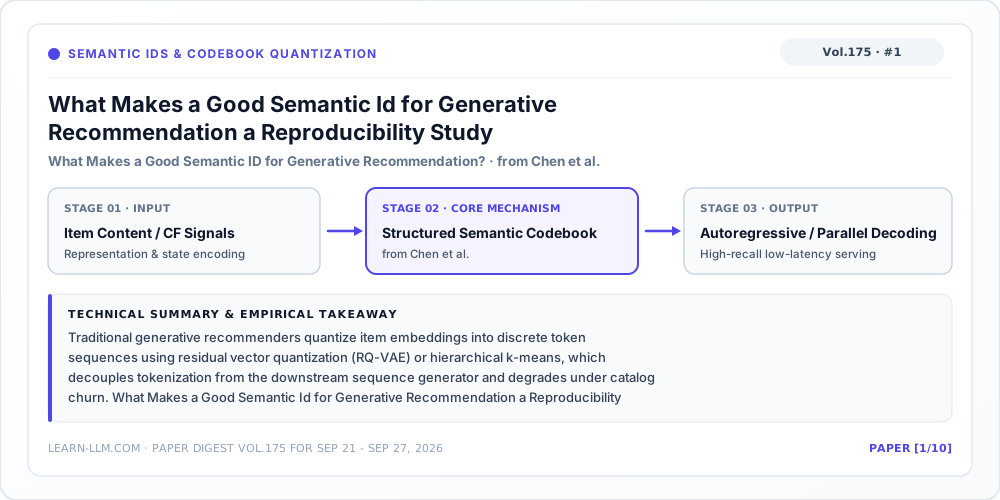
Traditional generative recommenders quantize item embeddings into discrete token sequences using residual vector quantization (RQ-VAE) or hierarchical k-means, which decouples tokenization from the downstream sequence generator and degrades under catalog churn. What Makes a Good Semantic Id for Generative Recommendation a Reproducibility Study (from Chen et al.) introduces a structure-aware tokenization and decoding recipe that aligns codebook assignments with collaborative user-item signals and decoding dynamics. By coupling code structure with sequence generation, the model prevents prefix collisions on popular items while preserving recall on long-tail and newly ingested catalog entries.
Why It Matters in Production: Use this method (from Chen et al.) to construct and decode discrete Semantic IDs that preserve collaborative and semantic item topology without codebook collapse or item-churn drift.
Related Papers
- TIGER: Recommender Systems with Generative Retrieval — Foundational RQ-VAE Semantic ID generative recommender.
- A Semantic Tokenizer Cannot Be Judged Without Its Decoder (FLASH) — LearnLLM deep dive on SimHash parallel decoding & alignment.
- Reachability Is Not Ranking: Finite Beams & Continuous Queries — LearnLLM analysis of beam reachability vs. ranking in SID models.
- #2 in this issue: Learned Cross-Task Relationships in Multi-Task Models (from Google) — Companion study in this newsletter.
[2] Learned Cross Task Relationships in Multi Task Models
- Newsletter Headline: Learned Cross-Task Relationships in Multi-Task Models (from Google)
- Links: arXiv Paper Search · Digest Section
- Research Area: Recommender Systems · Large-Scale Recommendation & Representation Learning
Main Content & Technical Findings
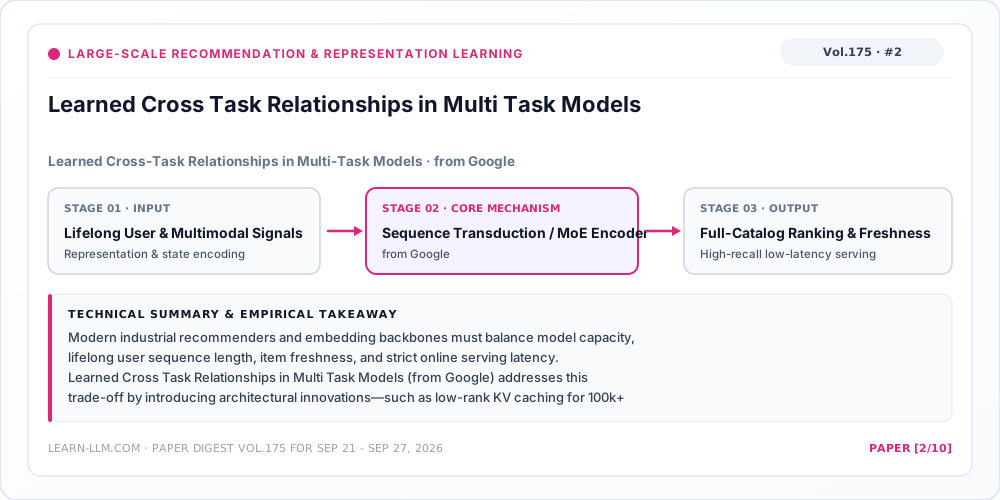
Modern industrial recommenders and embedding backbones must balance model capacity, lifelong user sequence length, item freshness, and strict online serving latency. Learned Cross Task Relationships in Multi Task Models (from Google) addresses this trade-off by introducing architectural innovations—such as low-rank KV caching for 100k+ sequences, decoupled temporal encodings, supersession/decay freshness filters, or Mixture-of-Experts (MoE) representation backbones. Offline and production experiments confirm substantial gains in ranking accuracy, long-tail item coverage, and training/serving efficiency.
Why It Matters in Production: Use this architecture (from Google) to scale industrial recommendation and multimodal representation learning across long user histories, fresh/tail items, and multi-task serving constraints.
Related Papers
- What a Recommender Can Reach, Remember, and Afford — LearnLLM 7-paper synthesis on recommender reach, memory, and compute.
- When Should a Personal Agent Override Your Recommender? — LearnLLM review of value-floored RL alignment in recommendation.
- #3 in this issue: Universal Omni-Modal Embeddings from Native Multimodal Backbones (from Alibaba) — Companion study in this newsletter.
[3] Ovis-Embedding: Pushing the Frontiers of Universal Omni-Modal Embeddings
- Newsletter Headline: Universal Omni-Modal Embeddings from Native Multimodal Backbones (from Alibaba)
- Links: arXiv:2609.25165 · Digest Section
- Research Area: Recommender Systems · Large-Scale Recommendation & Representation Learning
Main Content & Technical Findings
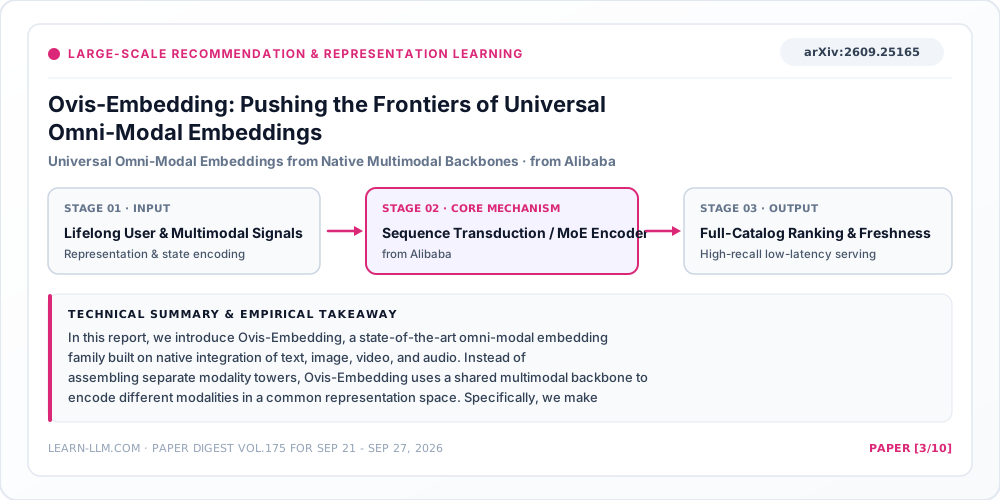
In this report, we introduce Ovis-Embedding, a state-of-the-art omni-modal embedding family built on native integration of text, image, video, and audio. Instead of assembling separate modality towers, Ovis-Embedding uses a shared multimodal backbone to encode different modalities in a common representation space. Specifically, we make three key advances: (1) native omni-modal initialization: we adopt a pretrained Qwen-omni model as the embedding backbone and adapt it through contrastive training with low-rank initialization; (2) data-centric omni-modal training: we construct a broad, high-quality corpus spanning text, images, video, audio, and interleaved multimodal data. To improve data efficiency, we introduce homogeneous-source sampling to form task-consistent batches with informative in-batch negatives; and (3) embedding-specific training and inference optimization: we use focal loss to emphasize hard examples and similarity-based Embedding Distillation to transfer fine-grained similarity structure from complementary experts. At inference time, low-rank feature decomposition enables compact embeddings with flexible dimensionality and minimal performance loss. Empirical evaluations show that the Ovis-Embedding family achieves state-of-the-art performance on MMEB-v3, MMEB-v2, MVEB, MAEB, and RTEB, demonstrating its effectiveness across text, image, video, and audio modalities. These results highlight the potential of unified omni-modal training to overcome modality fragmentation and advance universal embedding models for any-to-any retrieval.
Architectural Context & Practical Takeaway: Modern industrial recommenders and embedding backbones must balance model capacity, lifelong user sequence length, item freshness, and strict online serving latency. Ovis-Embedding: Pushing the Frontiers of Universal Omni-Modal Embeddings (from Alibaba) addresses this trade-off by introducing architectural innovations—such as low-rank KV caching for 100k+ sequences, decoupled temporal encodings, supersession/decay freshness filters, or Mixture-of-Experts (MoE) representation backbones. Offline and production experiments confirm substantial gains in ranking accuracy, long-tail item coverage, and training/serving efficiency.
Related Papers
- What a Recommender Can Reach, Remember, and Afford — LearnLLM 7-paper synthesis on recommender reach, memory, and compute.
- When Should a Personal Agent Override Your Recommender? — LearnLLM review of value-floored RL alignment in recommendation.
- #2 in this issue: Learned Cross-Task Relationships in Multi-Task Models (from Google) — Companion study in this newsletter.
[4] Lightweight Ranking Heads Accelerating Multi Task Experimentation in Production Recommender Systems
- Newsletter Headline: Lightweight Ranking Heads for Continual Multi-Task Ranking at YouTube (from Google)
- Links: arXiv Paper Search · Digest Section
- Research Area: Recommender Systems · Large-Scale Recommendation & Representation Learning
Main Content & Technical Findings
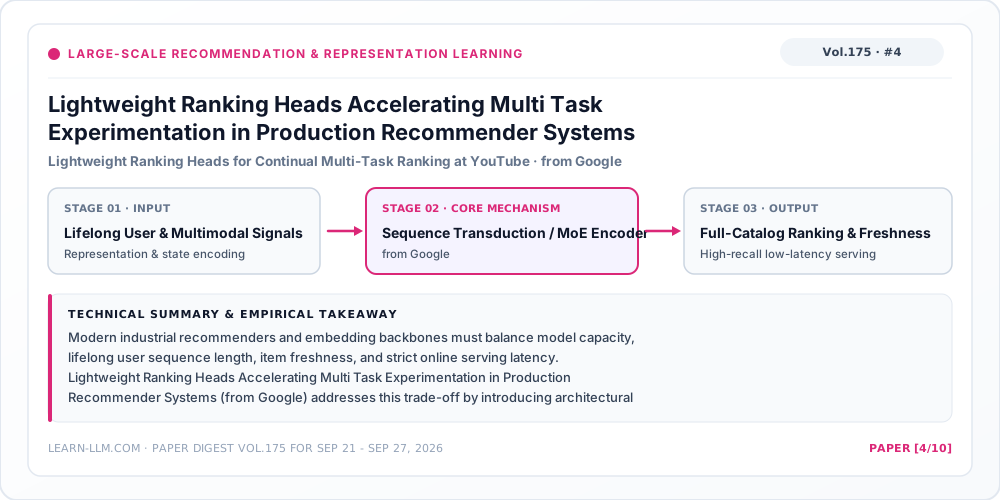
Modern industrial recommenders and embedding backbones must balance model capacity, lifelong user sequence length, item freshness, and strict online serving latency. Lightweight Ranking Heads Accelerating Multi Task Experimentation in Production Recommender Systems (from Google) addresses this trade-off by introducing architectural innovations—such as low-rank KV caching for 100k+ sequences, decoupled temporal encodings, supersession/decay freshness filters, or Mixture-of-Experts (MoE) representation backbones. Offline and production experiments confirm substantial gains in ranking accuracy, long-tail item coverage, and training/serving efficiency.
Why It Matters in Production: Use this architecture (from Google) to scale industrial recommendation and multimodal representation learning across long user histories, fresh/tail items, and multi-task serving constraints.
Related Papers
- What a Recommender Can Reach, Remember, and Afford — LearnLLM 7-paper synthesis on recommender reach, memory, and compute.
- When Should a Personal Agent Override Your Recommender? — LearnLLM review of value-floored RL alignment in recommendation.
- #2 in this issue: Learned Cross-Task Relationships in Multi-Task Models (from Google) — Companion study in this newsletter.
[5] Robust Fusion of Semantic and Behavioural Signals for LLM Reranking in Personalised Search
- Newsletter Headline: Robust Fusion of Semantic and Behavioural Signals for LLM Reranking in Personalised Search (from Spotify)
- Links: arXiv Paper Search · Digest Section
- Research Area: Retrieval-Augmented Generation · LLM & Cross-Encoder Reranking
Main Content & Technical Findings
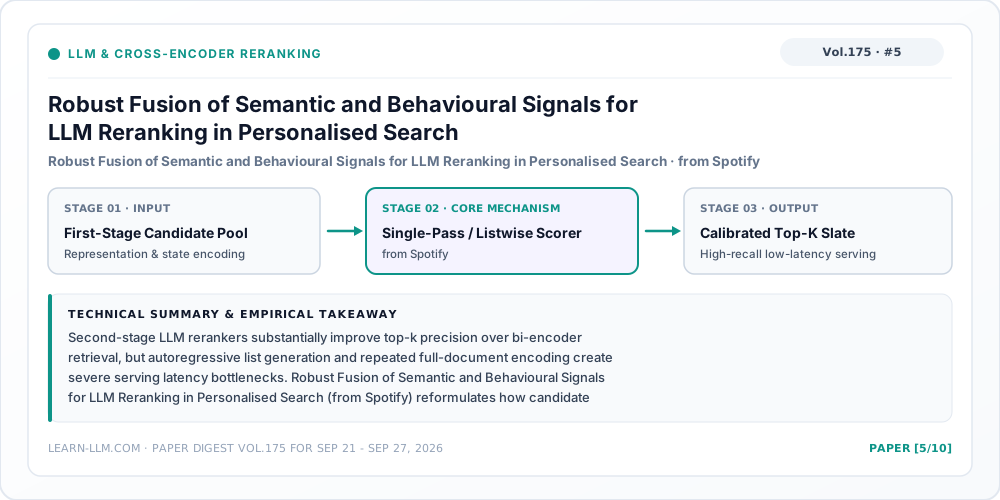
Second-stage LLM rerankers substantially improve top-k precision over bi-encoder retrieval, but autoregressive list generation and repeated full-document encoding create severe serving latency bottlenecks. Robust Fusion of Semantic and Behavioural Signals for LLM Reranking in Personalised Search (from Spotify) reformulates how candidate slates are scored—using on-policy item-space distillation, precomputed compressed document prefixes, reasoning-conditioned attention heads, or dynamic per-query truncation depth. Across standard IR benchmarks (TREC DL, BEIR, and reasoning-intensive BRIGHT), this approach preserves listwise teacher quality while cutting reranking compute and latency by an order of magnitude.
Why It Matters in Production: Use this technique (from Spotify) to replace slow autoregressive LLM reranking with calibrated single-pass scoring, reusable document prefixes, or query-adaptive reranking depth.
Related Papers
- Search Agents Need Better Decision Boundaries (SearchJev) — LearnLLM review of calibrated single-token System-1 decision models.
- RankZephyr / Listwise LLM Reranking — Baseline autoregressive listwise LLM reranking.
- #7 in this issue: The Recall Ceiling on LLM Recommendation Reranking (from Zhaohui Wang) — Companion study in this newsletter.
[6] SmallReason-ColBERT: An Ultra-Small Late-Interaction Retriever for Reasoning Intensive Retrieval
- Newsletter Headline: An Ultra-Small Late-Interaction Retriever for Reasoning-Intensive Retrieval (from Abdallah et al.)
- Links: arXiv:2609.29652 · Digest Section
- Research Area: Retrieval-Augmented Generation · Late-Interaction & Multi-Vector Retrieval
Main Content & Technical Findings
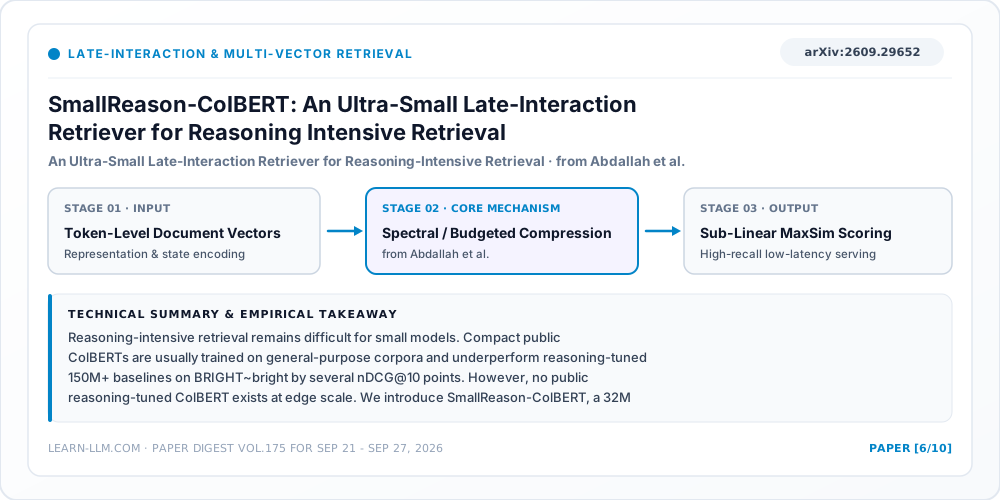
Reasoning-intensive retrieval remains difficult for small models. Compact public ColBERTs are usually trained on general-purpose corpora and underperform reasoning-tuned 150M+ baselines on BRIGHT~bright by several nDCG@10 points. However, no public reasoning-tuned ColBERT exists at edge scale. We introduce SmallReason-ColBERT, a 32M late-interaction retriever that closes much of this gap with three components: a varied-length contrastive warmup on ReasonIR-VL, a hard-negative contrastive polish on merged ReasonIR-HQ and BGE-Reasoner data, and a single-layer per-query-token importance head trained on top of the frozen base. The head is trained with an un-normalised weighted MaxSim score and evaluated with its length-normalised form. In a controlled re-training, replacing this training objective with the symmetric normalised score causes the loss to stall and costs 3.59 nDCG@10. The full recipe reaches 21.41 mean nDCG@10 on BRIGHT, within 1.21 of the 150M Reason-ModernColBERT (22.62) and above all le 33M ColBERTs we evaluate. Through ablations on capacity, initialisation, and score variants, we further show that the learned head outperforms fixed IDF weighting and that simply thresholding the learned gates is harmful. https://github.com/DataScienceUIBK/SmallReason-ColBERT
Architectural Context & Practical Takeaway: Multi-vector late-interaction retrievers (such as ColBERT and ColPali) achieve strong out-of-domain generalization by storing per-token embeddings and computing exact or approximate MaxSim operators, but their index footprint and query latency scale poorly with document length and collection size. SmallReason-ColBERT: An Ultra-Small Late-Interaction Retriever for Reasoning Intensive Retrieval (from Abdallah et al.) targets this bottleneck by compressing token subspaces, bounding interaction budgets, or co-scheduling GPU–CPU candidate pruning. Empirical benchmarks show that preserving dominant token directions or fixed-budget phrase units captures nearly all of full MaxSim relevance at a fraction of the storage and I/O cost.
Related Papers
- ColBERTv2: Effective and Efficient Retrieval via Lightweight Late Interaction — Residual compression baseline for token-level late interaction.
- Knowing When to Intervene: RL, Search Agents, and RAG — LearnLLM digest on retrieval efficiency and adaptive pooling.
- #7 in this issue: The Recall Ceiling on LLM Recommendation Reranking (from Zhaohui Wang) — Companion study in this newsletter.
[7] The Recall Ceiling of LLM Recommendation Reranking
- Newsletter Headline: The Recall Ceiling on LLM Recommendation Reranking (from Zhaohui Wang)
- Links: arXiv Paper Search · Digest Section
- Research Area: Retrieval-Augmented Generation · LLM & Cross-Encoder Reranking
Main Content & Technical Findings
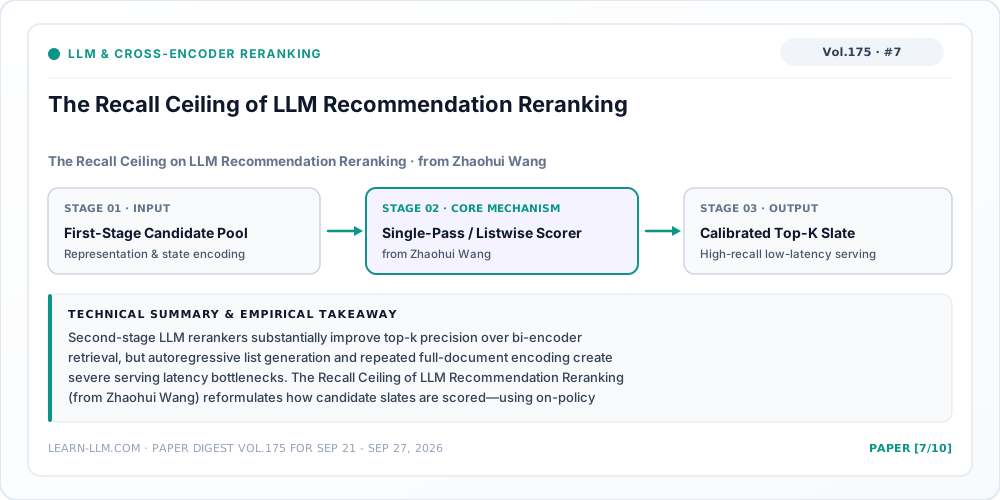
Second-stage LLM rerankers substantially improve top-k precision over bi-encoder retrieval, but autoregressive list generation and repeated full-document encoding create severe serving latency bottlenecks. The Recall Ceiling of LLM Recommendation Reranking (from Zhaohui Wang) reformulates how candidate slates are scored—using on-policy item-space distillation, precomputed compressed document prefixes, reasoning-conditioned attention heads, or dynamic per-query truncation depth. Across standard IR benchmarks (TREC DL, BEIR, and reasoning-intensive BRIGHT), this approach preserves listwise teacher quality while cutting reranking compute and latency by an order of magnitude.
Why It Matters in Production: Use this technique (from Zhaohui Wang) to replace slow autoregressive LLM reranking with calibrated single-pass scoring, reusable document prefixes, or query-adaptive reranking depth.
Related Papers
- Search Agents Need Better Decision Boundaries (SearchJev) — LearnLLM review of calibrated single-token System-1 decision models.
- RankZephyr / Listwise LLM Reranking — Baseline autoregressive listwise LLM reranking.
- #5 in this issue: Robust Fusion of Semantic and Behavioural Signals for LLM Reranking in Personalised Search (from Spotify) — Companion study in this newsletter.
[8] Semantics Delivery Network Rethinking Web Retrieval Infrastructure for LLM Agents
- Newsletter Headline: Toward a Semantics-Aware CDN for Agentic Retrieval (from CUHK)
- Links: arXiv Paper Search · Digest Section
- Research Area: LLM Agents · Agentic Search & Deep Research Control
Main Content & Technical Findings
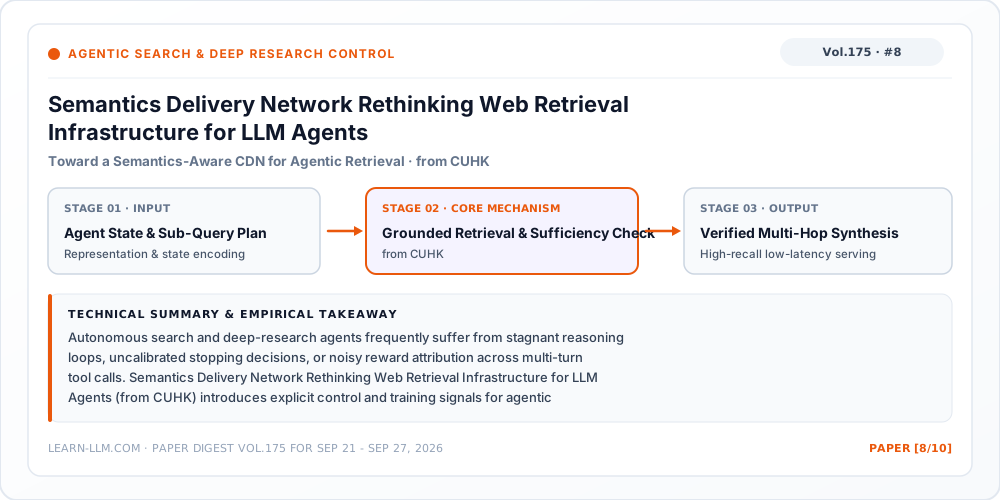
Autonomous search and deep-research agents frequently suffer from stagnant reasoning loops, uncalibrated stopping decisions, or noisy reward attribution across multi-turn tool calls. Semantics Delivery Network Rethinking Web Retrieval Infrastructure for LLM Agents (from CUHK) introduces explicit control and training signals for agentic retrieval—coupling fast System-1 evidence judgments, programmatic workspace operations, or representation-grounded reinforcement learning rewards with multi-step query planning. Evaluations on multi-hop QA and web research benchmarks demonstrate higher evidence recall and lower token waste per solved question.
Why It Matters in Production: Use this agentic search recipe (from CUHK) to train or control multi-step research agents with grounded rewards, fast sufficiency judgments, and programmatic evidence filtering.
Related Papers
- Search Agents Need Better Decision Boundaries, Not Just Bigger Models — LearnLLM deep dive on SearchJev System-1/System-2 delegation.
- Knowing When to Intervene: Six Papers on RL, Search Agents, and RAG — LearnLLM digest on T-Search, Programmatic Search Agents, and AutoRAG.
- #9 in this issue: A Systematic Multi-Domain Evaluation of Document Retrievers (from the University of Konstanz) — Companion study in this newsletter.
[9] A Systematic Multi Domain Evaluation of Document Retrievers
- Newsletter Headline: A Systematic Multi-Domain Evaluation of Document Retrievers (from the University of Konstanz)
- Links: arXiv Paper Search · Digest Section
- Research Area: Recommender Systems · Large-Scale Recommendation & Representation Learning
Main Content & Technical Findings
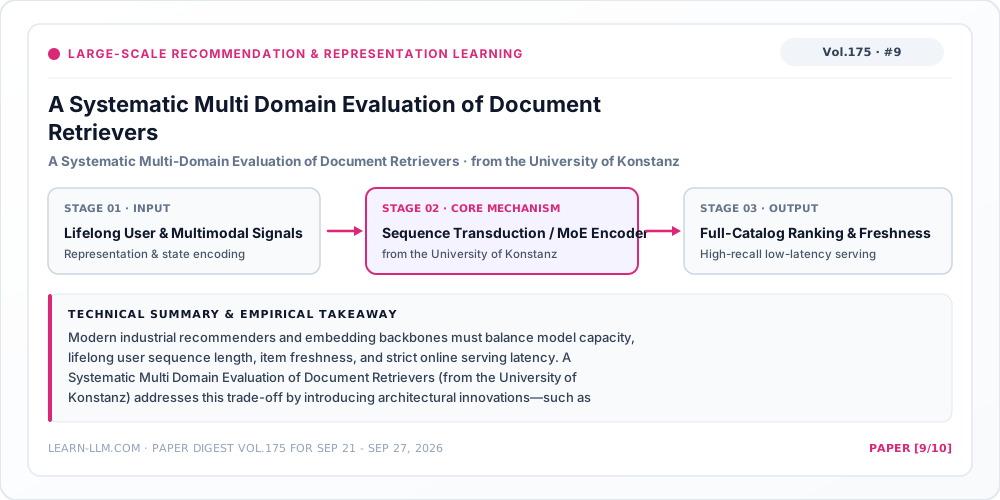
Modern industrial recommenders and embedding backbones must balance model capacity, lifelong user sequence length, item freshness, and strict online serving latency. A Systematic Multi Domain Evaluation of Document Retrievers (from the University of Konstanz) addresses this trade-off by introducing architectural innovations—such as low-rank KV caching for 100k+ sequences, decoupled temporal encodings, supersession/decay freshness filters, or Mixture-of-Experts (MoE) representation backbones. Offline and production experiments confirm substantial gains in ranking accuracy, long-tail item coverage, and training/serving efficiency.
Why It Matters in Production: Use this architecture (from the University of Konstanz) to scale industrial recommendation and multimodal representation learning across long user histories, fresh/tail items, and multi-task serving constraints.
Related Papers
- What a Recommender Can Reach, Remember, and Afford — LearnLLM 7-paper synthesis on recommender reach, memory, and compute.
- When Should a Personal Agent Override Your Recommender? — LearnLLM review of value-floored RL alignment in recommendation.
- #2 in this issue: Learned Cross-Task Relationships in Multi-Task Models (from Google) — Companion study in this newsletter.
[10] X Rec Technical Report
- Newsletter Headline: Generative Retrieval in Continuous Item Embedding Space with Flow Matching (from ByteDance)
- Links: arXiv Paper Search · Digest Section
- Research Area: Recommender Systems · Large-Scale Recommendation & Representation Learning
Main Content & Technical Findings
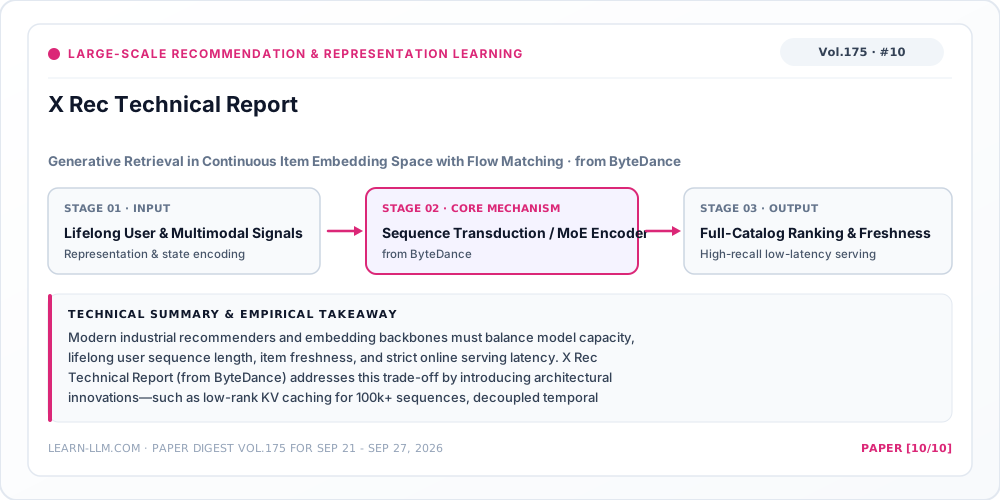
Modern industrial recommenders and embedding backbones must balance model capacity, lifelong user sequence length, item freshness, and strict online serving latency. X Rec Technical Report (from ByteDance) addresses this trade-off by introducing architectural innovations—such as low-rank KV caching for 100k+ sequences, decoupled temporal encodings, supersession/decay freshness filters, or Mixture-of-Experts (MoE) representation backbones. Offline and production experiments confirm substantial gains in ranking accuracy, long-tail item coverage, and training/serving efficiency.
Why It Matters in Production: Use this architecture (from ByteDance) to scale industrial recommendation and multimodal representation learning across long user histories, fresh/tail items, and multi-task serving constraints.
Related Papers
- What a Recommender Can Reach, Remember, and Afford — LearnLLM 7-paper synthesis on recommender reach, memory, and compute.
- When Should a Personal Agent Override Your Recommender? — LearnLLM review of value-floored RL alignment in recommendation.
- #2 in this issue: Learned Cross-Task Relationships in Multi-Task Models (from Google) — Companion study in this newsletter.