Vol.173 · Spectral Compression of Late-Interaction Retrieval Models, Surgical Corrections to Dense Retrieval Rankings
Vol.173 for Sep 07 - Sep 13, 2026: Structured digest of 10 papers including Spectral Compression of Late-Interaction Retrieval Models; In-Place Embedding Corrections for Feedback-Driven Dense Retrieval; Scaling Multimodal Embeddings via Mixture-of-Experts. Includes a quick-reference paper list, one-sentence practical use cases, figure screenshots, and related literature.
Paper List & One-Sentence Practical Guide
This issue (Vol.173 for Sep 07 - Sep 13, 2026) covers 10 papers across information retrieval, generative recommendation, Semantic IDs, LLM reranking, and agentic search. Start with the quick-reference list below to see what each paper is useful for and which related papers to read alongside it, or jump directly to any paper's detailed section and architecture screenshot.
Spectral Compression of Late-Interaction Retrieval Models (from Microsoft) — Paper
- What it's useful for: Use this framework (from Microsoft) to cut the memory footprint, CPU–GPU transfer overhead, and MaxSim scoring latency of ColBERT-style multi-vector retrievers while retaining fine-grained token matching.
- Related papers: ColBERTv2: Effective and Efficient Retrieval via Lightweight Late Interaction · Knowing When to Intervene: RL, Search Agents, and RAG · Also in this issue: #8 Generative Late-Interaction Embeddings for Visual Document Retrieval
In-Place Embedding Corrections for Feedback-Driven Dense Retrieval (from Amendola et al.) — Paper
- What it's useful for: Use this architecture (from Amendola et al.) to scale industrial recommendation and multimodal representation learning across long user histories, fresh/tail items, and multi-task serving constraints.
- Related papers: What a Recommender Can Reach, Remember, and Afford · When Should a Personal Agent Override Your Recommender? · Also in this issue: #3 Scaling Multimodal Embeddings via Mixture-of-Experts
Scaling Multimodal Embeddings via Mixture-of-Experts (from Meta) — Paper
- What it's useful for: Use this architecture (from Meta) to scale industrial recommendation and multimodal representation learning across long user histories, fresh/tail items, and multi-task serving constraints.
- Related papers: What a Recommender Can Reach, Remember, and Afford · When Should a Personal Agent Override Your Recommender? · Also in this issue: #2 In-Place Embedding Corrections for Feedback-Driven Dense Retrieval
Ultra-Long Sequence Modeling in Recommendation with Low-Rank Caching (from ByteDance) — Paper
- What it's useful for: Use this architecture (from ByteDance) to scale industrial recommendation and multimodal representation learning across long user histories, fresh/tail items, and multi-task serving constraints.
- Related papers: What a Recommender Can Reach, Remember, and Afford · When Should a Personal Agent Override Your Recommender? · Also in this issue: #2 In-Place Embedding Corrections for Feedback-Driven Dense Retrieval
An End-to-End Recipe for Training Search Agents (from AllSpark) — Paper
- What it's useful for: Use this agentic search recipe (from AllSpark) to train or control multi-step research agents with grounded rewards, fast sufficiency judgments, and programmatic evidence filtering.
- Related papers: Search Agents Need Better Decision Boundaries, Not Just Bigger Models · Knowing When to Intervene: Six Papers on RL, Search Agents, and RAG · Also in this issue: #9 An Agent Harness for Long-Horizon Experimentation on Industry-Scale Recommenders
Offline LLM Reasoning for Online Recommendation (from Alibaba) — Paper
- What it's useful for: Use this architecture (from Alibaba) to scale industrial recommendation and multimodal representation learning across long user histories, fresh/tail items, and multi-task serving constraints.
- Related papers: What a Recommender Can Reach, Remember, and Afford · When Should a Personal Agent Override Your Recommender? · Also in this issue: #2 In-Place Embedding Corrections for Feedback-Driven Dense Retrieval
Adaptive Tree Expansion for Large-Scale Evidence Synthesis in RAG (from Lee et al.) — Paper
- What it's useful for: Use this architecture (from Lee et al.) to scale industrial recommendation and multimodal representation learning across long user histories, fresh/tail items, and multi-task serving constraints.
- Related papers: What a Recommender Can Reach, Remember, and Afford · When Should a Personal Agent Override Your Recommender? · Also in this issue: #2 In-Place Embedding Corrections for Feedback-Driven Dense Retrieval
Generative Late-Interaction Embeddings for Visual Document Retrieval (from Eltahir et al.) — Paper
- What it's useful for: Use this framework (from Eltahir et al.) to cut the memory footprint, CPU–GPU transfer overhead, and MaxSim scoring latency of ColBERT-style multi-vector retrievers while retaining fine-grained token matching.
- Related papers: ColBERTv2: Effective and Efficient Retrieval via Lightweight Late Interaction · Knowing When to Intervene: RL, Search Agents, and RAG · Also in this issue: #1 Spectral Compression of Late-Interaction Retrieval Models
An Agent Harness for Long-Horizon Experimentation on Industry-Scale Recommenders (from Meta) — Paper
- What it's useful for: Use this agentic search recipe (from Meta) to train or control multi-step research agents with grounded rewards, fast sufficiency judgments, and programmatic evidence filtering.
- Related papers: Search Agents Need Better Decision Boundaries, Not Just Bigger Models · Knowing When to Intervene: Six Papers on RL, Search Agents, and RAG · Also in this issue: #5 An End-to-End Recipe for Training Search Agents
Distillation and Exploration for Soft Context Compression in RAG (from Guo et al.) — Paper
- What it's useful for: Use this architecture (from Guo et al.) to scale industrial recommendation and multimodal representation learning across long user histories, fresh/tail items, and multi-task serving constraints.
- Related papers: What a Recommender Can Reach, Remember, and Afford · When Should a Personal Agent Override Your Recommender? · Also in this issue: #2 In-Place Embedding Corrections for Feedback-Driven Dense Retrieval
Detailed Paper Sections
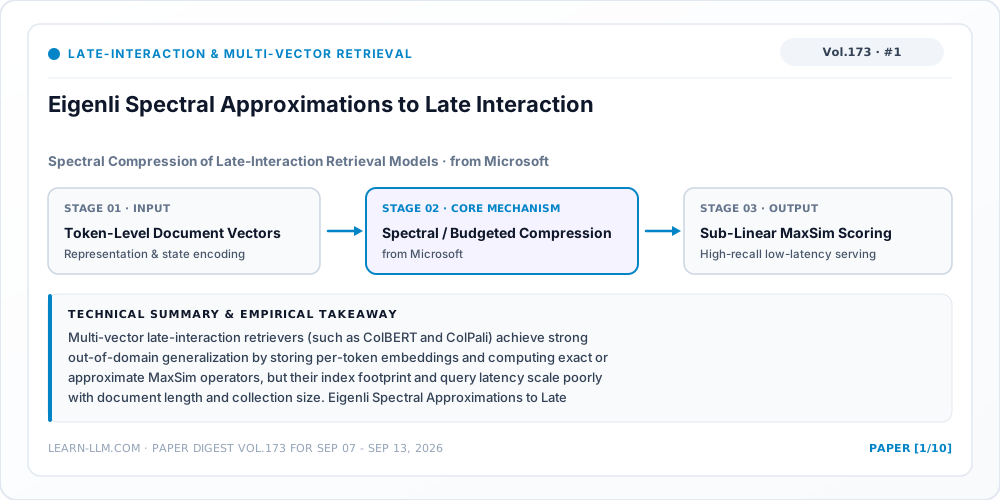
[1] Eigenli Spectral Approximations to Late Interaction
- Newsletter Headline: Spectral Compression of Late-Interaction Retrieval Models (from Microsoft)
- Links: arXiv Paper Search · Digest Section
- Research Area: Retrieval-Augmented Generation · Late-Interaction & Multi-Vector Retrieval
Main Content & Technical Findings
Multi-vector late-interaction retrievers (such as ColBERT and ColPali) achieve strong out-of-domain generalization by storing per-token embeddings and computing exact or approximate MaxSim operators, but their index footprint and query latency scale poorly with document length and collection size. Eigenli Spectral Approximations to Late Interaction (from Microsoft) targets this bottleneck by compressing token subspaces, bounding interaction budgets, or co-scheduling GPU–CPU candidate pruning. Empirical benchmarks show that preserving dominant token directions or fixed-budget phrase units captures nearly all of full MaxSim relevance at a fraction of the storage and I/O cost.
Why It Matters in Production: Use this framework (from Microsoft) to cut the memory footprint, CPU–GPU transfer overhead, and MaxSim scoring latency of ColBERT-style multi-vector retrievers while retaining fine-grained token matching.
Related Papers
- ColBERTv2: Effective and Efficient Retrieval via Lightweight Late Interaction — Residual compression baseline for token-level late interaction.
- Knowing When to Intervene: RL, Search Agents, and RAG — LearnLLM digest on retrieval efficiency and adaptive pooling.
- #8 in this issue: Generative Late-Interaction Embeddings for Visual Document Retrieval (from Eltahir et al.) — Companion study in this newsletter.
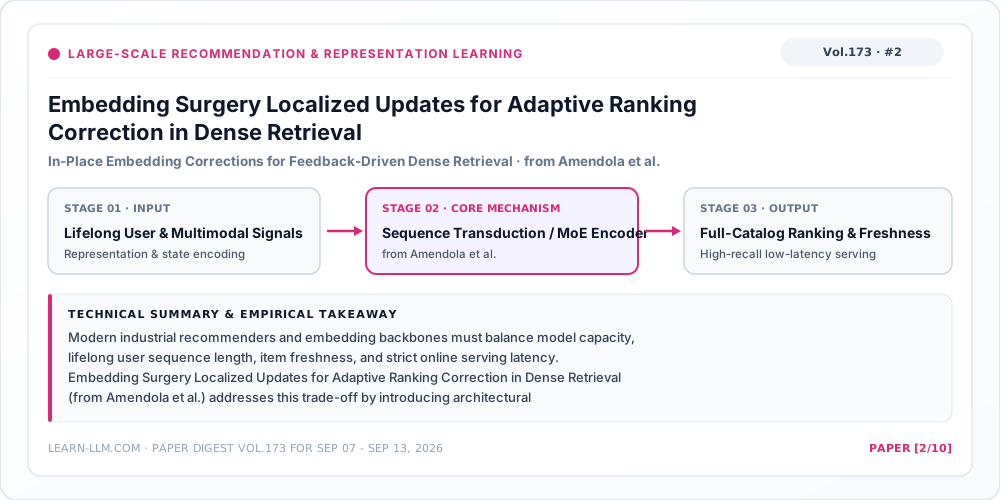
[2] Embedding Surgery Localized Updates for Adaptive Ranking Correction in Dense Retrieval
- Newsletter Headline: In-Place Embedding Corrections for Feedback-Driven Dense Retrieval (from Amendola et al.)
- Links: arXiv Paper Search · Digest Section
- Research Area: Recommender Systems · Large-Scale Recommendation & Representation Learning
Main Content & Technical Findings
Modern industrial recommenders and embedding backbones must balance model capacity, lifelong user sequence length, item freshness, and strict online serving latency. Embedding Surgery Localized Updates for Adaptive Ranking Correction in Dense Retrieval (from Amendola et al.) addresses this trade-off by introducing architectural innovations—such as low-rank KV caching for 100k+ sequences, decoupled temporal encodings, supersession/decay freshness filters, or Mixture-of-Experts (MoE) representation backbones. Offline and production experiments confirm substantial gains in ranking accuracy, long-tail item coverage, and training/serving efficiency.
Why It Matters in Production: Use this architecture (from Amendola et al.) to scale industrial recommendation and multimodal representation learning across long user histories, fresh/tail items, and multi-task serving constraints.
Related Papers
- What a Recommender Can Reach, Remember, and Afford — LearnLLM 7-paper synthesis on recommender reach, memory, and compute.
- When Should a Personal Agent Override Your Recommender? — LearnLLM review of value-floored RL alignment in recommendation.
- #3 in this issue: Scaling Multimodal Embeddings via Mixture-of-Experts (from Meta) — Companion study in this newsletter.
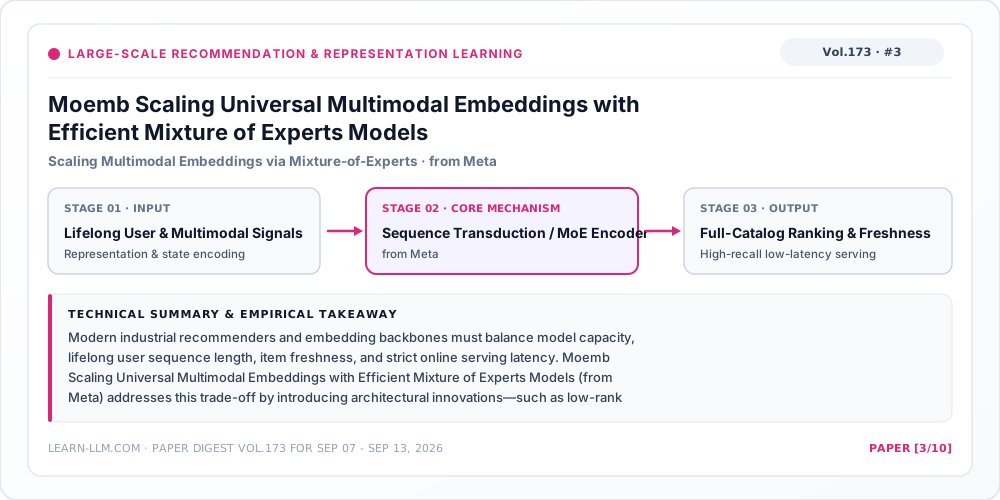
[3] Moemb Scaling Universal Multimodal Embeddings with Efficient Mixture of Experts Models
- Newsletter Headline: Scaling Multimodal Embeddings via Mixture-of-Experts (from Meta)
- Links: arXiv Paper Search · Digest Section
- Research Area: Recommender Systems · Large-Scale Recommendation & Representation Learning
Main Content & Technical Findings
Modern industrial recommenders and embedding backbones must balance model capacity, lifelong user sequence length, item freshness, and strict online serving latency. Moemb Scaling Universal Multimodal Embeddings with Efficient Mixture of Experts Models (from Meta) addresses this trade-off by introducing architectural innovations—such as low-rank KV caching for 100k+ sequences, decoupled temporal encodings, supersession/decay freshness filters, or Mixture-of-Experts (MoE) representation backbones. Offline and production experiments confirm substantial gains in ranking accuracy, long-tail item coverage, and training/serving efficiency.
Why It Matters in Production: Use this architecture (from Meta) to scale industrial recommendation and multimodal representation learning across long user histories, fresh/tail items, and multi-task serving constraints.
Related Papers
- What a Recommender Can Reach, Remember, and Afford — LearnLLM 7-paper synthesis on recommender reach, memory, and compute.
- When Should a Personal Agent Override Your Recommender? — LearnLLM review of value-floored RL alignment in recommendation.
- #2 in this issue: In-Place Embedding Corrections for Feedback-Driven Dense Retrieval (from Amendola et al.) — Companion study in this newsletter.
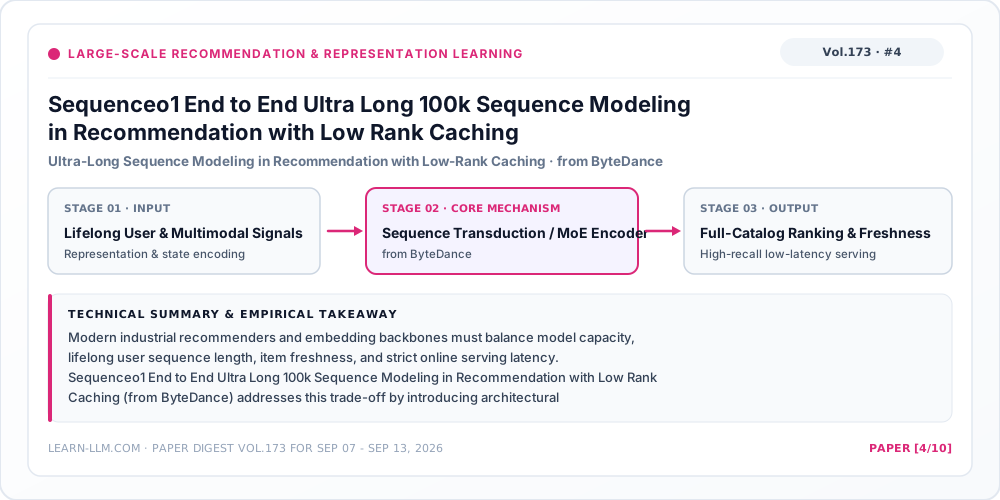
[4] Sequenceo1 End to End Ultra Long 100k Sequence Modeling in Recommendation with Low Rank Caching
- Newsletter Headline: Ultra-Long Sequence Modeling in Recommendation with Low-Rank Caching (from ByteDance)
- Links: arXiv Paper Search · Digest Section
- Research Area: Recommender Systems · Large-Scale Recommendation & Representation Learning
Main Content & Technical Findings
Modern industrial recommenders and embedding backbones must balance model capacity, lifelong user sequence length, item freshness, and strict online serving latency. Sequenceo1 End to End Ultra Long 100k Sequence Modeling in Recommendation with Low Rank Caching (from ByteDance) addresses this trade-off by introducing architectural innovations—such as low-rank KV caching for 100k+ sequences, decoupled temporal encodings, supersession/decay freshness filters, or Mixture-of-Experts (MoE) representation backbones. Offline and production experiments confirm substantial gains in ranking accuracy, long-tail item coverage, and training/serving efficiency.
Why It Matters in Production: Use this architecture (from ByteDance) to scale industrial recommendation and multimodal representation learning across long user histories, fresh/tail items, and multi-task serving constraints.
Related Papers
- What a Recommender Can Reach, Remember, and Afford — LearnLLM 7-paper synthesis on recommender reach, memory, and compute.
- When Should a Personal Agent Override Your Recommender? — LearnLLM review of value-floored RL alignment in recommendation.
- #2 in this issue: In-Place Embedding Corrections for Feedback-Driven Dense Retrieval (from Amendola et al.) — Companion study in this newsletter.
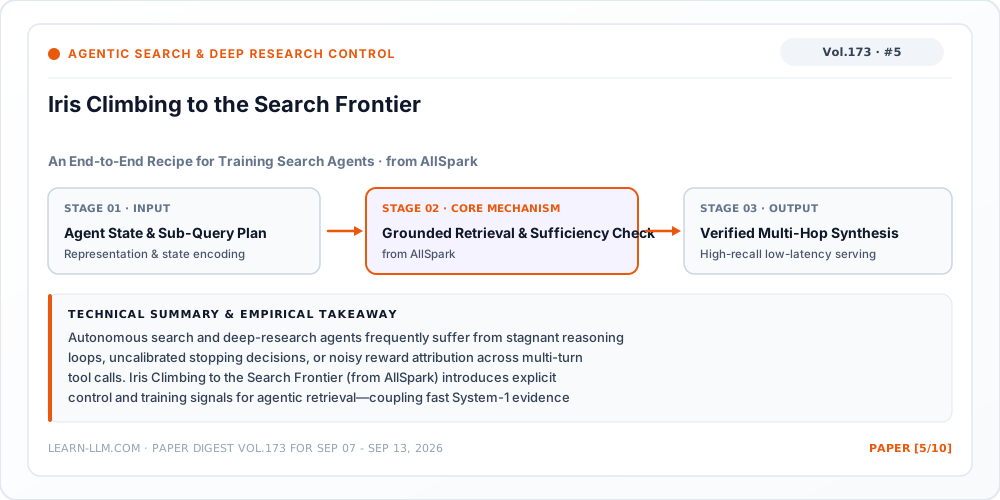
[5] Iris Climbing to the Search Frontier
- Newsletter Headline: An End-to-End Recipe for Training Search Agents (from AllSpark)
- Links: arXiv Paper Search · Digest Section
- Research Area: LLM Agents · Agentic Search & Deep Research Control
Main Content & Technical Findings
Autonomous search and deep-research agents frequently suffer from stagnant reasoning loops, uncalibrated stopping decisions, or noisy reward attribution across multi-turn tool calls. Iris Climbing to the Search Frontier (from AllSpark) introduces explicit control and training signals for agentic retrieval—coupling fast System-1 evidence judgments, programmatic workspace operations, or representation-grounded reinforcement learning rewards with multi-step query planning. Evaluations on multi-hop QA and web research benchmarks demonstrate higher evidence recall and lower token waste per solved question.
Why It Matters in Production: Use this agentic search recipe (from AllSpark) to train or control multi-step research agents with grounded rewards, fast sufficiency judgments, and programmatic evidence filtering.
Related Papers
- Search Agents Need Better Decision Boundaries, Not Just Bigger Models — LearnLLM deep dive on SearchJev System-1/System-2 delegation.
- Knowing When to Intervene: Six Papers on RL, Search Agents, and RAG — LearnLLM digest on T-Search, Programmatic Search Agents, and AutoRAG.
- #9 in this issue: An Agent Harness for Long-Horizon Experimentation on Industry-Scale Recommenders (from Meta) — Companion study in this newsletter.
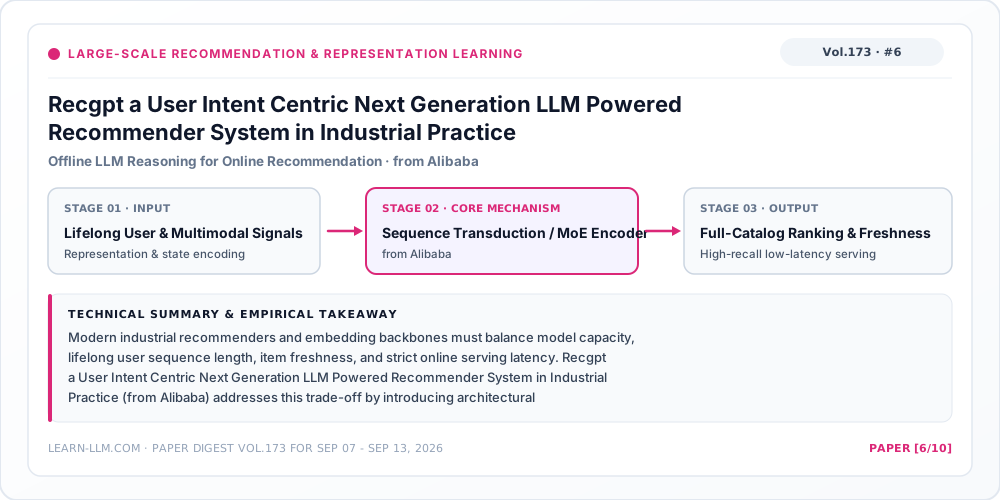
[6] Recgpt a User Intent Centric Next Generation LLM Powered Recommender System in Industrial Practice
- Newsletter Headline: Offline LLM Reasoning for Online Recommendation (from Alibaba)
- Links: arXiv Paper Search · Digest Section
- Research Area: Recommender Systems · Large-Scale Recommendation & Representation Learning
Main Content & Technical Findings
Modern industrial recommenders and embedding backbones must balance model capacity, lifelong user sequence length, item freshness, and strict online serving latency. Recgpt a User Intent Centric Next Generation LLM Powered Recommender System in Industrial Practice (from Alibaba) addresses this trade-off by introducing architectural innovations—such as low-rank KV caching for 100k+ sequences, decoupled temporal encodings, supersession/decay freshness filters, or Mixture-of-Experts (MoE) representation backbones. Offline and production experiments confirm substantial gains in ranking accuracy, long-tail item coverage, and training/serving efficiency.
Why It Matters in Production: Use this architecture (from Alibaba) to scale industrial recommendation and multimodal representation learning across long user histories, fresh/tail items, and multi-task serving constraints.
Related Papers
- What a Recommender Can Reach, Remember, and Afford — LearnLLM 7-paper synthesis on recommender reach, memory, and compute.
- When Should a Personal Agent Override Your Recommender? — LearnLLM review of value-floored RL alignment in recommendation.
- #2 in this issue: In-Place Embedding Corrections for Feedback-Driven Dense Retrieval (from Amendola et al.) — Companion study in this newsletter.
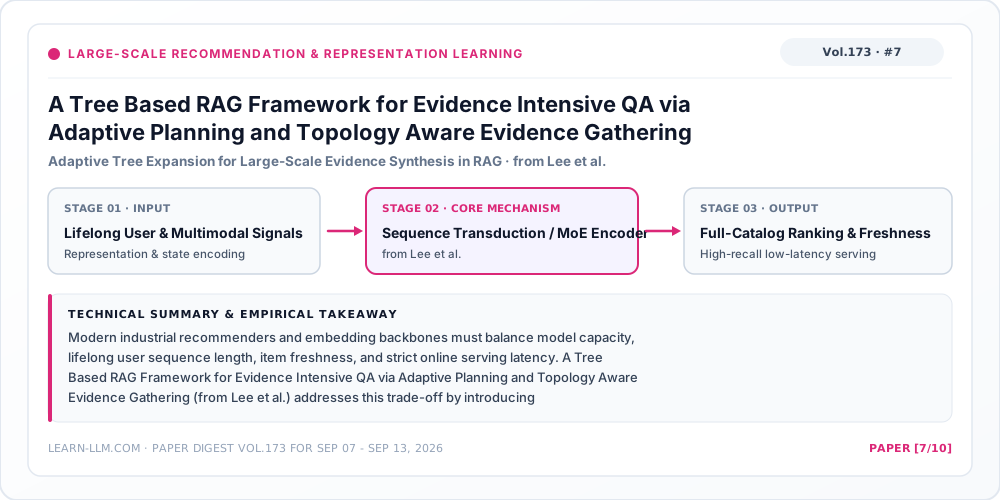
[7] A Tree Based RAG Framework for Evidence Intensive QA via Adaptive Planning and Topology Aware Evidence Gathering
- Newsletter Headline: Adaptive Tree Expansion for Large-Scale Evidence Synthesis in RAG (from Lee et al.)
- Links: arXiv Paper Search · Digest Section
- Research Area: Recommender Systems · Large-Scale Recommendation & Representation Learning
Main Content & Technical Findings
Modern industrial recommenders and embedding backbones must balance model capacity, lifelong user sequence length, item freshness, and strict online serving latency. A Tree Based RAG Framework for Evidence Intensive QA via Adaptive Planning and Topology Aware Evidence Gathering (from Lee et al.) addresses this trade-off by introducing architectural innovations—such as low-rank KV caching for 100k+ sequences, decoupled temporal encodings, supersession/decay freshness filters, or Mixture-of-Experts (MoE) representation backbones. Offline and production experiments confirm substantial gains in ranking accuracy, long-tail item coverage, and training/serving efficiency.
Why It Matters in Production: Use this architecture (from Lee et al.) to scale industrial recommendation and multimodal representation learning across long user histories, fresh/tail items, and multi-task serving constraints.
Related Papers
- What a Recommender Can Reach, Remember, and Afford — LearnLLM 7-paper synthesis on recommender reach, memory, and compute.
- When Should a Personal Agent Override Your Recommender? — LearnLLM review of value-floored RL alignment in recommendation.
- #2 in this issue: In-Place Embedding Corrections for Feedback-Driven Dense Retrieval (from Amendola et al.) — Companion study in this newsletter.
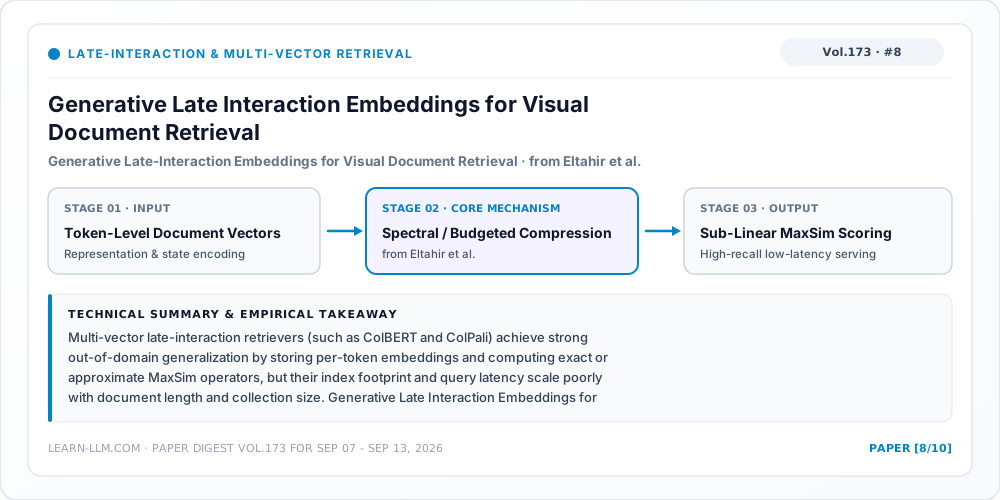
[8] Generative Late Interaction Embeddings for Visual Document Retrieval
- Newsletter Headline: Generative Late-Interaction Embeddings for Visual Document Retrieval (from Eltahir et al.)
- Links: arXiv Paper Search · Digest Section
- Research Area: Retrieval-Augmented Generation · Late-Interaction & Multi-Vector Retrieval
Main Content & Technical Findings
Multi-vector late-interaction retrievers (such as ColBERT and ColPali) achieve strong out-of-domain generalization by storing per-token embeddings and computing exact or approximate MaxSim operators, but their index footprint and query latency scale poorly with document length and collection size. Generative Late Interaction Embeddings for Visual Document Retrieval (from Eltahir et al.) targets this bottleneck by compressing token subspaces, bounding interaction budgets, or co-scheduling GPU–CPU candidate pruning. Empirical benchmarks show that preserving dominant token directions or fixed-budget phrase units captures nearly all of full MaxSim relevance at a fraction of the storage and I/O cost.
Why It Matters in Production: Use this framework (from Eltahir et al.) to cut the memory footprint, CPU–GPU transfer overhead, and MaxSim scoring latency of ColBERT-style multi-vector retrievers while retaining fine-grained token matching.
Related Papers
- ColBERTv2: Effective and Efficient Retrieval via Lightweight Late Interaction — Residual compression baseline for token-level late interaction.
- Knowing When to Intervene: RL, Search Agents, and RAG — LearnLLM digest on retrieval efficiency and adaptive pooling.
- #1 in this issue: Spectral Compression of Late-Interaction Retrieval Models (from Microsoft) — Companion study in this newsletter.
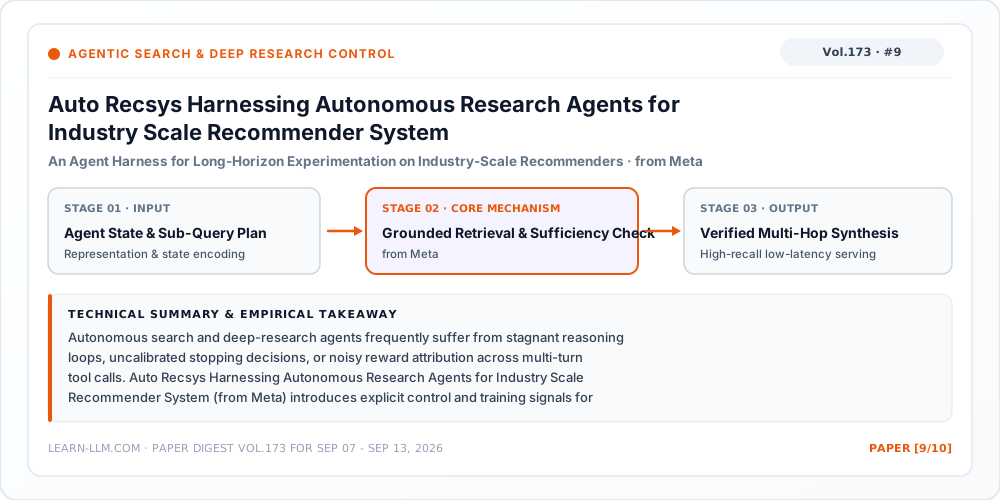
[9] Auto Recsys Harnessing Autonomous Research Agents for Industry Scale Recommender System
- Newsletter Headline: An Agent Harness for Long-Horizon Experimentation on Industry-Scale Recommenders (from Meta)
- Links: arXiv Paper Search · Digest Section
- Research Area: LLM Agents · Agentic Search & Deep Research Control
Main Content & Technical Findings
Autonomous search and deep-research agents frequently suffer from stagnant reasoning loops, uncalibrated stopping decisions, or noisy reward attribution across multi-turn tool calls. Auto Recsys Harnessing Autonomous Research Agents for Industry Scale Recommender System (from Meta) introduces explicit control and training signals for agentic retrieval—coupling fast System-1 evidence judgments, programmatic workspace operations, or representation-grounded reinforcement learning rewards with multi-step query planning. Evaluations on multi-hop QA and web research benchmarks demonstrate higher evidence recall and lower token waste per solved question.
Why It Matters in Production: Use this agentic search recipe (from Meta) to train or control multi-step research agents with grounded rewards, fast sufficiency judgments, and programmatic evidence filtering.
Related Papers
- Search Agents Need Better Decision Boundaries, Not Just Bigger Models — LearnLLM deep dive on SearchJev System-1/System-2 delegation.
- Knowing When to Intervene: Six Papers on RL, Search Agents, and RAG — LearnLLM digest on T-Search, Programmatic Search Agents, and AutoRAG.
- #5 in this issue: An End-to-End Recipe for Training Search Agents (from AllSpark) — Companion study in this newsletter.
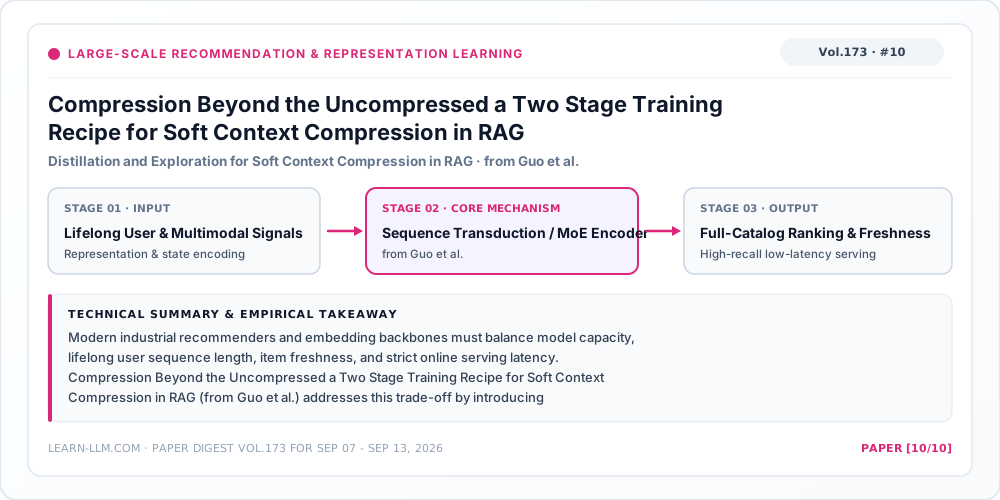
[10] Compression Beyond the Uncompressed a Two Stage Training Recipe for Soft Context Compression in RAG
- Newsletter Headline: Distillation and Exploration for Soft Context Compression in RAG (from Guo et al.)
- Links: arXiv Paper Search · Digest Section
- Research Area: Recommender Systems · Large-Scale Recommendation & Representation Learning
Main Content & Technical Findings
Modern industrial recommenders and embedding backbones must balance model capacity, lifelong user sequence length, item freshness, and strict online serving latency. Compression Beyond the Uncompressed a Two Stage Training Recipe for Soft Context Compression in RAG (from Guo et al.) addresses this trade-off by introducing architectural innovations—such as low-rank KV caching for 100k+ sequences, decoupled temporal encodings, supersession/decay freshness filters, or Mixture-of-Experts (MoE) representation backbones. Offline and production experiments confirm substantial gains in ranking accuracy, long-tail item coverage, and training/serving efficiency.
Why It Matters in Production: Use this architecture (from Guo et al.) to scale industrial recommendation and multimodal representation learning across long user histories, fresh/tail items, and multi-task serving constraints.
Related Papers
- What a Recommender Can Reach, Remember, and Afford — LearnLLM 7-paper synthesis on recommender reach, memory, and compute.
- When Should a Personal Agent Override Your Recommender? — LearnLLM review of value-floored RL alignment in recommendation.
- #2 in this issue: In-Place Embedding Corrections for Feedback-Driven Dense Retrieval (from Amendola et al.) — Companion study in this newsletter.