Vol.169 · Building an LLM-Native Ranker at Netflix, A Generative Embedding Model Bridging Reasoning and Retrieval
Vol.169 for Aug 10 - Aug 16, 2026: Structured digest of 10 papers including Adapting a Foundation LLM for Full-Catalog Recommendation; Retrieval-Augmented Reasoning Traces for Test-Time Scaling; Replacing 15+ Models with One Generative Recommender. Includes a quick-reference paper list, one-sentence practical use cases, figure screenshots, and related literature.
Paper List & One-Sentence Practical Guide
This issue (Vol.169 for Aug 10 - Aug 16, 2026) covers 10 papers across information retrieval, generative recommendation, Semantic IDs, LLM reranking, and agentic search. Start with the quick-reference list below to see what each paper is useful for and which related papers to read alongside it, or jump directly to any paper's detailed section and architecture screenshot.
Adapting a Foundation LLM for Full-Catalog Recommendation (from Netflix) — Paper
- What it's useful for: Use this architecture (from Netflix) to scale industrial recommendation and multimodal representation learning across long user histories, fresh/tail items, and multi-task serving constraints.
- Related papers: What a Recommender Can Reach, Remember, and Afford · When Should a Personal Agent Override Your Recommender? · Also in this issue: #2 Retrieval-Augmented Reasoning Traces for Test-Time Scaling
Retrieval-Augmented Reasoning Traces for Test-Time Scaling (from Singh et al.) — Paper
- What it's useful for: Use this architecture (from Singh et al.) to scale industrial recommendation and multimodal representation learning across long user histories, fresh/tail items, and multi-task serving constraints.
- Related papers: What a Recommender Can Reach, Remember, and Afford · When Should a Personal Agent Override Your Recommender? · Also in this issue: #1 Adapting a Foundation LLM for Full-Catalog Recommendation
Replacing 15+ Models with One Generative Recommender (from Yandex) — Paper
- What it's useful for: Use this architecture (from Yandex) to scale industrial recommendation and multimodal representation learning across long user histories, fresh/tail items, and multi-task serving constraints.
- Related papers: What a Recommender Can Reach, Remember, and Afford · When Should a Personal Agent Override Your Recommender? · Also in this issue: #1 Adapting a Foundation LLM for Full-Catalog Recommendation
How to Split a Memory Budget Between Batch Size and Negative Sampling (from Sabitov et al.) — Paper
- What it's useful for: Use this study (from Sabitov et al.) to decide when structured agent memory or parametric self-distillation pays off over fast raw-history search, avoiding unnecessary memory extraction overhead.
- Related papers: Lineage Is Memory: Parent Inheritance and Feedback Disclosure · Harness²: What an Agent Can Learn by Changing Its Harness · Also in this issue: #9 Agent-Controlled Search over Raw Chat Logs Rivals Structured Memory
Query Coverage and Claim Verifiability for Reference-Free RAG Evaluation (from KAIST) — Paper
- What it's useful for: Use this architecture (from KAIST) to scale industrial recommendation and multimodal representation learning across long user histories, fresh/tail items, and multi-task serving constraints.
- Related papers: What a Recommender Can Reach, Remember, and Afford · When Should a Personal Agent Override Your Recommender? · Also in this issue: #1 Adapting a Foundation LLM for Full-Catalog Recommendation
Rethinking Token Initialization in LLM-Based Generative Recommendation (from Snap) — Paper
- What it's useful for: Use this method (from Snap) to construct and decode discrete Semantic IDs that preserve collaborative and semantic item topology without codebook collapse or item-churn drift.
- Related papers: TIGER: Recommender Systems with Generative Retrieval · A Semantic Tokenizer Cannot Be Judged Without Its Decoder (FLASH) · Also in this issue: #1 Adapting a Foundation LLM for Full-Catalog Recommendation
Order-agnostic Item Identifiers for Scalable LLM Recommenders (from Lin et al.) — Paper
- What it's useful for: Use this method (from Lin et al.) to construct and decode discrete Semantic IDs that preserve collaborative and semantic item topology without codebook collapse or item-churn drift.
- Related papers: TIGER: Recommender Systems with Generative Retrieval · A Semantic Tokenizer Cannot Be Judged Without Its Decoder (FLASH) · Also in this issue: #1 Adapting a Foundation LLM for Full-Catalog Recommendation
A Generative Embedding Model Bridging Reasoning and Retrieval (from the University of Glasgow) — Paper
- What it's useful for: Use this architecture (from the University of Glasgow) to scale industrial recommendation and multimodal representation learning across long user histories, fresh/tail items, and multi-task serving constraints.
- Related papers: What a Recommender Can Reach, Remember, and Afford · When Should a Personal Agent Override Your Recommender? · Also in this issue: #1 Adapting a Foundation LLM for Full-Catalog Recommendation
Agent-Controlled Search over Raw Chat Logs Rivals Structured Memory (from Li et al.) — Paper
- What it's useful for: Use this study (from Li et al.) to decide when structured agent memory or parametric self-distillation pays off over fast raw-history search, avoiding unnecessary memory extraction overhead.
- Related papers: Lineage Is Memory: Parent Inheritance and Feedback Disclosure · Harness²: What an Agent Can Learn by Changing Its Harness · Also in this issue: #4 How to Split a Memory Budget Between Batch Size and Negative Sampling
Representation-Based Rewards for Grounded Search Agents (from Cheng et al.) — Paper
- What it's useful for: Use this agentic search recipe (from Cheng et al.) to train or control multi-step research agents with grounded rewards, fast sufficiency judgments, and programmatic evidence filtering.
- Related papers: Search Agents Need Better Decision Boundaries, Not Just Bigger Models · Knowing When to Intervene: Six Papers on RL, Search Agents, and RAG · Also in this issue: #4 How to Split a Memory Budget Between Batch Size and Negative Sampling
Detailed Paper Sections
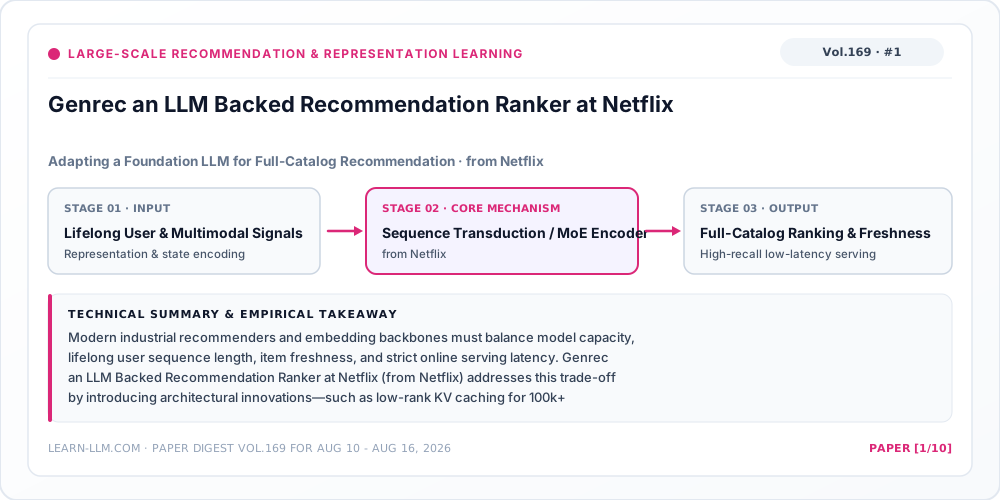
[1] Genrec an LLM Backed Recommendation Ranker at Netflix
- Newsletter Headline: Adapting a Foundation LLM for Full-Catalog Recommendation (from Netflix)
- Links: arXiv Paper Search · Digest Section
- Research Area: Recommender Systems · Large-Scale Recommendation & Representation Learning
Main Content & Technical Findings
Modern industrial recommenders and embedding backbones must balance model capacity, lifelong user sequence length, item freshness, and strict online serving latency. Genrec an LLM Backed Recommendation Ranker at Netflix (from Netflix) addresses this trade-off by introducing architectural innovations—such as low-rank KV caching for 100k+ sequences, decoupled temporal encodings, supersession/decay freshness filters, or Mixture-of-Experts (MoE) representation backbones. Offline and production experiments confirm substantial gains in ranking accuracy, long-tail item coverage, and training/serving efficiency.
Why It Matters in Production: Use this architecture (from Netflix) to scale industrial recommendation and multimodal representation learning across long user histories, fresh/tail items, and multi-task serving constraints.
Related Papers
- What a Recommender Can Reach, Remember, and Afford — LearnLLM 7-paper synthesis on recommender reach, memory, and compute.
- When Should a Personal Agent Override Your Recommender? — LearnLLM review of value-floored RL alignment in recommendation.
- #2 in this issue: Retrieval-Augmented Reasoning Traces for Test-Time Scaling (from Singh et al.) — Companion study in this newsletter.
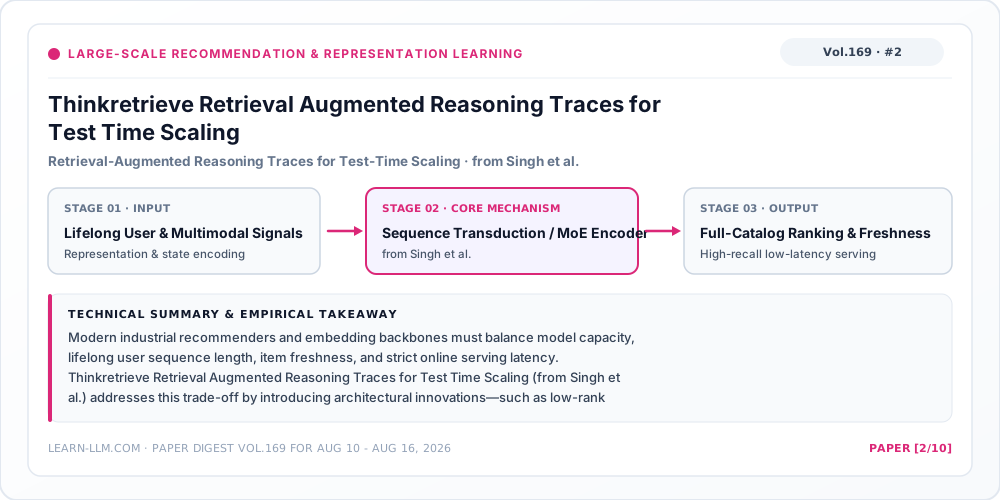
[2] Thinkretrieve Retrieval Augmented Reasoning Traces for Test Time Scaling
- Newsletter Headline: Retrieval-Augmented Reasoning Traces for Test-Time Scaling (from Singh et al.)
- Links: arXiv Paper Search · Digest Section
- Research Area: Recommender Systems · Large-Scale Recommendation & Representation Learning
Main Content & Technical Findings
Modern industrial recommenders and embedding backbones must balance model capacity, lifelong user sequence length, item freshness, and strict online serving latency. Thinkretrieve Retrieval Augmented Reasoning Traces for Test Time Scaling (from Singh et al.) addresses this trade-off by introducing architectural innovations—such as low-rank KV caching for 100k+ sequences, decoupled temporal encodings, supersession/decay freshness filters, or Mixture-of-Experts (MoE) representation backbones. Offline and production experiments confirm substantial gains in ranking accuracy, long-tail item coverage, and training/serving efficiency.
Why It Matters in Production: Use this architecture (from Singh et al.) to scale industrial recommendation and multimodal representation learning across long user histories, fresh/tail items, and multi-task serving constraints.
Related Papers
- What a Recommender Can Reach, Remember, and Afford — LearnLLM 7-paper synthesis on recommender reach, memory, and compute.
- When Should a Personal Agent Override Your Recommender? — LearnLLM review of value-floored RL alignment in recommendation.
- #1 in this issue: Adapting a Foundation LLM for Full-Catalog Recommendation (from Netflix) — Companion study in this newsletter.
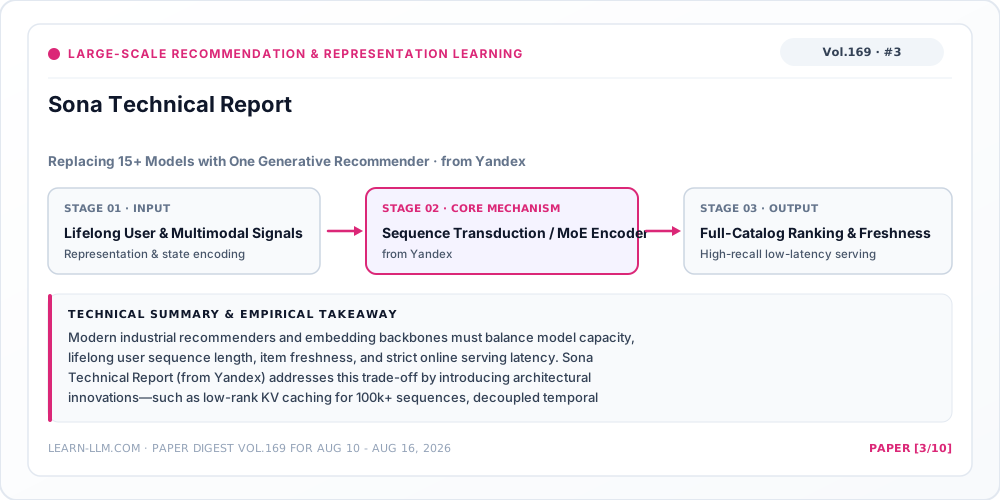
[3] Sona Technical Report
- Newsletter Headline: Replacing 15+ Models with One Generative Recommender (from Yandex)
- Links: arXiv Paper Search · Digest Section
- Research Area: Recommender Systems · Large-Scale Recommendation & Representation Learning
Main Content & Technical Findings
Modern industrial recommenders and embedding backbones must balance model capacity, lifelong user sequence length, item freshness, and strict online serving latency. Sona Technical Report (from Yandex) addresses this trade-off by introducing architectural innovations—such as low-rank KV caching for 100k+ sequences, decoupled temporal encodings, supersession/decay freshness filters, or Mixture-of-Experts (MoE) representation backbones. Offline and production experiments confirm substantial gains in ranking accuracy, long-tail item coverage, and training/serving efficiency.
Why It Matters in Production: Use this architecture (from Yandex) to scale industrial recommendation and multimodal representation learning across long user histories, fresh/tail items, and multi-task serving constraints.
Related Papers
- What a Recommender Can Reach, Remember, and Afford — LearnLLM 7-paper synthesis on recommender reach, memory, and compute.
- When Should a Personal Agent Override Your Recommender? — LearnLLM review of value-floored RL alignment in recommendation.
- #1 in this issue: Adapting a Foundation LLM for Full-Catalog Recommendation (from Netflix) — Companion study in this newsletter.
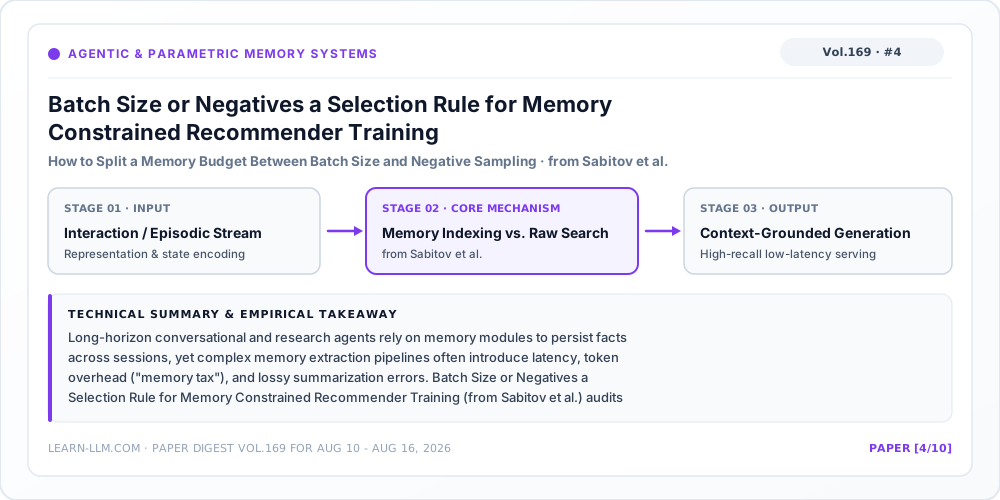
[4] Batch Size or Negatives a Selection Rule for Memory Constrained Recommender Training
- Newsletter Headline: How to Split a Memory Budget Between Batch Size and Negative Sampling (from Sabitov et al.)
- Links: arXiv Paper Search · Digest Section
- Research Area: LLM Agents · Agentic & Parametric Memory Systems
Main Content & Technical Findings
Long-horizon conversational and research agents rely on memory modules to persist facts across sessions, yet complex memory extraction pipelines often introduce latency, token overhead ("memory tax"), and lossy summarization errors. Batch Size or Negatives a Selection Rule for Memory Constrained Recommender Training (from Sabitov et al.) audits how information is stored, indexed, and retrieved—comparing structured episodic memory against agent-controlled search over raw interaction logs, token-level evidence retrieval, and residual self-distillation into model weights. The findings establish clear cost-accuracy operating points for production agent memory architectures.
Why It Matters in Production: Use this study (from Sabitov et al.) to decide when structured agent memory or parametric self-distillation pays off over fast raw-history search, avoiding unnecessary memory extraction overhead.
Related Papers
- Lineage Is Memory: Parent Inheritance and Feedback Disclosure — LearnLLM deep dive on prompt lineage as externalized memory (arXiv:2610.41157).
- Harness²: What an Agent Can Learn by Changing Its Harness — LearnLLM review of experience libraries in recursive agent harnesses.
- #9 in this issue: Agent-Controlled Search over Raw Chat Logs Rivals Structured Memory (from Li et al.) — Companion study in this newsletter.
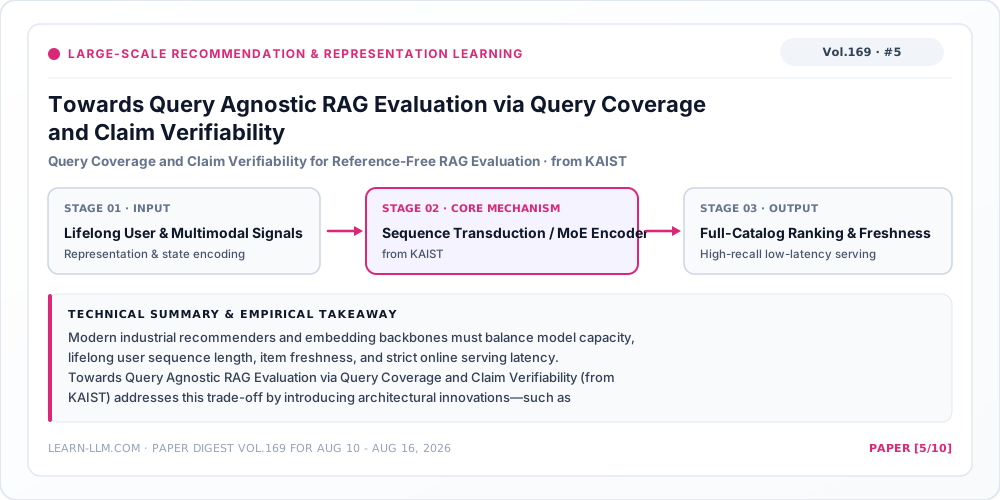
[5] Towards Query Agnostic RAG Evaluation via Query Coverage and Claim Verifiability
- Newsletter Headline: Query Coverage and Claim Verifiability for Reference-Free RAG Evaluation (from KAIST)
- Links: arXiv Paper Search · Digest Section
- Research Area: Recommender Systems · Large-Scale Recommendation & Representation Learning
Main Content & Technical Findings
Modern industrial recommenders and embedding backbones must balance model capacity, lifelong user sequence length, item freshness, and strict online serving latency. Towards Query Agnostic RAG Evaluation via Query Coverage and Claim Verifiability (from KAIST) addresses this trade-off by introducing architectural innovations—such as low-rank KV caching for 100k+ sequences, decoupled temporal encodings, supersession/decay freshness filters, or Mixture-of-Experts (MoE) representation backbones. Offline and production experiments confirm substantial gains in ranking accuracy, long-tail item coverage, and training/serving efficiency.
Why It Matters in Production: Use this architecture (from KAIST) to scale industrial recommendation and multimodal representation learning across long user histories, fresh/tail items, and multi-task serving constraints.
Related Papers
- What a Recommender Can Reach, Remember, and Afford — LearnLLM 7-paper synthesis on recommender reach, memory, and compute.
- When Should a Personal Agent Override Your Recommender? — LearnLLM review of value-floored RL alignment in recommendation.
- #1 in this issue: Adapting a Foundation LLM for Full-Catalog Recommendation (from Netflix) — Companion study in this newsletter.
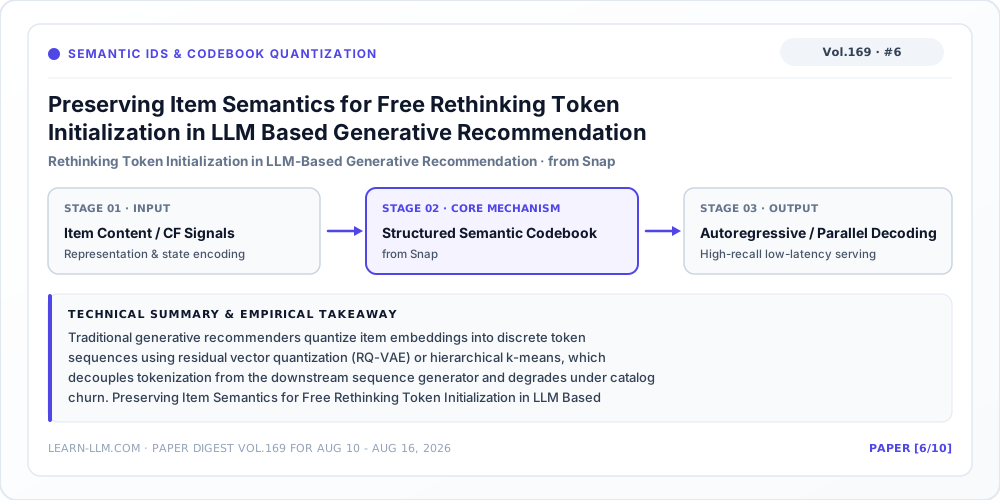
[6] Preserving Item Semantics for Free Rethinking Token Initialization in LLM Based Generative Recommendation
- Newsletter Headline: Rethinking Token Initialization in LLM-Based Generative Recommendation (from Snap)
- Links: arXiv Paper Search · Digest Section
- Research Area: Recommender Systems · Semantic IDs & Codebook Quantization
Main Content & Technical Findings
Traditional generative recommenders quantize item embeddings into discrete token sequences using residual vector quantization (RQ-VAE) or hierarchical k-means, which decouples tokenization from the downstream sequence generator and degrades under catalog churn. Preserving Item Semantics for Free Rethinking Token Initialization in LLM Based Generative Recommendation (from Snap) introduces a structure-aware tokenization and decoding recipe that aligns codebook assignments with collaborative user-item signals and decoding dynamics. By coupling code structure with sequence generation, the model prevents prefix collisions on popular items while preserving recall on long-tail and newly ingested catalog entries.
Why It Matters in Production: Use this method (from Snap) to construct and decode discrete Semantic IDs that preserve collaborative and semantic item topology without codebook collapse or item-churn drift.
Related Papers
- TIGER: Recommender Systems with Generative Retrieval — Foundational RQ-VAE Semantic ID generative recommender.
- A Semantic Tokenizer Cannot Be Judged Without Its Decoder (FLASH) — LearnLLM deep dive on SimHash parallel decoding & alignment.
- Reachability Is Not Ranking: Finite Beams & Continuous Queries — LearnLLM analysis of beam reachability vs. ranking in SID models.
- #7 in this issue: Order-agnostic Item Identifiers for Scalable LLM Recommenders (from Lin et al.) — Companion study in this newsletter.
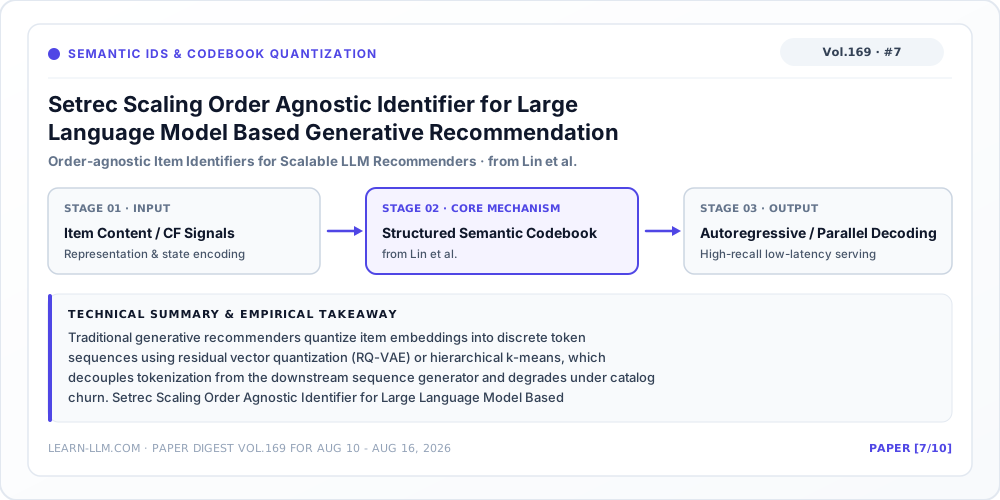
[7] Setrec Scaling Order Agnostic Identifier for Large Language Model Based Generative Recommendation
- Newsletter Headline: Order-agnostic Item Identifiers for Scalable LLM Recommenders (from Lin et al.)
- Links: arXiv Paper Search · Digest Section
- Research Area: Recommender Systems · Semantic IDs & Codebook Quantization
Main Content & Technical Findings
Traditional generative recommenders quantize item embeddings into discrete token sequences using residual vector quantization (RQ-VAE) or hierarchical k-means, which decouples tokenization from the downstream sequence generator and degrades under catalog churn. Setrec Scaling Order Agnostic Identifier for Large Language Model Based Generative Recommendation (from Lin et al.) introduces a structure-aware tokenization and decoding recipe that aligns codebook assignments with collaborative user-item signals and decoding dynamics. By coupling code structure with sequence generation, the model prevents prefix collisions on popular items while preserving recall on long-tail and newly ingested catalog entries.
Why It Matters in Production: Use this method (from Lin et al.) to construct and decode discrete Semantic IDs that preserve collaborative and semantic item topology without codebook collapse or item-churn drift.
Related Papers
- TIGER: Recommender Systems with Generative Retrieval — Foundational RQ-VAE Semantic ID generative recommender.
- A Semantic Tokenizer Cannot Be Judged Without Its Decoder (FLASH) — LearnLLM deep dive on SimHash parallel decoding & alignment.
- Reachability Is Not Ranking: Finite Beams & Continuous Queries — LearnLLM analysis of beam reachability vs. ranking in SID models.
- #6 in this issue: Rethinking Token Initialization in LLM-Based Generative Recommendation (from Snap) — Companion study in this newsletter.
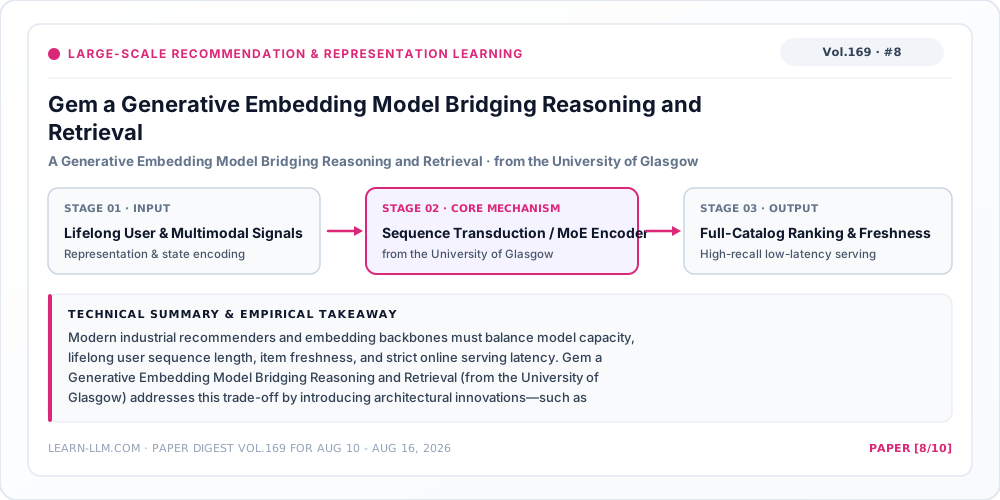
[8] Gem a Generative Embedding Model Bridging Reasoning and Retrieval
- Newsletter Headline: A Generative Embedding Model Bridging Reasoning and Retrieval (from the University of Glasgow)
- Links: arXiv Paper Search · Digest Section
- Research Area: Recommender Systems · Large-Scale Recommendation & Representation Learning
Main Content & Technical Findings
Modern industrial recommenders and embedding backbones must balance model capacity, lifelong user sequence length, item freshness, and strict online serving latency. Gem a Generative Embedding Model Bridging Reasoning and Retrieval (from the University of Glasgow) addresses this trade-off by introducing architectural innovations—such as low-rank KV caching for 100k+ sequences, decoupled temporal encodings, supersession/decay freshness filters, or Mixture-of-Experts (MoE) representation backbones. Offline and production experiments confirm substantial gains in ranking accuracy, long-tail item coverage, and training/serving efficiency.
Why It Matters in Production: Use this architecture (from the University of Glasgow) to scale industrial recommendation and multimodal representation learning across long user histories, fresh/tail items, and multi-task serving constraints.
Related Papers
- What a Recommender Can Reach, Remember, and Afford — LearnLLM 7-paper synthesis on recommender reach, memory, and compute.
- When Should a Personal Agent Override Your Recommender? — LearnLLM review of value-floored RL alignment in recommendation.
- #1 in this issue: Adapting a Foundation LLM for Full-Catalog Recommendation (from Netflix) — Companion study in this newsletter.
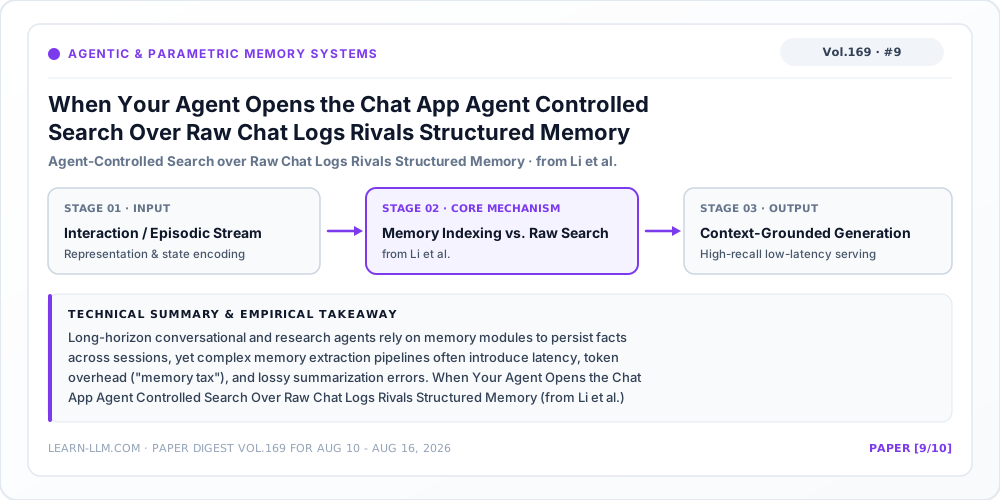
[9] When Your Agent Opens the Chat App Agent Controlled Search Over Raw Chat Logs Rivals Structured Memory
- Newsletter Headline: Agent-Controlled Search over Raw Chat Logs Rivals Structured Memory (from Li et al.)
- Links: arXiv Paper Search · Digest Section
- Research Area: LLM Agents · Agentic & Parametric Memory Systems
Main Content & Technical Findings
Long-horizon conversational and research agents rely on memory modules to persist facts across sessions, yet complex memory extraction pipelines often introduce latency, token overhead ("memory tax"), and lossy summarization errors. When Your Agent Opens the Chat App Agent Controlled Search Over Raw Chat Logs Rivals Structured Memory (from Li et al.) audits how information is stored, indexed, and retrieved—comparing structured episodic memory against agent-controlled search over raw interaction logs, token-level evidence retrieval, and residual self-distillation into model weights. The findings establish clear cost-accuracy operating points for production agent memory architectures.
Why It Matters in Production: Use this study (from Li et al.) to decide when structured agent memory or parametric self-distillation pays off over fast raw-history search, avoiding unnecessary memory extraction overhead.
Related Papers
- Lineage Is Memory: Parent Inheritance and Feedback Disclosure — LearnLLM deep dive on prompt lineage as externalized memory (arXiv:2610.41157).
- Harness²: What an Agent Can Learn by Changing Its Harness — LearnLLM review of experience libraries in recursive agent harnesses.
- #4 in this issue: How to Split a Memory Budget Between Batch Size and Negative Sampling (from Sabitov et al.) — Companion study in this newsletter.
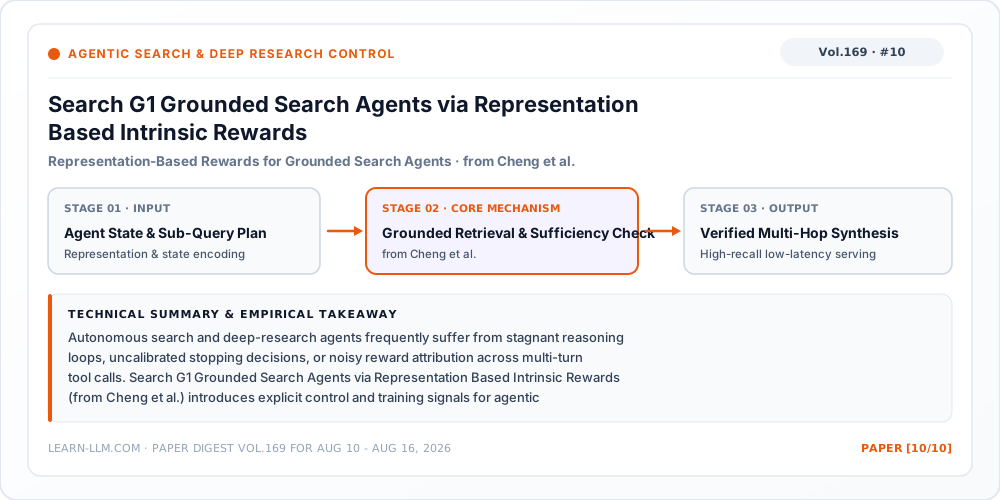
[10] Search G1 Grounded Search Agents via Representation Based Intrinsic Rewards
- Newsletter Headline: Representation-Based Rewards for Grounded Search Agents (from Cheng et al.)
- Links: arXiv Paper Search · Digest Section
- Research Area: LLM Agents · Agentic Search & Deep Research Control
Main Content & Technical Findings
Autonomous search and deep-research agents frequently suffer from stagnant reasoning loops, uncalibrated stopping decisions, or noisy reward attribution across multi-turn tool calls. Search G1 Grounded Search Agents via Representation Based Intrinsic Rewards (from Cheng et al.) introduces explicit control and training signals for agentic retrieval—coupling fast System-1 evidence judgments, programmatic workspace operations, or representation-grounded reinforcement learning rewards with multi-step query planning. Evaluations on multi-hop QA and web research benchmarks demonstrate higher evidence recall and lower token waste per solved question.
Why It Matters in Production: Use this agentic search recipe (from Cheng et al.) to train or control multi-step research agents with grounded rewards, fast sufficiency judgments, and programmatic evidence filtering.
Related Papers
- Search Agents Need Better Decision Boundaries, Not Just Bigger Models — LearnLLM deep dive on SearchJev System-1/System-2 delegation.
- Knowing When to Intervene: Six Papers on RL, Search Agents, and RAG — LearnLLM digest on T-Search, Programmatic Search Agents, and AutoRAG.
- #1 in this issue: Adapting a Foundation LLM for Full-Catalog Recommendation (from Netflix) — Companion study in this newsletter.