Vol.170 · Do Latent Reasoning Steps Actually Help Retrieval?, Adapting Dense Retrievers from Agent Search Traces
Vol.170 for Aug 17 - Aug 23, 2026: Structured digest of 10 papers including Retrieval Grounding Latent Reasoning for Dense Retrieval; Adapting Dense Retrievers from Agent Search Traces; Learned Supersession and Decay Filters for Recommender Freshness. Includes a quick-reference paper list, one-sentence practical use cases, figure screenshots, and related literature.
Paper List & One-Sentence Practical Guide
This issue (Vol.170 for Aug 17 - Aug 23, 2026) covers 10 papers across information retrieval, generative recommendation, Semantic IDs, LLM reranking, and agentic search. Start with the quick-reference list below to see what each paper is useful for and which related papers to read alongside it, or jump directly to any paper's detailed section and architecture screenshot.
Retrieval Grounding Latent Reasoning for Dense Retrieval (from Meituan) — Paper
- What it's useful for: Use this architecture (from Meituan) to scale industrial recommendation and multimodal representation learning across long user histories, fresh/tail items, and multi-task serving constraints.
- Related papers: What a Recommender Can Reach, Remember, and Afford · When Should a Personal Agent Override Your Recommender? · Also in this issue: #3 Learned Supersession and Decay Filters for Recommender Freshness
Adapting Dense Retrievers from Agent Search Traces (from Microsoft) — Paper
- What it's useful for: Use this agentic search recipe (from Microsoft) to train or control multi-step research agents with grounded rewards, fast sufficiency judgments, and programmatic evidence filtering.
- Related papers: Search Agents Need Better Decision Boundaries, Not Just Bigger Models · Knowing When to Intervene: Six Papers on RL, Search Agents, and RAG · Also in this issue: #8 Budget-Efficient RL for Multi-Hop Reasoning Agents
Learned Supersession and Decay Filters for Recommender Freshness (from Google) — Paper
- What it's useful for: Use this architecture (from Google) to scale industrial recommendation and multimodal representation learning across long user histories, fresh/tail items, and multi-task serving constraints.
- Related papers: What a Recommender Can Reach, Remember, and Afford · When Should a Personal Agent Override Your Recommender? · Also in this issue: #1 Retrieval Grounding Latent Reasoning for Dense Retrieval
How Retriever Redundancy and Diversity Impact RAG Effectiveness (from The University of Queensland) — Paper
- What it's useful for: Use this architecture (from The University of Queensland) to scale industrial recommendation and multimodal representation learning across long user histories, fresh/tail items, and multi-task serving constraints.
- Related papers: What a Recommender Can Reach, Remember, and Afford · When Should a Personal Agent Override Your Recommender? · Also in this issue: #1 Retrieval Grounding Latent Reasoning for Dense Retrieval
A Lightweight Temporal Encoding for Generative Recommendation (from Alibaba) — Paper
- What it's useful for: Use this architecture (from Alibaba) to scale industrial recommendation and multimodal representation learning across long user histories, fresh/tail items, and multi-task serving constraints.
- Related papers: What a Recommender Can Reach, Remember, and Afford · When Should a Personal Agent Override Your Recommender? · Also in this issue: #1 Retrieval Grounding Latent Reasoning for Dense Retrieval
Quantization and Dimensionality Reduction for Vector Indexing (from CWI) — Paper
- What it's useful for: Use this indexing architecture (from CWI) to scale dense, sparse, or lexical retrieval to billion/trillion-vector corpora using low-bit quantization, two-stage FP8/FP16 cascades, or hierarchical BM25.
- Related papers: RaBitQ / Approximate Nearest Neighbor Search · A Semantic Tokenizer Cannot Be Judged Without Its Decoder · Also in this issue: #7 Component-Level Grafting for Knowledge Distillation in Sequential Recommendation
Component-Level Grafting for Knowledge Distillation in Sequential Recommendation (from Pohang University) — Paper
- What it's useful for: Use this architecture (from Pohang University) to scale industrial recommendation and multimodal representation learning across long user histories, fresh/tail items, and multi-task serving constraints.
- Related papers: What a Recommender Can Reach, Remember, and Afford · When Should a Personal Agent Override Your Recommender? · Also in this issue: #1 Retrieval Grounding Latent Reasoning for Dense Retrieval
Budget-Efficient RL for Multi-Hop Reasoning Agents (from Han et al.) — Paper
- What it's useful for: Use this agentic search recipe (from Han et al.) to train or control multi-step research agents with grounded rewards, fast sufficiency judgments, and programmatic evidence filtering.
- Related papers: Search Agents Need Better Decision Boundaries, Not Just Bigger Models · Knowing When to Intervene: Six Papers on RL, Search Agents, and RAG · Also in this issue: #2 Adapting Dense Retrievers from Agent Search Traces
Tracing Last-Item Dominance in SASRec-Style Recommenders (from Hokkaido University) — Paper
- What it's useful for: Use this architecture (from Hokkaido University) to scale industrial recommendation and multimodal representation learning across long user histories, fresh/tail items, and multi-task serving constraints.
- Related papers: What a Recommender Can Reach, Remember, and Afford · When Should a Personal Agent Override Your Recommender? · Also in this issue: #1 Retrieval Grounding Latent Reasoning for Dense Retrieval
Stagnant Reasoning in Deep Research Agents and How to Fix It (from Soudani et al.) — Paper
- What it's useful for: Use this agentic search recipe (from Soudani et al.) to train or control multi-step research agents with grounded rewards, fast sufficiency judgments, and programmatic evidence filtering.
- Related papers: Search Agents Need Better Decision Boundaries, Not Just Bigger Models · Knowing When to Intervene: Six Papers on RL, Search Agents, and RAG · Also in this issue: #2 Adapting Dense Retrievers from Agent Search Traces
Detailed Paper Sections
[1] Retrieval Grounding Latent Reasoning for Dense Retrieval
- Newsletter Headline: Retrieval Grounding Latent Reasoning for Dense Retrieval (from Meituan)
- Links: arXiv Paper Search · Digest Section
- Research Area: Recommender Systems · Large-Scale Recommendation & Representation Learning
Main Content & Technical Findings
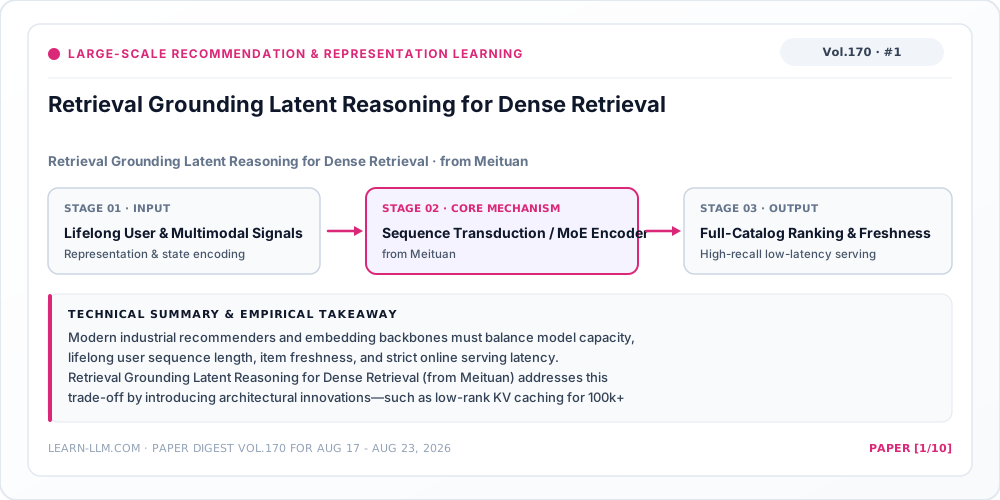
Modern industrial recommenders and embedding backbones must balance model capacity, lifelong user sequence length, item freshness, and strict online serving latency. Retrieval Grounding Latent Reasoning for Dense Retrieval (from Meituan) addresses this trade-off by introducing architectural innovations—such as low-rank KV caching for 100k+ sequences, decoupled temporal encodings, supersession/decay freshness filters, or Mixture-of-Experts (MoE) representation backbones. Offline and production experiments confirm substantial gains in ranking accuracy, long-tail item coverage, and training/serving efficiency.
Why It Matters in Production: Use this architecture (from Meituan) to scale industrial recommendation and multimodal representation learning across long user histories, fresh/tail items, and multi-task serving constraints.
Related Papers
- What a Recommender Can Reach, Remember, and Afford — LearnLLM 7-paper synthesis on recommender reach, memory, and compute.
- When Should a Personal Agent Override Your Recommender? — LearnLLM review of value-floored RL alignment in recommendation.
- #3 in this issue: Learned Supersession and Decay Filters for Recommender Freshness (from Google) — Companion study in this newsletter.
[2] Navigation Informed Embeddings Dense Retriever Adaptation from Agent Search Traces
- Newsletter Headline: Adapting Dense Retrievers from Agent Search Traces (from Microsoft)
- Links: arXiv Paper Search · Digest Section
- Research Area: LLM Agents · Agentic Search & Deep Research Control
Main Content & Technical Findings
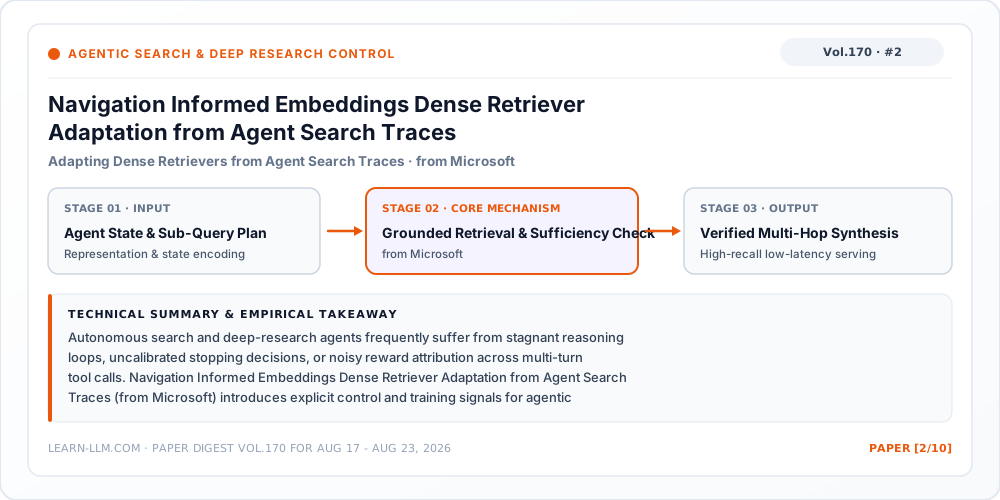
Autonomous search and deep-research agents frequently suffer from stagnant reasoning loops, uncalibrated stopping decisions, or noisy reward attribution across multi-turn tool calls. Navigation Informed Embeddings Dense Retriever Adaptation from Agent Search Traces (from Microsoft) introduces explicit control and training signals for agentic retrieval—coupling fast System-1 evidence judgments, programmatic workspace operations, or representation-grounded reinforcement learning rewards with multi-step query planning. Evaluations on multi-hop QA and web research benchmarks demonstrate higher evidence recall and lower token waste per solved question.
Why It Matters in Production: Use this agentic search recipe (from Microsoft) to train or control multi-step research agents with grounded rewards, fast sufficiency judgments, and programmatic evidence filtering.
Related Papers
- Search Agents Need Better Decision Boundaries, Not Just Bigger Models — LearnLLM deep dive on SearchJev System-1/System-2 delegation.
- Knowing When to Intervene: Six Papers on RL, Search Agents, and RAG — LearnLLM digest on T-Search, Programmatic Search Agents, and AutoRAG.
- #8 in this issue: Budget-Efficient RL for Multi-Hop Reasoning Agents (from Han et al.) — Companion study in this newsletter.
[3] Decomposing Staleness in Recommender Systems a Dual Filter Framework for Supersession and Decay
- Newsletter Headline: Learned Supersession and Decay Filters for Recommender Freshness (from Google)
- Links: arXiv Paper Search · Digest Section
- Research Area: Recommender Systems · Large-Scale Recommendation & Representation Learning
Main Content & Technical Findings
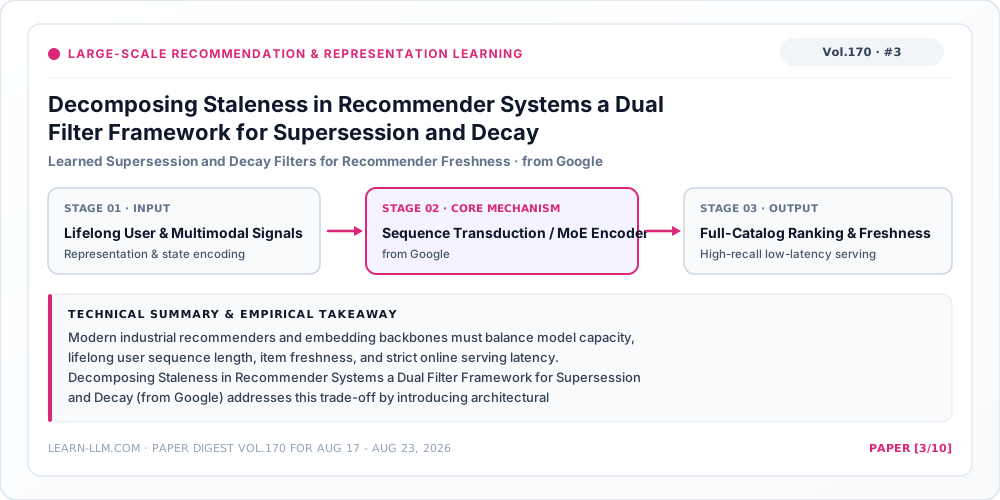
Modern industrial recommenders and embedding backbones must balance model capacity, lifelong user sequence length, item freshness, and strict online serving latency. Decomposing Staleness in Recommender Systems a Dual Filter Framework for Supersession and Decay (from Google) addresses this trade-off by introducing architectural innovations—such as low-rank KV caching for 100k+ sequences, decoupled temporal encodings, supersession/decay freshness filters, or Mixture-of-Experts (MoE) representation backbones. Offline and production experiments confirm substantial gains in ranking accuracy, long-tail item coverage, and training/serving efficiency.
Why It Matters in Production: Use this architecture (from Google) to scale industrial recommendation and multimodal representation learning across long user histories, fresh/tail items, and multi-task serving constraints.
Related Papers
- What a Recommender Can Reach, Remember, and Afford — LearnLLM 7-paper synthesis on recommender reach, memory, and compute.
- When Should a Personal Agent Override Your Recommender? — LearnLLM review of value-floored RL alignment in recommendation.
- #1 in this issue: Retrieval Grounding Latent Reasoning for Dense Retrieval (from Meituan) — Companion study in this newsletter.
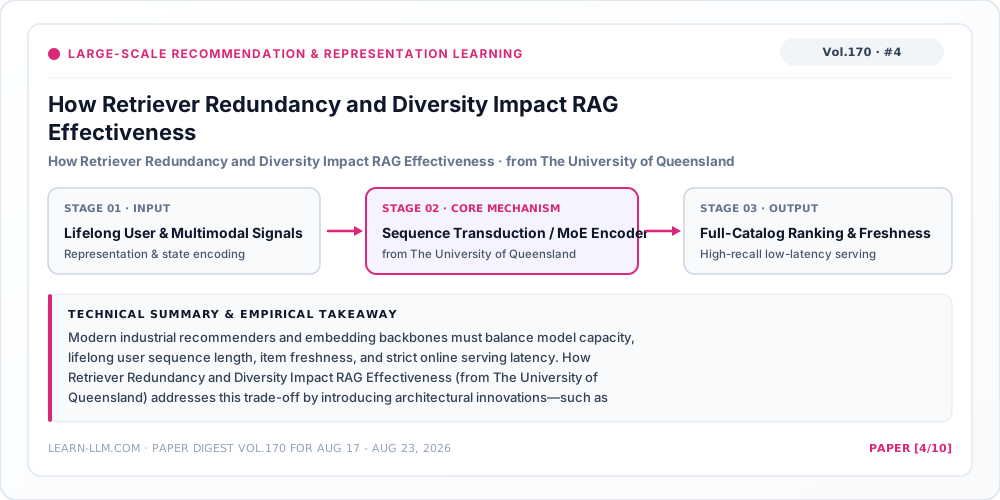
[4] How Retriever Redundancy and Diversity Impact RAG Effectiveness
- Newsletter Headline: How Retriever Redundancy and Diversity Impact RAG Effectiveness (from The University of Queensland)
- Links: arXiv Paper Search · Digest Section
- Research Area: Recommender Systems · Large-Scale Recommendation & Representation Learning
Main Content & Technical Findings
Modern industrial recommenders and embedding backbones must balance model capacity, lifelong user sequence length, item freshness, and strict online serving latency. How Retriever Redundancy and Diversity Impact RAG Effectiveness (from The University of Queensland) addresses this trade-off by introducing architectural innovations—such as low-rank KV caching for 100k+ sequences, decoupled temporal encodings, supersession/decay freshness filters, or Mixture-of-Experts (MoE) representation backbones. Offline and production experiments confirm substantial gains in ranking accuracy, long-tail item coverage, and training/serving efficiency.
Why It Matters in Production: Use this architecture (from The University of Queensland) to scale industrial recommendation and multimodal representation learning across long user histories, fresh/tail items, and multi-task serving constraints.
Related Papers
- What a Recommender Can Reach, Remember, and Afford — LearnLLM 7-paper synthesis on recommender reach, memory, and compute.
- When Should a Personal Agent Override Your Recommender? — LearnLLM review of value-floored RL alignment in recommendation.
- #1 in this issue: Retrieval Grounding Latent Reasoning for Dense Retrieval (from Meituan) — Companion study in this newsletter.
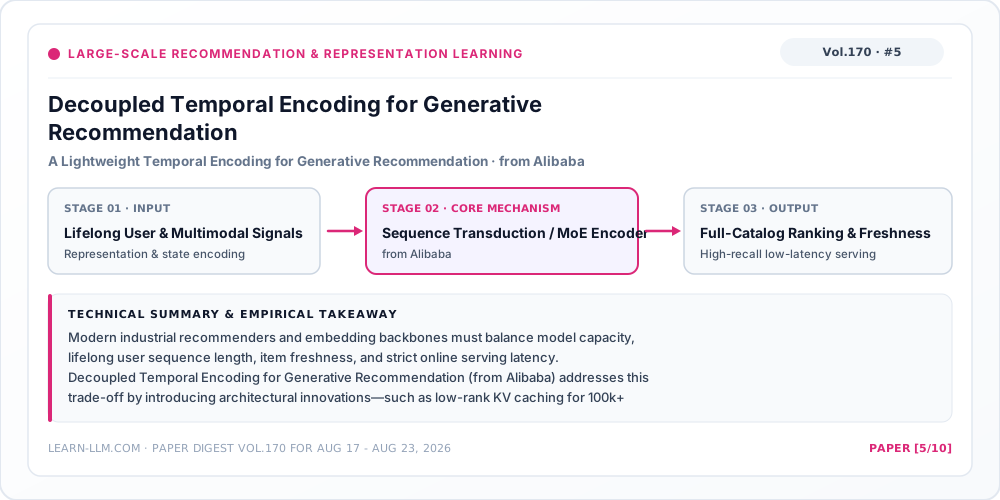
[5] Decoupled Temporal Encoding for Generative Recommendation
- Newsletter Headline: A Lightweight Temporal Encoding for Generative Recommendation (from Alibaba)
- Links: arXiv Paper Search · Digest Section
- Research Area: Recommender Systems · Large-Scale Recommendation & Representation Learning
Main Content & Technical Findings
Modern industrial recommenders and embedding backbones must balance model capacity, lifelong user sequence length, item freshness, and strict online serving latency. Decoupled Temporal Encoding for Generative Recommendation (from Alibaba) addresses this trade-off by introducing architectural innovations—such as low-rank KV caching for 100k+ sequences, decoupled temporal encodings, supersession/decay freshness filters, or Mixture-of-Experts (MoE) representation backbones. Offline and production experiments confirm substantial gains in ranking accuracy, long-tail item coverage, and training/serving efficiency.
Why It Matters in Production: Use this architecture (from Alibaba) to scale industrial recommendation and multimodal representation learning across long user histories, fresh/tail items, and multi-task serving constraints.
Related Papers
- What a Recommender Can Reach, Remember, and Afford — LearnLLM 7-paper synthesis on recommender reach, memory, and compute.
- When Should a Personal Agent Override Your Recommender? — LearnLLM review of value-floored RL alignment in recommendation.
- #1 in this issue: Retrieval Grounding Latent Reasoning for Dense Retrieval (from Meituan) — Companion study in this newsletter.
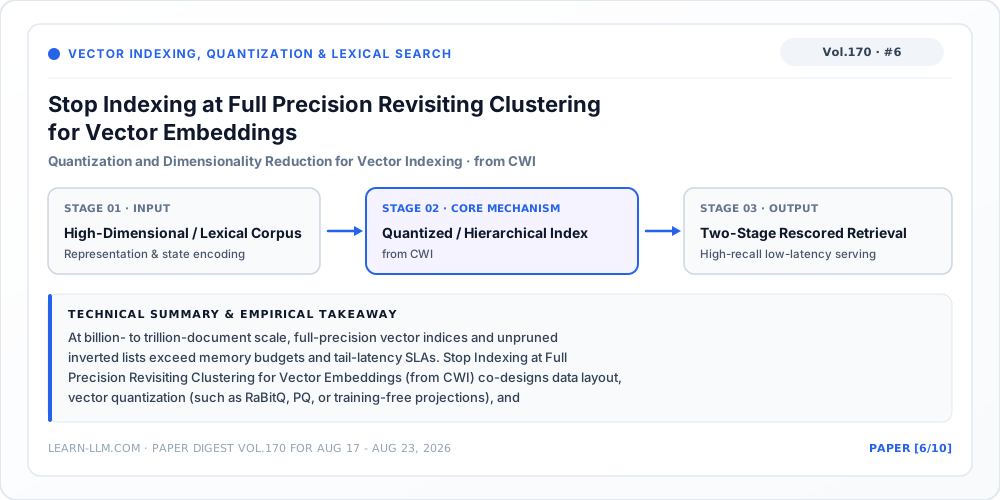
[6] Stop Indexing at Full Precision Revisiting Clustering for Vector Embeddings
- Newsletter Headline: Quantization and Dimensionality Reduction for Vector Indexing (from CWI)
- Links: arXiv Paper Search · Digest Section
- Research Area: Retrieval-Augmented Generation · Vector Indexing, Quantization & Lexical Search
Main Content & Technical Findings
At billion- to trillion-document scale, full-precision vector indices and unpruned inverted lists exceed memory budgets and tail-latency SLAs. Stop Indexing at Full Precision Revisiting Clustering for Vector Embeddings (from CWI) co-designs data layout, vector quantization (such as RaBitQ, PQ, or training-free projections), and graph/inverted-file traversal policies. By pairing compact first-stage index codes with targeted high-precision rescoring or query-adaptive search budgets, the system achieves high recall@k at dramatically reduced RAM/VRAM cost and higher QPS.
Why It Matters in Production: Use this indexing architecture (from CWI) to scale dense, sparse, or lexical retrieval to billion/trillion-vector corpora using low-bit quantization, two-stage FP8/FP16 cascades, or hierarchical BM25.
Related Papers
- RaBitQ / Approximate Nearest Neighbor Search — High-efficiency randomized bit quantization for ANN search.
- A Semantic Tokenizer Cannot Be Judged Without Its Decoder — LearnLLM review of Randomized SimHash projections in retrieval.
- #7 in this issue: Component-Level Grafting for Knowledge Distillation in Sequential Recommendation (from Pohang University) — Companion study in this newsletter.
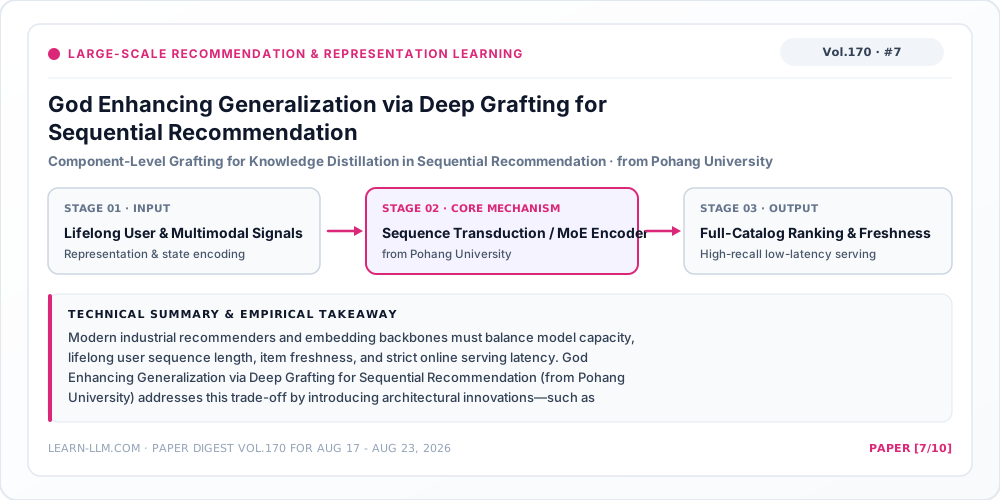
[7] God Enhancing Generalization via Deep Grafting for Sequential Recommendation
- Newsletter Headline: Component-Level Grafting for Knowledge Distillation in Sequential Recommendation (from Pohang University)
- Links: arXiv Paper Search · Digest Section
- Research Area: Recommender Systems · Large-Scale Recommendation & Representation Learning
Main Content & Technical Findings
Modern industrial recommenders and embedding backbones must balance model capacity, lifelong user sequence length, item freshness, and strict online serving latency. God Enhancing Generalization via Deep Grafting for Sequential Recommendation (from Pohang University) addresses this trade-off by introducing architectural innovations—such as low-rank KV caching for 100k+ sequences, decoupled temporal encodings, supersession/decay freshness filters, or Mixture-of-Experts (MoE) representation backbones. Offline and production experiments confirm substantial gains in ranking accuracy, long-tail item coverage, and training/serving efficiency.
Why It Matters in Production: Use this architecture (from Pohang University) to scale industrial recommendation and multimodal representation learning across long user histories, fresh/tail items, and multi-task serving constraints.
Related Papers
- What a Recommender Can Reach, Remember, and Afford — LearnLLM 7-paper synthesis on recommender reach, memory, and compute.
- When Should a Personal Agent Override Your Recommender? — LearnLLM review of value-floored RL alignment in recommendation.
- #1 in this issue: Retrieval Grounding Latent Reasoning for Dense Retrieval (from Meituan) — Companion study in this newsletter.
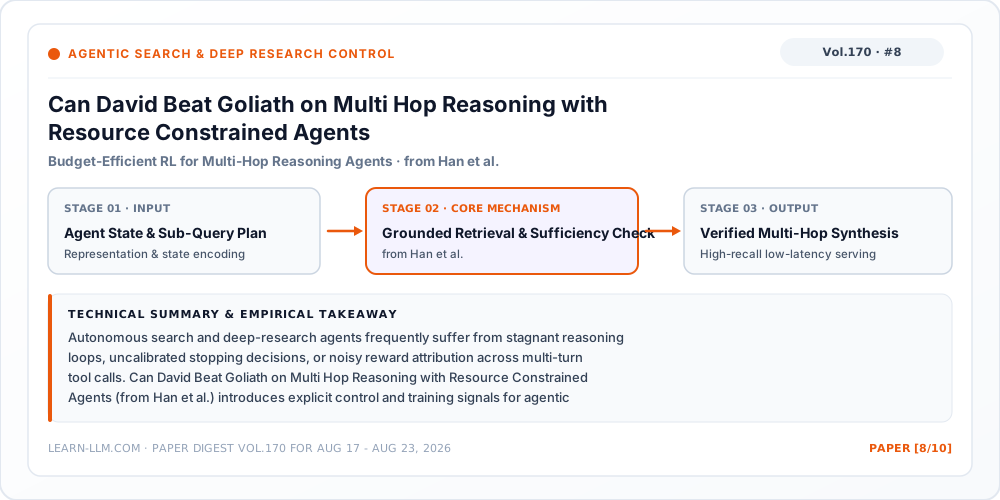
[8] Can David Beat Goliath on Multi Hop Reasoning with Resource Constrained Agents
- Newsletter Headline: Budget-Efficient RL for Multi-Hop Reasoning Agents (from Han et al.)
- Links: arXiv Paper Search · Digest Section
- Research Area: LLM Agents · Agentic Search & Deep Research Control
Main Content & Technical Findings
Autonomous search and deep-research agents frequently suffer from stagnant reasoning loops, uncalibrated stopping decisions, or noisy reward attribution across multi-turn tool calls. Can David Beat Goliath on Multi Hop Reasoning with Resource Constrained Agents (from Han et al.) introduces explicit control and training signals for agentic retrieval—coupling fast System-1 evidence judgments, programmatic workspace operations, or representation-grounded reinforcement learning rewards with multi-step query planning. Evaluations on multi-hop QA and web research benchmarks demonstrate higher evidence recall and lower token waste per solved question.
Why It Matters in Production: Use this agentic search recipe (from Han et al.) to train or control multi-step research agents with grounded rewards, fast sufficiency judgments, and programmatic evidence filtering.
Related Papers
- Search Agents Need Better Decision Boundaries, Not Just Bigger Models — LearnLLM deep dive on SearchJev System-1/System-2 delegation.
- Knowing When to Intervene: Six Papers on RL, Search Agents, and RAG — LearnLLM digest on T-Search, Programmatic Search Agents, and AutoRAG.
- #2 in this issue: Adapting Dense Retrievers from Agent Search Traces (from Microsoft) — Companion study in this newsletter.
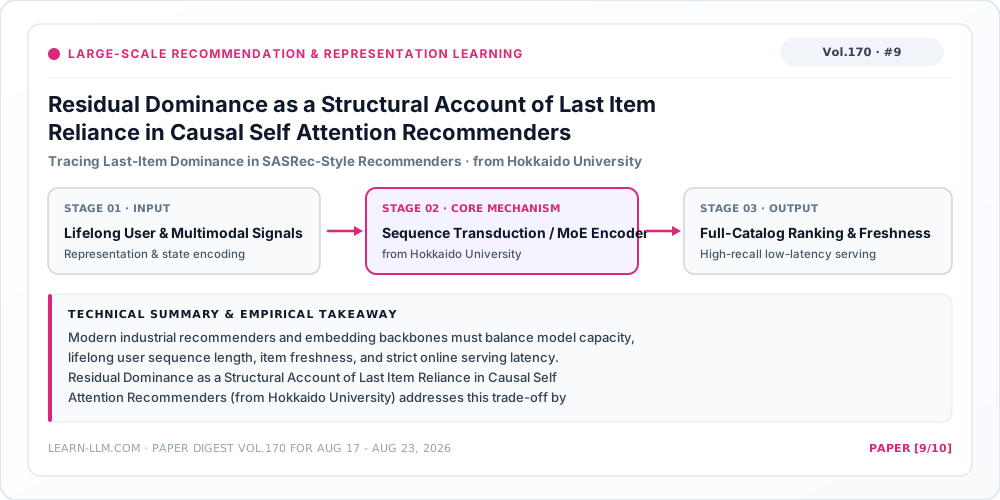
[9] Residual Dominance as a Structural Account of Last Item Reliance in Causal Self Attention Recommenders
- Newsletter Headline: Tracing Last-Item Dominance in SASRec-Style Recommenders (from Hokkaido University)
- Links: arXiv Paper Search · Digest Section
- Research Area: Recommender Systems · Large-Scale Recommendation & Representation Learning
Main Content & Technical Findings
Modern industrial recommenders and embedding backbones must balance model capacity, lifelong user sequence length, item freshness, and strict online serving latency. Residual Dominance as a Structural Account of Last Item Reliance in Causal Self Attention Recommenders (from Hokkaido University) addresses this trade-off by introducing architectural innovations—such as low-rank KV caching for 100k+ sequences, decoupled temporal encodings, supersession/decay freshness filters, or Mixture-of-Experts (MoE) representation backbones. Offline and production experiments confirm substantial gains in ranking accuracy, long-tail item coverage, and training/serving efficiency.
Why It Matters in Production: Use this architecture (from Hokkaido University) to scale industrial recommendation and multimodal representation learning across long user histories, fresh/tail items, and multi-task serving constraints.
Related Papers
- What a Recommender Can Reach, Remember, and Afford — LearnLLM 7-paper synthesis on recommender reach, memory, and compute.
- When Should a Personal Agent Override Your Recommender? — LearnLLM review of value-floored RL alignment in recommendation.
- #1 in this issue: Retrieval Grounding Latent Reasoning for Dense Retrieval (from Meituan) — Companion study in this newsletter.
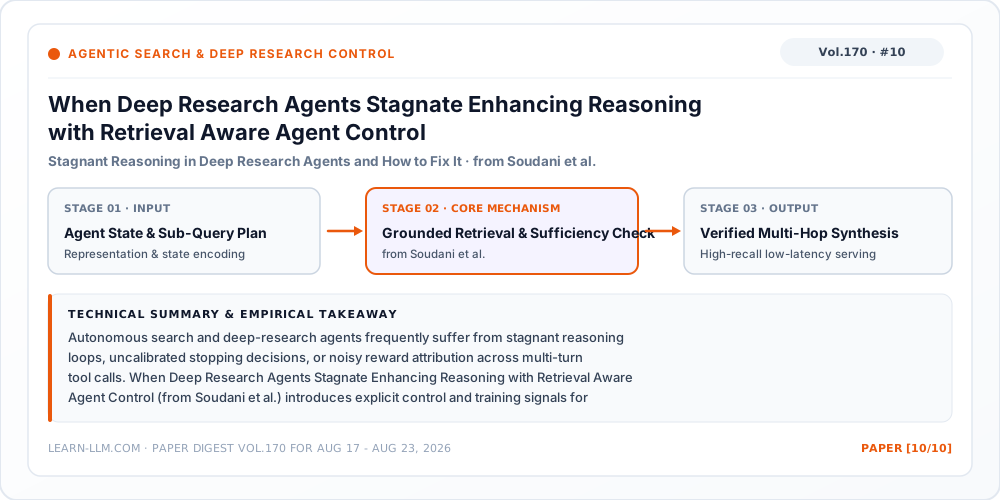
[10] When Deep Research Agents Stagnate Enhancing Reasoning with Retrieval Aware Agent Control
- Newsletter Headline: Stagnant Reasoning in Deep Research Agents and How to Fix It (from Soudani et al.)
- Links: arXiv Paper Search · Digest Section
- Research Area: LLM Agents · Agentic Search & Deep Research Control
Main Content & Technical Findings
Autonomous search and deep-research agents frequently suffer from stagnant reasoning loops, uncalibrated stopping decisions, or noisy reward attribution across multi-turn tool calls. When Deep Research Agents Stagnate Enhancing Reasoning with Retrieval Aware Agent Control (from Soudani et al.) introduces explicit control and training signals for agentic retrieval—coupling fast System-1 evidence judgments, programmatic workspace operations, or representation-grounded reinforcement learning rewards with multi-step query planning. Evaluations on multi-hop QA and web research benchmarks demonstrate higher evidence recall and lower token waste per solved question.
Why It Matters in Production: Use this agentic search recipe (from Soudani et al.) to train or control multi-step research agents with grounded rewards, fast sufficiency judgments, and programmatic evidence filtering.
Related Papers
- Search Agents Need Better Decision Boundaries, Not Just Bigger Models — LearnLLM deep dive on SearchJev System-1/System-2 delegation.
- Knowing When to Intervene: Six Papers on RL, Search Agents, and RAG — LearnLLM digest on T-Search, Programmatic Search Agents, and AutoRAG.
- #2 in this issue: Adapting Dense Retrievers from Agent Search Traces (from Microsoft) — Companion study in this newsletter.